“Explore Your Heritage,” states a sign outside the recently refurbished Wrexham County Borough Museum & Archives.
So, before I had even begun to discover how its £2m facelift had brought the 19th-century barracks up to 21st-century museum standards, I was already pondering questions about what to expect from a border town museum and how it would engage its residents and the wider public.
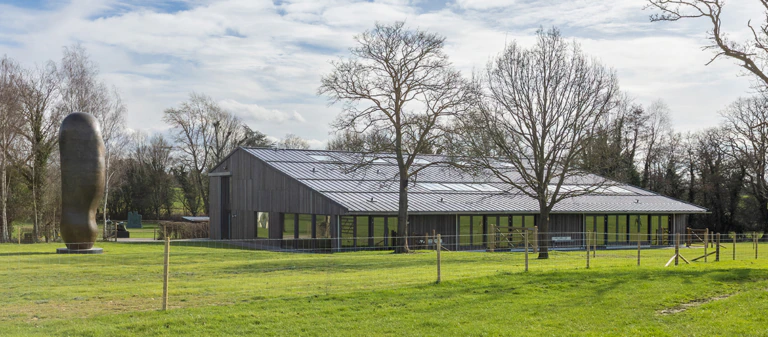
The large, glazed extension works well, particularly because the heritage of the building has not been masked, allowing the traditional sandstone structure and its archways to be admired. This bright, welcoming space houses the reception, shop and cafe area.
There are three bilingual exhibition spaces on the ground floor. The entrance to the main gallery is flanked on each side by themed community displays curated by museum staff, volunteers and community organisations. These include a secondary school, which has selected artefacts relating to the Gresford colliery disaster of 1934.
It is obvious that the museum has sought to engage audiences with their heritage. However, it could benefit from a little more information about some of the artefacts or a quote from a participant highlighting why they had chosen a particular item.
A video installation gradually fades-in archive photographs of local landscapes and urban scenes. The moving images can be seen from outside, enticing people to come in to explore.
“Smelly old Wrexham”
A key exhibit is Wrexham’s oldest resident, Brymbo Man. The displays reveal how the Bronze Age burial space was accidentally uncovered by workmen digging a trench in 1958. The stone-lined box revealed skeletal remains, a beaker pot and a flint knife.
Visitors can read or listen to newspaper extracts about its discovery and the display reveals how Brymbo Man’s face has been reconstructed through scientific techniques. This encourages visitors to think about what has been discovered as well as what cannot be explained by science.
The archaeology theme continues with the discovery of the Rossett Hoard, which includes a socketed axe, pieces of gold and a tanged blade dating from 1000-800BC. The display also includes two engaging short films: the first explains how ore was made into metal and the second provides an experimental demonstration of how the axe could have been moulded and produced.
The use of computers is a key feature throughout the main gallery. On a positive note it allows further exploration of key artefacts and related stories, but unfortunately a couple of the touchscreen displays were not operational when I visited.
Thankfully, there were plenty of other films, commentaries and low-tech interactives to keep visitors engaged. The Age of the Princes interactive, snakes and ladders with an historical twist, allows participants to compete to be the Prince of Wales in the 13th century.
The wall-mounted board game, along with its spinning dial and magnetic pieces, incorporates aspects of Welsh history, and requires two participants to play. I saw several families enjoying the cut and thrust of medieval life.
The area referred to as Smelly Old Wrexham encourages visitors to follow a trail around the Victorian streets of the town guided by a greyhound and to lift flaps to smell various aromas of the industrial age, including Wrexham’s leatherworks and brewery – a sure hit for everybody.
Local history
The Dating Game challenges visitors to date seven artefacts from the Stone Age through to the medieval period. Depending on your answers you get a boo or a cheer, which adds a bit of fun to what could have been a dull historic timeline.
Our Heritage, Our Stories is an exhibition devised with local history societies from around Wrexham that aims to tell stories from their communities. Audio equipment competed for attention in the gallery, there was no introductory panel and each organisation had designed their own pop-up panel. It looked a bit disjointed, although I am sure the participants gained a lot from the process.
The final temporary exhibition space currently shows Hall of Heroes, featuring football memorabilia, including some from the legendary John Charles collection. From the summer it will showcase collections from Amgueddfa Cymru – National Museum Wales and the National Library of Wales, which will be a more fitting use for this space. It is a great opportunity for all to build stronger links and provide access to exciting collections in north-east Wales.
As I left the museum I was again reminded of the “Explore Your Heritage” sign. Wrexham’s archaeological, industrial and volatile past are all here, as are access to national collections and temporary exhibitions. This is not my heritage to explore as such, rather I was visiting an old haunt, but there is interest here too for tourists and for others from across the border.
Lynn Podmore is the learning and visitor services manager at Tatton Park, Cheshire
So, before I had even begun to discover how its £2m facelift had brought the 19th-century barracks up to 21st-century museum standards, I was already pondering questions about what to expect from a border town museum and how it would engage its residents and the wider public.
The large, glazed extension works well, particularly because the heritage of the building has not been masked, allowing the traditional sandstone structure and its archways to be admired. This bright, welcoming space houses the reception, shop and cafe area.
There are three bilingual exhibition spaces on the ground floor. The entrance to the main gallery is flanked on each side by themed community displays curated by museum staff, volunteers and community organisations. These include a secondary school, which has selected artefacts relating to the Gresford colliery disaster of 1934.
It is obvious that the museum has sought to engage audiences with their heritage. However, it could benefit from a little more information about some of the artefacts or a quote from a participant highlighting why they had chosen a particular item.
A video installation gradually fades-in archive photographs of local landscapes and urban scenes. The moving images can be seen from outside, enticing people to come in to explore.
“Smelly old Wrexham”
A key exhibit is Wrexham’s oldest resident, Brymbo Man. The displays reveal how the Bronze Age burial space was accidentally uncovered by workmen digging a trench in 1958. The stone-lined box revealed skeletal remains, a beaker pot and a flint knife.
Visitors can read or listen to newspaper extracts about its discovery and the display reveals how Brymbo Man’s face has been reconstructed through scientific techniques. This encourages visitors to think about what has been discovered as well as what cannot be explained by science.
The archaeology theme continues with the discovery of the Rossett Hoard, which includes a socketed axe, pieces of gold and a tanged blade dating from 1000-800BC. The display also includes two engaging short films: the first explains how ore was made into metal and the second provides an experimental demonstration of how the axe could have been moulded and produced.
The use of computers is a key feature throughout the main gallery. On a positive note it allows further exploration of key artefacts and related stories, but unfortunately a couple of the touchscreen displays were not operational when I visited.
Thankfully, there were plenty of other films, commentaries and low-tech interactives to keep visitors engaged. The Age of the Princes interactive, snakes and ladders with an historical twist, allows participants to compete to be the Prince of Wales in the 13th century.
The wall-mounted board game, along with its spinning dial and magnetic pieces, incorporates aspects of Welsh history, and requires two participants to play. I saw several families enjoying the cut and thrust of medieval life.
The area referred to as Smelly Old Wrexham encourages visitors to follow a trail around the Victorian streets of the town guided by a greyhound and to lift flaps to smell various aromas of the industrial age, including Wrexham’s leatherworks and brewery – a sure hit for everybody.
Local history
The Dating Game challenges visitors to date seven artefacts from the Stone Age through to the medieval period. Depending on your answers you get a boo or a cheer, which adds a bit of fun to what could have been a dull historic timeline.
Our Heritage, Our Stories is an exhibition devised with local history societies from around Wrexham that aims to tell stories from their communities. Audio equipment competed for attention in the gallery, there was no introductory panel and each organisation had designed their own pop-up panel. It looked a bit disjointed, although I am sure the participants gained a lot from the process.
The final temporary exhibition space currently shows Hall of Heroes, featuring football memorabilia, including some from the legendary John Charles collection. From the summer it will showcase collections from Amgueddfa Cymru – National Museum Wales and the National Library of Wales, which will be a more fitting use for this space. It is a great opportunity for all to build stronger links and provide access to exciting collections in north-east Wales.
As I left the museum I was again reminded of the “Explore Your Heritage” sign. Wrexham’s archaeological, industrial and volatile past are all here, as are access to national collections and temporary exhibitions. This is not my heritage to explore as such, rather I was visiting an old haunt, but there is interest here too for tourists and for others from across the border.
Lynn Podmore is the learning and visitor services manager at Tatton Park, Cheshire
Project data
- Cost £2m
- Main funders Heritage Lottery Fund; Wrexham County Borough Council; Welsh Assembly Government
- Exhibitions design Bright3d
- Architect Austin-Smith: Lord
- Main contractor ISG Regions
- Gallery fit-out Workhaus
- AV and IT fit-out Fusion LX
- Display cases Armour Systems
- Illustrations Bark Design
- Interactives and audiovisuals Concept, Centre Screen; Ancient Arts; Ay-pe; Heritage Interactive; Davies Community Films; Spinitex (Toukan); Media Vision; EDM, Bark Design; AIVAF