All local museums are feeling the heat, but spare a particular thought for those in London’s lesser-visited boroughs. Whereas tourists may drift into a museum in the central area, the rest depend almost exclusively on local residents.
Yet a January poll of 3,600 Londoners found that those living in the city’s outer boroughs, such as Waltham Forest, were 25% less likely to consider visiting a museum than those living in inner boroughs such as Islington.
Most Londoners are familiar with Wandsworth only because of its prison, so the borough’s new museum, which opened this autumn, has its work cut out.
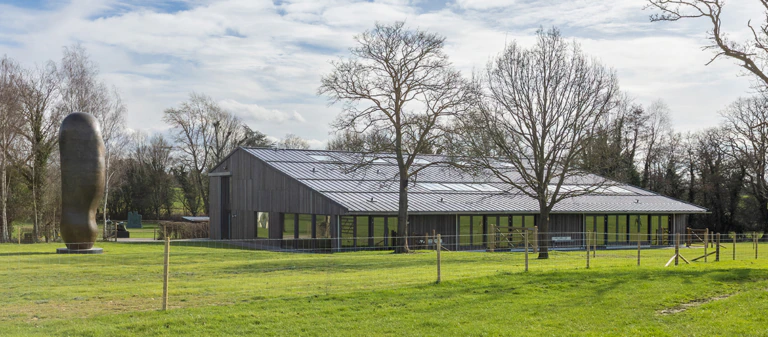
The museum shares a building with the De Morgan Foundation, and the largest room has been given over to the shop and an excellent cafe. But having paid £8 for admission, I was disappointed to find only two galleries.
The first gallery is devoted to a timeline that runs around the room and highlights key dates in the “human story”, “the natural landscape” and the “cultural landscape”, from the period before the British Isles separated from the continent up to the present day. Three central displays seek to define and describe these separate strands.
First for knowledge
There were several “firsts” here that caught my eye: the first record of a black resident (a 1626 newspaper announcement for a runaway slave), for example, as well as texts noting that London’s first mosque, and Britain’s first airplane company and first railway, were situated within the borough.
Visitors then move into the main gallery, where there is a temporary exhibition (until 25 February) that aims to tell the History of Wandsworth in 100 Objects, mainly paintings. There is a telephone switchboard from the local exchange, a gas cooker from the Wandgas company, a section of wooden pipe and a child’s model of a Bristol bomber.
During my visit on a Saturday, three groups of parents with young children were also in the museum. All went straight to the telephone exchange and the wooden pipe, and then left. There seemed to be little to capture their interest – or mine. Several vitrines were empty, none of the three interactives worked and many objects did not have labels, including an entire wall of what
I can only assume were 19th- and 20th-century drawings and watercolours of local buildings. Instead of helping to situate me in this rather amorphous borough (whose borders have shifted over time), the timeline room devoted far too much space to making unhelpful distinctions between the natural and cultural landscapes.
Wandsworth today has a diverse community, and the timeline suggests a museum eager to reassure visitors that this is nothing new. Yet there was nothing in the main gallery that followed this up.
Untold story
Cultural organisations are being told to “do more with less”. In the case of Wandsworth Museum, this might actually be possible. The objects and the stories behind them are there, but the latter just aren’t being told.
Instead of giving us an incoherent jumble of 100 objects, why not take just 10? It would have been possible to make compelling thematic displays around, for example, Avro planes, a fine painting of the local trade unionist and MP John Burns (a key figure in Labour history) or the 1647 Putney Debates (a fascinating episode in the history of British democracy).
Why not highlight the river’s role in shaping the borough and its activities? I had to work out for myself that there was a river, the Wandle, in Wandsworth, which, in turn, explains the presence of the Young’s brewery.
Wandsworth Museum is better lit, less dusty and text heavy, and offers better catering facilities than the old cliche of a local museum. Otherwise, it differs little from the norm: a confusing and uninspiring collection of miscellaneous objects. It even has a collection of stuffed birds of the sort endemic to Victorian drawing rooms.
An £8 ticket may not be much if it offers unlimited visits for a year. The question is whether visitors would want to go back.
Jonathan Conlin teaches history at the University of Southampton
Main funder Hintze Family Charitable Foundation £2m
Display cases Click Netherfield