Even on a wet Sunday there can be few more picturesque locations than that of the newly reopened Lakeland Motor Museum.
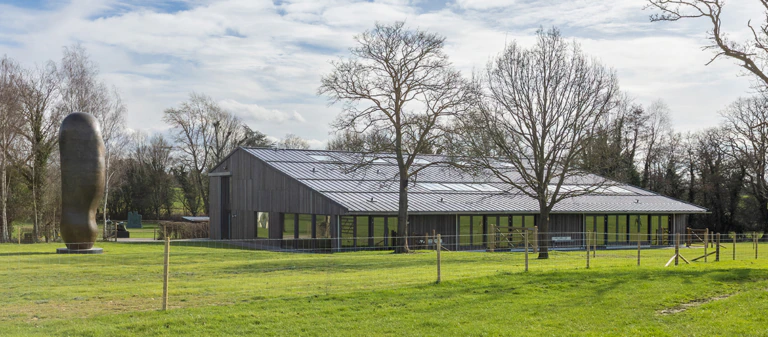
The collection, previously housed at nearby Holker Hall, is now displayed in a striking building on the banks of the river Leven, close to the southern end of Lake Windermere.
The main building is a clever mix of old and new; the large display gallery is a modern steel and glass structure clad in vivid ultramarine as a reminder that the museum is located on a site where the Reckitt’s company packed and dispatched Dolly Blue ultramarine pigment. At either end of the new structure older buildings have been incorporated along with a cafe.
Entering the exhibition from the shop, visitors are greeted by a large airy space crammed with cars, motorbikes and other vehicles. The sheer number of objects on show is almost too much to take in and while there is much to admire and pore over, an introduction on the history of the collection and its raison d’etre would be helpful.
The main gallery features a number of rare and special cars including a beautiful 1936 Bentley owned by Donald Campbell, which carried Bluebird blue paintwork, a Back to the Future DeLorean and an Aston Martin Virage.
I was pleased to see that there are almost no barriers around the cars, giving a far more accessible feel to the museum, although some vehicles were displayed very close together.
The most significant cars feature well-designed graphic panels giving technical details and images of the vehicle that add greatly to the interpretation but I wished there had been more – some cars had labels giving only the most basic information.
More interpretation is available through video presentations displayed on panels similar to the large graphics. These feature archive footage of a variety of topics, ranging from Al Capone to film of the Amphicar, a quirky 1960s amphibious car displayed nearby.
The car collection is varied – there are examples of cars you would expect to see in most motoring collections, such as the classic Mini, but also rarer exhibits such as a 1960 MGA Roadster used by traffic police to chase speeding motorists. What is more difficult to discern is any theme or pattern to the display, and I suspect many visitors will struggle to work out why the cars are arranged as they are.
Motor heaven
Museum publicity boasts that there are more than 30,000 motoring-related objects displayed and it is hard to find a wall not covered with motoring memorabilia. As an evocation of the golden age of motoring, the museum succeeds admirably; there are scores of signs, notices, telephone boxes, petrol pumps, bicycles and motorbikes all over the building.
The centrepiece is a period garage, which is jam-packed with old tools and equipment, advertising signs, tyres, lamps and miscellaneous parts of old cars. For someone who once spent a summer vacation working in a garage, these sights and smells brought back vivid memories but for those brought up in the modern era a bit more interpretation would be helpful.
Many of the objects seem alien in an age when mechanics are vehicle technicians and cars are repaired using computer diagnostics. Nearby is the most obviously themed section of the car displays.
The success of the BBC TV show Life on Mars has reinforced a growing interest in cars from the 1970s and so a display featuring a 1972 Ford Escort Mexico, 1973 Austin Allegro, Citroën DS20 and Ford Fiesta was popular with visitors when I visited, despite the fact that, with the exception of the Escort Mexico, few if any of the other cars were seen as cool in the 1970s.
Yet more objects are on show in a series of period shop displays grouped around the outside of the museum, featuring a shoemaker’s workshop, ladies’ fashion shop, cycle shop and a bookshop. The latter provided some direct links to the main museum displays with a selection of motoring-themed books from the past.
The industrial past of the buildings that form part of the museum complex and the surrounding Backbarrow area are described in a series of displays that provide a welcome local context to the motoring exhibition.
The Reckitt’s packing plant, relocated from Hull during the second world war, employed 50 women, and evocative images and objects tell the story of the people and products of not only the ultramarine pigment industry but other trades, such as iron founding, gunpowder production and bobbin-making, that made use of the power of the nearby river Leven.
Evocative history
The Campbell Bluebird exhibition tells the story of Malcolm and Donald Campbell, and features replicas of the 1935 Bluebird Car and the jet-powered K7 Bluebird hydroplane in which Donald Campbell was killed in 1967.
More interesting for me was film footage of Campbell being interviewed about his motivation for trying to go ever faster, and the telling silence in the gallery itself that followed the footage of the crash on Coniston Water. There is little doubt that the thousands of objects displayed in the new museum will provide a nostalgic diversion for many.
It is clear that much work has gone into the relocation and setting up of what is likely to be a popular all-weather attraction in one of Britain’s most visited national parks.
But the fantastic collection is not quite enough on its own and to become a truly satisfying experience more work on its interpretation is needed. There are just too many objects on display for the visitor to take in during one visit and some judicious editing would reduce overcrowding and enable the exhibition to make more sense.
Better theming, more interactivity, especially for young visitors, and a little more explanation would make the museum more accessible to the thousands who will undoubtedly enjoy this evocative trip into British transport history.
Tim Bryan is the head of collections and interpretation at the Heritage Motor Centre, Gaydon
Cost undisclosed
Main funder Bowness Bay Boating Company
Architect O’Neil & Petrie
Engineer Petit Singleton Associates
Contractor Conlon Construction
Interior design/layout in-house
Audiovisuals Mirage Digital
Design Capra Design
The collection, previously housed at nearby Holker Hall, is now displayed in a striking building on the banks of the river Leven, close to the southern end of Lake Windermere.
The main building is a clever mix of old and new; the large display gallery is a modern steel and glass structure clad in vivid ultramarine as a reminder that the museum is located on a site where the Reckitt’s company packed and dispatched Dolly Blue ultramarine pigment. At either end of the new structure older buildings have been incorporated along with a cafe.
Entering the exhibition from the shop, visitors are greeted by a large airy space crammed with cars, motorbikes and other vehicles. The sheer number of objects on show is almost too much to take in and while there is much to admire and pore over, an introduction on the history of the collection and its raison d’etre would be helpful.
The main gallery features a number of rare and special cars including a beautiful 1936 Bentley owned by Donald Campbell, which carried Bluebird blue paintwork, a Back to the Future DeLorean and an Aston Martin Virage.
I was pleased to see that there are almost no barriers around the cars, giving a far more accessible feel to the museum, although some vehicles were displayed very close together.
The most significant cars feature well-designed graphic panels giving technical details and images of the vehicle that add greatly to the interpretation but I wished there had been more – some cars had labels giving only the most basic information.
More interpretation is available through video presentations displayed on panels similar to the large graphics. These feature archive footage of a variety of topics, ranging from Al Capone to film of the Amphicar, a quirky 1960s amphibious car displayed nearby.
The car collection is varied – there are examples of cars you would expect to see in most motoring collections, such as the classic Mini, but also rarer exhibits such as a 1960 MGA Roadster used by traffic police to chase speeding motorists. What is more difficult to discern is any theme or pattern to the display, and I suspect many visitors will struggle to work out why the cars are arranged as they are.
Motor heaven
Museum publicity boasts that there are more than 30,000 motoring-related objects displayed and it is hard to find a wall not covered with motoring memorabilia. As an evocation of the golden age of motoring, the museum succeeds admirably; there are scores of signs, notices, telephone boxes, petrol pumps, bicycles and motorbikes all over the building.
The centrepiece is a period garage, which is jam-packed with old tools and equipment, advertising signs, tyres, lamps and miscellaneous parts of old cars. For someone who once spent a summer vacation working in a garage, these sights and smells brought back vivid memories but for those brought up in the modern era a bit more interpretation would be helpful.
Many of the objects seem alien in an age when mechanics are vehicle technicians and cars are repaired using computer diagnostics. Nearby is the most obviously themed section of the car displays.
The success of the BBC TV show Life on Mars has reinforced a growing interest in cars from the 1970s and so a display featuring a 1972 Ford Escort Mexico, 1973 Austin Allegro, Citroën DS20 and Ford Fiesta was popular with visitors when I visited, despite the fact that, with the exception of the Escort Mexico, few if any of the other cars were seen as cool in the 1970s.
Yet more objects are on show in a series of period shop displays grouped around the outside of the museum, featuring a shoemaker’s workshop, ladies’ fashion shop, cycle shop and a bookshop. The latter provided some direct links to the main museum displays with a selection of motoring-themed books from the past.
The industrial past of the buildings that form part of the museum complex and the surrounding Backbarrow area are described in a series of displays that provide a welcome local context to the motoring exhibition.
The Reckitt’s packing plant, relocated from Hull during the second world war, employed 50 women, and evocative images and objects tell the story of the people and products of not only the ultramarine pigment industry but other trades, such as iron founding, gunpowder production and bobbin-making, that made use of the power of the nearby river Leven.
Evocative history
The Campbell Bluebird exhibition tells the story of Malcolm and Donald Campbell, and features replicas of the 1935 Bluebird Car and the jet-powered K7 Bluebird hydroplane in which Donald Campbell was killed in 1967.
More interesting for me was film footage of Campbell being interviewed about his motivation for trying to go ever faster, and the telling silence in the gallery itself that followed the footage of the crash on Coniston Water. There is little doubt that the thousands of objects displayed in the new museum will provide a nostalgic diversion for many.
It is clear that much work has gone into the relocation and setting up of what is likely to be a popular all-weather attraction in one of Britain’s most visited national parks.
But the fantastic collection is not quite enough on its own and to become a truly satisfying experience more work on its interpretation is needed. There are just too many objects on display for the visitor to take in during one visit and some judicious editing would reduce overcrowding and enable the exhibition to make more sense.
Better theming, more interactivity, especially for young visitors, and a little more explanation would make the museum more accessible to the thousands who will undoubtedly enjoy this evocative trip into British transport history.
Tim Bryan is the head of collections and interpretation at the Heritage Motor Centre, Gaydon
Project data
Cost undisclosed
Main funder Bowness Bay Boating Company
Architect O’Neil & Petrie
Engineer Petit Singleton Associates
Contractor Conlon Construction
Interior design/layout in-house
Audiovisuals Mirage Digital
Design Capra Design