If you have never been to Bexhill-on-Sea, let me recommend a visit this summer to see and experience the finest piece of modern architecture on the south coast.
The De La Warr Pavilion, a modernist masterpiece by Erich Mendelsohn and Serge Chermayeff, is celebrating its 75th birthday in 2010.
This radical seaside entertainment complex was commissioned by Bexhill Council following an open architectural competition run by the Royal Institute of British Architects. The winners were a German Jewish émigré architect fleeing the Nazis and a Russian-born designer educated at Harrow.
Their pavilion is named after its champion and promoter, the 9th Earl De La Warr, who managed to reconcile his inherited role as lord of the manor with being Bexhill’s first and last socialist mayor. The welded-steel frame pavilion was completed in under a year, started in January and ready for opening by December 1935.
This iconic building is Grade I-listed and after a lottery-funded £8m restoration and refurbishment, it opened in October 2005 as a contemporary arts centre.
Bexhill has a short history shaped by a cast of colourful characters. The modern town was created as an exclusive late-Victorian resort by the 7th Earl De La Warr. His son, who inherited the estate and title in 1896, oversaw Bexhill’s incorporation as a borough in 1902.
To celebrate the town’s new status and promote his resort, the 8th earl hosted Britain’s first motorcar races on 19 May 1902. This seminal event, organised by the Automobile Club of Great Britain and Ireland, attracted international attention and competitors. The speed trials put Bexhill on the map, though so too did the earl’s sensational divorce case, which scandalised Sussex in the same year.
The pavilion and the UK’s pioneer motor sports are still Bexhill’s twin claims to fame, inscribed on the road signs at the entrance to the town. These and a good selection of other local stories feature strongly in the enterprising Bexhill Museum, which reopened last summer after extension and refurbishment.
The official tape-cutting in November was performed by the town’s most recent celebrity, comedian Eddie Izzard, who has become the museum’s patron.
He went to school just along the coast in Eastbourne, but his father still lives in Bexhill. Izzard’s endearingly eccentric museum-opening-as-finale-to-a-half-marathon run (from Eastbourne) makes for entertaining viewing on YouTube.
The museum is five minutes’ walk along the prom from the De La Warr, set back one block from the seafront. Turn right at the clocktower and you can’t miss it, though from the street the modest single-storey brick building is low key. At the back, where the ground level drops and incorporates a lower floor, it overlooks a public park.
Bexhill Museum has occupied the 1902 Egerton Park Shelter Hall since 1914. The building is still owned by the local authority (now Rother District Council), which also employs the curator, but the museum and collections are the responsibility of the independent Society of Bexhill Museums, a charitable trust run by its members and supported by enthusiastic volunteers. This particular public-private partnership works very well.
The £2m-plus museum upgrade project has been made possible by nearly £1m from the Heritage Lottery Fund, matched by £600,000 from Rother District and money from local fundraising.
Architects John McAslan + Partners, who carried out the expert refurbishment of the De La Warr, have created a modernist box on one side of the original building with a Tardis-like interior.
This has doubled the museum’s display space with two new galleries, a flexible meeting room/education space, new entrance and shop, collections store and full access to all areas with a lift.
It is a seamless combination of old and new, retaining the best features of the original structure such as the attractive cast-iron roof columns and a beautiful parquet wood floor.
Dinosaur footprints
Appropriately, the first exhibit you come across is the large original 1930s architects’ model of the De La Warr, which includes a circular, open-air swimming pool and giant sculpted figure that were never constructed.
The original display area has been refurbished as the Sargent Gallery, named in honour of veteran former curator Henry Sargent, who worked at the museum for more than 60 years from the 1920s.
Many of the objects from the private collections that Sargent and others built up have been retained in their original settings and cases, and include important geological and natural history specimens.
Bexhill is well known for the fossilised dinosaur footprints, which are still revealed on the beach at low tide, and the museum has iguanodon and megalosaurus remains found nearby.
The local relevance of a giant Japanese spider crab displayed on the end wall was rather less obvious to me, but this is clearly a long-held and admired iconic object that the museum could not possibly dispose of.
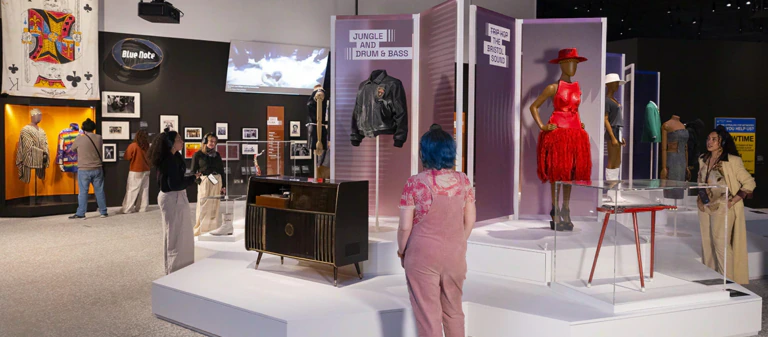
The first of the two new galleries presents the museum’s strong costume and fashion collections, which are effectively used to tell a broader social history story of the last 150 years. This is a flexible display space that will be used for special exhibitions and presentations from the museum’s permanent collections.
It includes multimedia installations where moving images and oral-history soundtracks can be added to the displays. These can also be linked to the museum’s smart new colour-coded website, which has been designed by a local company.
The website is stylish but refreshingly simple and a model for what every small museum should now be doing with new technology at low cost.
Motor heritage
The second new gallery picks up on Bexhill’s motor-racing heritage by featuring three unique locally developed vehicles built for speed in different eras and demonstrating different technologies.
There is a full-size reconstruction of the amazing steam-powered 1902 Serpollet Easter Egg racing car, a restored prototype of the 1950s Elva sports racer, which has a conventional engine but an aluminium body, and the record-breaking 1993 Volta electric racing car.
These groundbreaking cars are not just Top Gear-style boys’ toys, but are presented in the context of experimental motor technology and its environmental impact, with some entertaining interactive displays.
Sometimes less is more, and these three impressive objects are put to very effective use. Rather like Bexhill Museum as a whole, punching above its weight with creative new displays that present the town’s distinctive and quirky heritage using real objects and virtual technology. Altogether, quite a triumph.
Oliver Green is the former head curator of the London Transport Museum
Project data
Cost £2m
Main funders Heritage Lottery Fund £1m, Rother District Council £600,000
Architect John McAslan + Partners
Exhibition design RFA Design
Fit out ID Ess
Audiovisuals Red Brick Pictures
AV hardware Pure AV