The Ulster Museum in Belfast reopened its doors in October last year following a three-year, £17.2m redevelopment.
I have a personal and emotional attachment to the museum as my father used to take us regularly as a family, and I have no doubt that this early formative experience has influenced what I do now.
I remember small details of the original building – the steps up and down through the labyrinth of spaces, the pokey canteen on the top floor, the hessian walls and brown carpet in the temporary exhibition space, the dark stairs at the back. So I entered with a strong sense of nostalgia and familial memories.
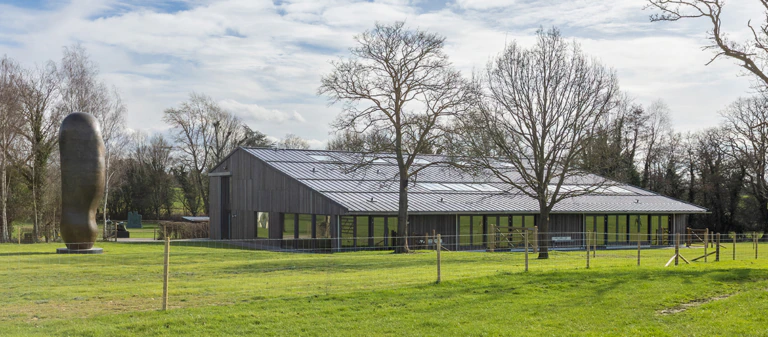
But the experience really begins outside with a redefinition of the museum’s relationship with Belfast’s fabulous Botanic Gardens.
The piazza at the entrance offers views over magnificent specimen trees from around the world and allows a greater sense of the scale of the building.
It is good to see the Barry Flanagan and Philip King sculptures near the entrance; it would be great if the museum could extend out into the park with special commissions.
Described as one of the most important cultural projects ever undertaken in Northern Ireland, the refurbishment of the Ulster Museum has resulted in a dramatic but sensitive transformation of the building.
The cluttered, oppressive, dark spaces have been replaced by openness. Polished steel and glass walkways now connect bright and airy galleries.
The project, funded by the Department of Culture, Arts and Leisure, the Heritage Lottery Fund and private donations, has literally raised the roof of Northern Ireland’s principal museum, and visitors are now welcomed into an impressive light-filled 23-metre-high atrium that leads to new History, Art and Nature Zones.
The Window on our World display cleverly scales four floors and three zones: History, Nature and Art. It features a range of iconic objects, giving visitors a sense of the scale and diversity of the museum’s collections. Once an hour, a stunning audiovisual show is projected onto the walls surrounding the tower.
There are a number of different shows and each one focuses on an object from the gallery. This makes you feel connected to the whole museum and gives you a different perspective from the previous experience.
International venue
As well as this dramatic Welcome area, the ground floor includes the nicely laid-out museum shop, a new lecture theatre, good-sized education suites, the Belfast Room (for community events), a multipurpose room and a 150-seater restaurant overlooking the Botanic Gardens.
The History Zone is situated on the first floor and offers a fascinating journey through Irish history from prehistoric Ireland through to the present day.
The gallery includes an impressive Armada exhibition with a collection of 16th-century jewellery recovered from the Spanish Armada galleass Girona, which was wrecked near Giant’s Causeway in 1588.
Other objects include locally discovered Stone Age axes made from porcellanite in the Early Peoples’ gallery and St Patrick’s Regalia – a gold collar of seven roses joined by 14 knots to six harps, once worn by the Earl of Shaftesbury.
An imposing Irish icon greets visitors in the Nature Zone. A giant deer (often referred to as Irish elk) skeleton and, beside it, the first reconstruction of the living animal ever to be displayed in Ireland, provide a sense of what is to come.
The Nature Zone travels through numerous galleries exploring the Ice Age, Deep Time, Earth’s Treasures, Living World and the Sea Around Us, finishing with Fossils and Evolution. Full of fascinating objects, the zone includes an emperor penguin, brought back to Ireland in the 19th century by explorer Francis Crozier.
A 200 million-year-old fossil of ammonite shells and driftwood provides a wonderful snapshot of an ancient sea floor. The layout and design is clear, informative and bright.
The Ulster Museum headlined its reopening with a major retrospective of work by Dublin-born Sean Scully, one of the most celebrated abstract artists of his generation.
This display, which is in the museum’s top-floor suite of nine adjoining art galleries, has signalled the museum’s ambitions to host landmark international shows and to establish Belfast as a leading venue for art exhibitions.
For this to happen the programme must maintain quality and the museum must now begin to network with major spaces in the UK and beyond to collaborate on major exhibitions.
I understand the reasoning behind bringing a renowned international artist to launch the Ulster Museum, but why is there nothing to represent Willie Doherty? He is the most important artist to emerge from the Troubles and his work perfectly dovetails Art, History and Nature.
The George and Angela Moore Gallery of Applied Art is a treasure trove of intricacy and delicacy, housing the museum’s jewellery collection and items from the Belleek pottery, which was founded in County Fermanagh in 1857.
One of the many eye-catching pieces is the Belleek covered Urn Vase; adorned with daisies and forget-me-nots. This extremely rare decorative vase exemplifies the skill and patience of Irish craftsmen.
Visitors can also take a peek into the dressing room of an 18th-century lady and view the most complete silver gift toilet set remaining today.
Value for money
One of the Ulster Museum’s most famous exhibits and the stalwart of school visits for previous generations is Takabuti, which is now the centrepiece of a new gallery exploring life and death in ancient Egypt.
The Egyptian mummy from the 7th-century BC, was brought to Belfast in the 1800s from Thebes in the Nile Valley, by Thomas Greg. It is recognised as one of the best-preserved mummies on public display anywhere and its new home ensures the continuity of her fascination for generations of young people.
It also provides an interesting context, as the display shows the level of civilisation in Ireland at the time she was alive.
The new museum places a major emphasis on engaging all ages with the diverse collections. Education suites and Discovery areas provide opportunities to build a Stone Age tomb, work a sun dial, touch a real elephant skull, try on corsets and crinolines, be a forensic scientist and discover a whole new world under the microscope.
Discover Zones are located in the History, Art and Nature Zones and it is a welcome addition to have practical educational facilities close to the displays on all floors.
The redeveloped Ulster Museum is a splendid experience for first-time visitors (such as my taxi driver to the airport, who had never been) and for lapsed visitors (such as my taxi driver to the museum, who had not been since he was a child).
My gut instinct is that £17.2m is great value for money and the people of Belfast have something to be proud of.
Stephen Snoddy is the director of the New Art Gallery, Walsall
Cost £17.2m
Main funders Department of Culture, Arts and Leisure (£11.2m), the Heritage Lottery Fund (£4.7m) £1.3m from trusts, foundations and private donations.
Architect Hamilton Architects
Main contractor Patton Construction
Exhibition design Haley Sharpe Design
Fit-out Beck
Display cases Click Netherfield