"Fiat lux" - let there be light. And let there be "advancement of learning and ennoblement of life" too. That's what's written on the walls of the Victoria building, the original home of Liverpool University.
"Light, learning and ennoblement" - not a bad mantra for the European Capital of Culture concept. And if Liverpool's stint is remembered for just one thing, then it should be the Victoria building. Yet this is no flashy new addition to the Liverpool skyline (there are plenty of those).
What makes it special is that it is open to the public for the first time. The building, the university's self-proclaimed "gift" to the city, has now been converted into the Victoria Gallery & Museum, the only new museum in Liverpool's year of culture.
This act of generosity cost £8.6m, raised from a range of sponsors and benefactors. It's obvious where the bulk of the money has gone as soon as you enter. The magnificent Victorian tiled columns disappear beneath your feet, their bases visible through circular bands of glass cut into the floor.
The entrance level has clearly been raised to create a level opening. This, plus a new glass lift slotted into the clock tower, means that the building is now fully accessible.
The slightly disconcerting sensation of seeing the massive columns sink beneath the floor is a clever touch. It draws attention to the building - and the building deserves it. While the outside is a mountain of red brick, the inside is covered in different types of terracotta and glazed tiles.
The collection is exhibited on two floors, with the uppermost dominated by the Tate Hall. Like the Tates in London, St Ives and, of course, Liverpool, this one is named after Sir Henry Tate, whose generosity paid for much of the building. The hall was once the university's library. Since then it has had several functions, including an exam venue.
This is evidently how it is remembered by some visitors, all of whom seem to have preferred being there as museum-goers rather than exam candidates. Their comments and the musings of other visitors are written on "leaves" hung up on either side of the museum's mascot: a stuffed sloth.
It's rather risky for a university museum to adopt such a lazy creature as its symbol, but the students can't possibly be slothful given that this is a member of the Russell Group, an association of 20 UK universities that are committed to maintaining high standards of research and education.
It's plain that the Victoria Gallery & Museum is part of a strategy to consolidate that position and give the university a public face and a community role. The displays manage to combine scholarly appeal with family activities. For the latter, there are trail leaflets, such as one that capitalises on the richly patterned tiles to encourage children to explore the architecture.
The collection is typical of a university museum in that it shifts from dinosaurs and dentistry to calculators and childbirth in the space of a few steps. But the eclectic displays work reasonably well, even if they have a tendency to be too wordy and poorly labelled. However, the museum only opened in May and the exhibits are taking shape.
There is a lot of potential given the diverse range of bequests that make up the holdings. The Liverpool connection is established by telling the story of local personalities, such as the dentist Rex Stewart, whose 1920s Birkenhead surgery has been recreated.
The floor below the Tate Hall is devoted to fine art and is separated into much smaller spaces. To the right are two galleries that once housed the women's common rooms. They now hold a sculpture collection (funded by the Henry Moore Foundation), plus a forthcoming display of ceramics.
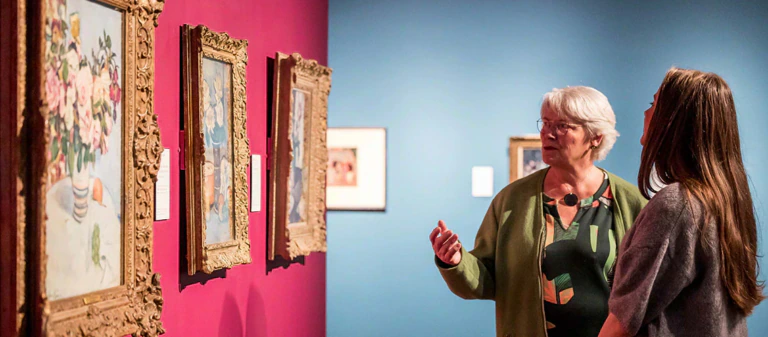
The paintings are on the other side of the building. These are hung according to theme and medium and include watercolour landscapes, a series of icons and a room devoted to the self-styled American Woodsman, John James Audubon (1785-1851).
Each setting is given a different wall colouring. Strong red walls show off Audubon's nature studies to good effect, while blue is used as the backdrop for a series of night-time scenes. One of the most striking works here is JMW Turner's Eruption of the Soufrière Mountains.
This is interpreted in different ways: a conventional text panel gives some facts and art history; an adjacent interactive explains about lava and has a piece of igneous rock to touch; two other devices allow visitors to smell and hear the eruption.
Alfred Waterhouse - the architect of the Victoria building - could scarcely have imagined that his tiled palace would one day become a place to stare at a stuffed sloth in the Tate Hall or eat a tian of smoked trout in the museum's swanky Waterhouse cafe. But I suspect he would have been pleased.
Not least because it is from the comfy seats of Waterhouse's cafe that one can really appreciate what is definitely the best object on show: the building itself. If Liverpool's Capital of Culture bid had failed, it might have remained the city's best-kept secret.
Stuart Burch is a senior lecturer in museum and heritage management at Nottingham Trent University
"Light, learning and ennoblement" - not a bad mantra for the European Capital of Culture concept. And if Liverpool's stint is remembered for just one thing, then it should be the Victoria building. Yet this is no flashy new addition to the Liverpool skyline (there are plenty of those).
What makes it special is that it is open to the public for the first time. The building, the university's self-proclaimed "gift" to the city, has now been converted into the Victoria Gallery & Museum, the only new museum in Liverpool's year of culture.
This act of generosity cost £8.6m, raised from a range of sponsors and benefactors. It's obvious where the bulk of the money has gone as soon as you enter. The magnificent Victorian tiled columns disappear beneath your feet, their bases visible through circular bands of glass cut into the floor.
The entrance level has clearly been raised to create a level opening. This, plus a new glass lift slotted into the clock tower, means that the building is now fully accessible.
The slightly disconcerting sensation of seeing the massive columns sink beneath the floor is a clever touch. It draws attention to the building - and the building deserves it. While the outside is a mountain of red brick, the inside is covered in different types of terracotta and glazed tiles.
The collection is exhibited on two floors, with the uppermost dominated by the Tate Hall. Like the Tates in London, St Ives and, of course, Liverpool, this one is named after Sir Henry Tate, whose generosity paid for much of the building. The hall was once the university's library. Since then it has had several functions, including an exam venue.
This is evidently how it is remembered by some visitors, all of whom seem to have preferred being there as museum-goers rather than exam candidates. Their comments and the musings of other visitors are written on "leaves" hung up on either side of the museum's mascot: a stuffed sloth.
It's rather risky for a university museum to adopt such a lazy creature as its symbol, but the students can't possibly be slothful given that this is a member of the Russell Group, an association of 20 UK universities that are committed to maintaining high standards of research and education.
It's plain that the Victoria Gallery & Museum is part of a strategy to consolidate that position and give the university a public face and a community role. The displays manage to combine scholarly appeal with family activities. For the latter, there are trail leaflets, such as one that capitalises on the richly patterned tiles to encourage children to explore the architecture.
The collection is typical of a university museum in that it shifts from dinosaurs and dentistry to calculators and childbirth in the space of a few steps. But the eclectic displays work reasonably well, even if they have a tendency to be too wordy and poorly labelled. However, the museum only opened in May and the exhibits are taking shape.
There is a lot of potential given the diverse range of bequests that make up the holdings. The Liverpool connection is established by telling the story of local personalities, such as the dentist Rex Stewart, whose 1920s Birkenhead surgery has been recreated.
The floor below the Tate Hall is devoted to fine art and is separated into much smaller spaces. To the right are two galleries that once housed the women's common rooms. They now hold a sculpture collection (funded by the Henry Moore Foundation), plus a forthcoming display of ceramics.
The paintings are on the other side of the building. These are hung according to theme and medium and include watercolour landscapes, a series of icons and a room devoted to the self-styled American Woodsman, John James Audubon (1785-1851).
Each setting is given a different wall colouring. Strong red walls show off Audubon's nature studies to good effect, while blue is used as the backdrop for a series of night-time scenes. One of the most striking works here is JMW Turner's Eruption of the Soufrière Mountains.
This is interpreted in different ways: a conventional text panel gives some facts and art history; an adjacent interactive explains about lava and has a piece of igneous rock to touch; two other devices allow visitors to smell and hear the eruption.
Alfred Waterhouse - the architect of the Victoria building - could scarcely have imagined that his tiled palace would one day become a place to stare at a stuffed sloth in the Tate Hall or eat a tian of smoked trout in the museum's swanky Waterhouse cafe. But I suspect he would have been pleased.
Not least because it is from the comfy seats of Waterhouse's cafe that one can really appreciate what is definitely the best object on show: the building itself. If Liverpool's Capital of Culture bid had failed, it might have remained the city's best-kept secret.
Stuart Burch is a senior lecturer in museum and heritage management at Nottingham Trent University
Project data
Cost: £8.6m
Main funders: University of Liverpool, Jenny Rathbone, the estate of the late Marian Thomason, the Linbury Trust, Friends of the University of Liverpool, PH Holt Foundation, Stone City Films, Henry Moore Foundation, the Pilgrim Trust, Dr and Mrs Michael Potts, Professor Drummond and Vivian Bone, Sir Neil and Lady Cossons, University of Liverpool's Women's Club, Sir Howard and Lady Newby
Architect: Levitt Bernstein
Exhibition design: in-house
Audiovisuals: National Design Consultancy
Lighting: LDA
Showcase design: in-house, Showcase construction JW Classical Joinery
Cost: £8.6m
Main funders: University of Liverpool, Jenny Rathbone, the estate of the late Marian Thomason, the Linbury Trust, Friends of the University of Liverpool, PH Holt Foundation, Stone City Films, Henry Moore Foundation, the Pilgrim Trust, Dr and Mrs Michael Potts, Professor Drummond and Vivian Bone, Sir Neil and Lady Cossons, University of Liverpool's Women's Club, Sir Howard and Lady Newby
Architect: Levitt Bernstein
Exhibition design: in-house
Audiovisuals: National Design Consultancy
Lighting: LDA
Showcase design: in-house, Showcase construction JW Classical Joinery