Amazon to Caribbean: Early Peoples of the Rainforest, Horniman Museum, London
This exhibition flies in the face of all received wisdom. The cultures it explores are relatively obscure, the area they come from is unfamiliar to the average person and the objects on display are not intrinsically valuable. Yet from them, the Horniman Museum has created a fascinating and engaging exhibition.
This exhibition is the result of field research by Hassan Arero, the museum's Kenyan-born head of anthropology, among the WaiWai of Masakenyari village in the equatorial rainforests of south Guyana and the Guyanese capital Georgetown between December 2003 and January 2004.
It examines the cultural links between Guyana, Surinam and Venezuela on the South American mainland and the Caribbean Antilles, including Trinidad and Tobago, St Lucia and Haiti.
It uses artefacts gathered by Arero augmented with loans from the British Museum, the British Library and the Natural History Museum, along with items collected in the 1950s and 1960s by earlier researchers P S Peberdy and Nicholas Guppy.
The cultures featured have been under threat for the past 400 years, and today the WaiWai are still facing increasing pressure to change their indigenous ways of life.
Further change will be inevitable, but there are encouraging signs of a revival of interest in Amerindian cultures, with Amerindian festivals in Trinidad, Puerto Rico and Guyana.
Amerindian societies have complex cosmologies and a strong integration with, and respect for, their environment. They divide the universe into the sky, the earth and the underworld, with each layer being associated with different birds and animals. Certain animals - particularly the jaguar and the anaconda - have powerful roles, which is reflected in the artefacts that each culture creates.
The artefacts themselves are exquisitely beautiful: patterned beaded aprons, intricately woven fans and baskets, elaborately carved cassava graters, parrot feather headdresses and imposing necklaces made of jaguars' teeth.
Faced with such stunning material, designer John Csáky Associates has kept the design low-key and low tech, while making sure the rich hues of the feathers, beads, ceramics and textiles are echoed by vibrant colours in the graphics. This exhibition is the perfect therapy for a dull, grey afternoon in winter.
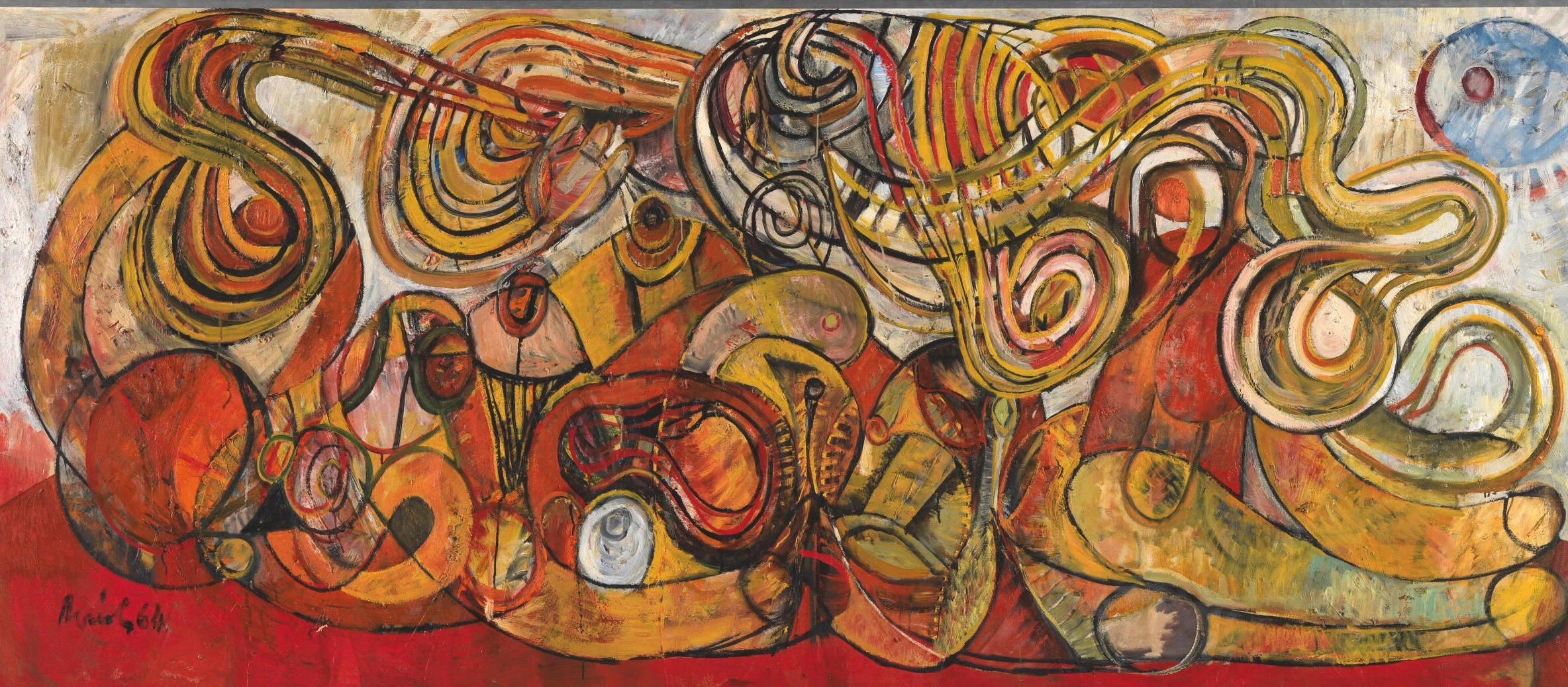
The links with the contemporary world are strengthened by the inclusion of work by artists from the region, including the sculptor and painter Oswald Hussein and the painter Aubrey Williams. Both draw heavily on the striking motifs - often taken from the natural world - and traditional mythology of the Amerindian cultures.
Hussein's sculpture 'Likisa', a shape-changing mythical figure, half bird and half jaguar, makes an arresting eye-catcher at the entrance to the exhibition, and Williams' vigorous, powerful paintings provide a contemporary bridge to the natural world, effectively assuming the traditional role of the shaman, who functioned as a link between earthly and celestial worlds.
The Horniman has been working with local groups to explore Caribbean identities, using material from the exhibition. Local groups including the memorably named Recycled Teenagers have been focusing on different aspects of Caribbean culture, and recording their thoughts and impressions.
The exhibition has been particularly well received by children, whose enthusiastic comments - 'cool', 'brillo', 'the jaguar is great' - are scrawled on sticky notes at the end of the exhibition.
Also at the end of the exhibition, almost as an afterthought, is a panel recording Arero's own impressions of his time with the WaiWai, and mentioning some of the people he met. This gives the exhibition a brief but strong sense of immediacy - you feel you can almost reach out and shake these people's hands.
This is my only criticism of the approach; this unique sense of contact should have been developed as a strand running throughout the exhibition. Arero may have been reluctant to feature too prominently in his own exhibition, but the absence of his voice, linking his hosts in Guyana with the Horniman's Caribbean community in south-east London, is a missed opportunity.
Let us hope that the Horniman's next major exhibition, based on fieldwork on the music of Kerala on the south west coast of India, will see the curator taking more of a leading role.
Jane Weeks is a museum consultant
Project data
Cost: £340,000
Main funders: MLA Renaissance London, Designation Challenge Fund, Arts Council England, Horniman Museum
This exhibition flies in the face of all received wisdom. The cultures it explores are relatively obscure, the area they come from is unfamiliar to the average person and the objects on display are not intrinsically valuable. Yet from them, the Horniman Museum has created a fascinating and engaging exhibition.
This exhibition is the result of field research by Hassan Arero, the museum's Kenyan-born head of anthropology, among the WaiWai of Masakenyari village in the equatorial rainforests of south Guyana and the Guyanese capital Georgetown between December 2003 and January 2004.
It examines the cultural links between Guyana, Surinam and Venezuela on the South American mainland and the Caribbean Antilles, including Trinidad and Tobago, St Lucia and Haiti.
It uses artefacts gathered by Arero augmented with loans from the British Museum, the British Library and the Natural History Museum, along with items collected in the 1950s and 1960s by earlier researchers P S Peberdy and Nicholas Guppy.
The cultures featured have been under threat for the past 400 years, and today the WaiWai are still facing increasing pressure to change their indigenous ways of life.
Further change will be inevitable, but there are encouraging signs of a revival of interest in Amerindian cultures, with Amerindian festivals in Trinidad, Puerto Rico and Guyana.
Amerindian societies have complex cosmologies and a strong integration with, and respect for, their environment. They divide the universe into the sky, the earth and the underworld, with each layer being associated with different birds and animals. Certain animals - particularly the jaguar and the anaconda - have powerful roles, which is reflected in the artefacts that each culture creates.
The artefacts themselves are exquisitely beautiful: patterned beaded aprons, intricately woven fans and baskets, elaborately carved cassava graters, parrot feather headdresses and imposing necklaces made of jaguars' teeth.
Faced with such stunning material, designer John Csáky Associates has kept the design low-key and low tech, while making sure the rich hues of the feathers, beads, ceramics and textiles are echoed by vibrant colours in the graphics. This exhibition is the perfect therapy for a dull, grey afternoon in winter.
The links with the contemporary world are strengthened by the inclusion of work by artists from the region, including the sculptor and painter Oswald Hussein and the painter Aubrey Williams. Both draw heavily on the striking motifs - often taken from the natural world - and traditional mythology of the Amerindian cultures.
Hussein's sculpture 'Likisa', a shape-changing mythical figure, half bird and half jaguar, makes an arresting eye-catcher at the entrance to the exhibition, and Williams' vigorous, powerful paintings provide a contemporary bridge to the natural world, effectively assuming the traditional role of the shaman, who functioned as a link between earthly and celestial worlds.
The Horniman has been working with local groups to explore Caribbean identities, using material from the exhibition. Local groups including the memorably named Recycled Teenagers have been focusing on different aspects of Caribbean culture, and recording their thoughts and impressions.
The exhibition has been particularly well received by children, whose enthusiastic comments - 'cool', 'brillo', 'the jaguar is great' - are scrawled on sticky notes at the end of the exhibition.
Also at the end of the exhibition, almost as an afterthought, is a panel recording Arero's own impressions of his time with the WaiWai, and mentioning some of the people he met. This gives the exhibition a brief but strong sense of immediacy - you feel you can almost reach out and shake these people's hands.
This is my only criticism of the approach; this unique sense of contact should have been developed as a strand running throughout the exhibition. Arero may have been reluctant to feature too prominently in his own exhibition, but the absence of his voice, linking his hosts in Guyana with the Horniman's Caribbean community in south-east London, is a missed opportunity.
Let us hope that the Horniman's next major exhibition, based on fieldwork on the music of Kerala on the south west coast of India, will see the curator taking more of a leading role.
Jane Weeks is a museum consultant
Project data
Cost: £340,000
Main funders: MLA Renaissance London, Designation Challenge Fund, Arts Council England, Horniman Museum