British Museum, London
Family aside, I have two lifelong obsessions; museums and live theatre. Both claim to deal with the reality of things or experiences, but rarely do they coincide or overlap. Dramatists are uneasy with the precision of documentary truth; traditionally curators shun theatricality.
But the much-trumpeted British Museum exhibition, the First Emperor, appeals to both of my cultural obsessions. Mounted on a temporary stage erected over the desks of the Reading Room, the show - and I use the word deliberately - is performed under the great blue dome in a sequence of scenes and tableaux. This is literally and metaphorically theatre-in-the round. And it works astonishingly well.
Many cliche-ridden commentators have called this a blockbuster of an exhibition. It is not. The catalogue lists a mere 134 artefacts. This is a small exhibition of great significance. There are sufficient extraordinary things to see and experience. More would be surfeit.
For most visitors this is primarily an opportunity to see some terracotta warriors, although the use in the media of familiar library pictures of the serried ranks in central China had clearly led people to expect many more figures in the exhibition.
"Not even a platoon," commented one person, while the elderly American lady who dogged my footsteps was heard to mutter "notta lotta terracotta" before admitting, as she left, that this had been one of the great experiences of her life - "like hearing Callas or Pavarotti." I share both her initial disappointment and her final dramatic catharsis.
It was courageous of British Museum director Neil MacGregor, the show's curator Jane Portal and their colleagues to name the exhibition the First Emperor and to propose an exploration of the life and influence of Qin Shihuangdi. As the historian and journalist Dan Snow has commented: "His achievements and his legacy dwarf those of Alexander, Caesar and Napoleon. And yet he is largely unknown in the western world."
There are no images of him surviving from his own time, only imaginary portraits painted some 2,000 years after his death. What biographical history we have was written by apologists of the Han dynasty, who overthrew his successors.
They depicted him, rightly or wrongly, as a tyrannical ethnic cleanser, burner of books and purger of philosophers. The situation is analogous to the Tudor/Stuart demonisation of Richard III or, as MacGregor has observed, "It is almost as if the British Empire were known only through French sources."
Some scholars have criticised the curators for mounting an apologist narrative, for whitewashing, downplaying the brutality of the Qin regime. This is unfair. The curators have struck the right balance, taking pains to stress the limitations and partiality of historical sources and stressing instead the primacy of present and future archaeological evidence. To rely on the tangible shows integrity.
The Qin legacy
In the west we have come to expect that most inventions, not only the traditional four of gunpowder, printing, paper and the magnetic compass, originated in China. Clearly the rule of Qin Shihuangdi was part of that process. Over a short span of time, he not only politically and militarily unified a number of warring states, but also established a unified code of law, coinage, weights and measures, and formal writing.
He imposed rules on weapon production, agriculture, the width of roads and carts and began the first great wall. Had the railway then been invented there is no doubt that the trains would have run on time. Certainly Qin's longest-lasting legacy has been the creation of a centralised civil service staffed by intellectual scholar-officials. But where is he in this exhibition, other than as a brooding presence?
The show begins with a conventional British Museum exposition. We pass by maps, gigantic photographs and film projections, before finding treasures of jade, gold and bronze. Then we discover that the climax is a confrontation with masterly images made from the base soil of China.
The absence or invisibility of the principal enigmatic hero, the ruler of All-Under-Heaven, is both intriguing and uplifting. He is not yet the star of his own show. This is Hamlet without the Prince of Denmark or the Odyssey without Odysseus.
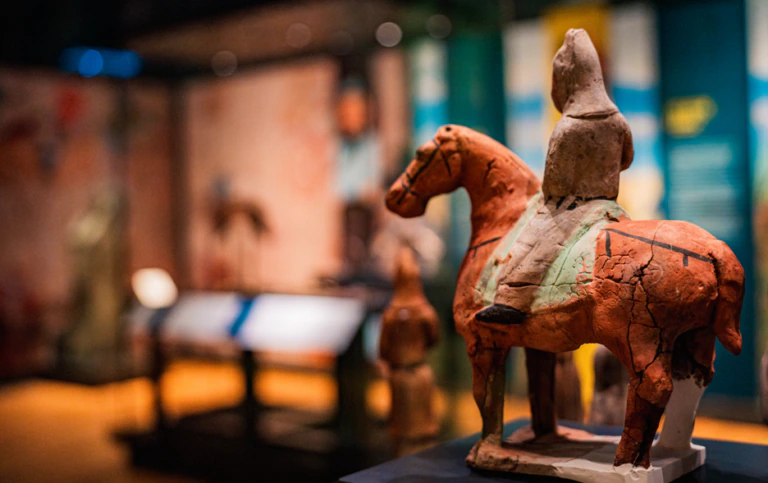
Front of stage in this historical drama are the character actors, the other parts played by members of the company. With more than feet of clay, generals, infantrymen, cavalrymen, archers, stable boys, acrobats, weight-lifters, and musicians, stand, kneel, crouch, and silently await, if not Godot, the orders of the emperor.
And we know too, that the emperor will die, drinking what he hoped was an elixir of eternal life, that his empire, expected to last 10,000 generations, will collapse in bloody civil war. This is hubris, the stuff of Shakespearian or classical Greek tragedy.
However wonderful the Xian archaeological site might be, gazing down at distant myriad warriors does not give the same hair-raising sensation of being next to figures in free space. We note, not only their surprising height, facial expressions and gestures, but also their different ethnicities and ages. In their stance and costume we sense human personalities.
The inclusion, too, of officials, acrobats and musicians, unexpected by me and many visitors, deepened the experience. I was struck by the exquisite beauty of the bronze geese, swans and heron, now even more fragile than pottery. This is not just a show of military power, but also evidence of a cultural and spiritual ethos.
Experts tell us that, despite the appearance of the contrary, these are not replicas of real people. They were made by anonymous artisans on a rigidly supervised mass production system. Only at the end of this process were the figures given individual touches such as facial hair or headgear.
Prior to the project there seems little tradition of realistic sculpture in ancient China. Yet it is impossible to stand before these plain clay figures and not to respond to them as one would to live breathing actors on a stage.
I was conscious also of another ghost. Karl Marx, at his desk in the Reading Room below my feet, would appreciate the dramatic irony that the narrative of an emperor was being told through the images of ordinary people.
That great Marxist dramatist Bertolt Brecht once asked: "Who built Thebes of the Seven Gates?", noting that workers are always ignored and only the great men of history are remembered. Here the emperor is absent. The people are the poetry and the play.
Most museum exhibitions aim to provide considered answers; most dramas raise even more questions. The implications of my visit continue to resonate in my mind. As an ex-curator the heretical hope begins to grow that the temptation to excavate the imperial burial mound might be resisted.
The tomb is after all, like sunken ships, a mass funeral site. Archaeologists still lack the skills properly to conserve probable precious textile and lacquer artefacts. What if the ceremonial rivers of mercury still flow?
Grey appeal
And there is the unashamedly sentimental realisation that the uncovering of the emperor will be an indictment of the warriors' brief to protect him. They will have failed. There are also modern passions to acknowledge. One young Chinese student confided her fears that the presence of even a few warriors in Bloomsbury placed her emperor in Xian in greater jeopardy.
I suspect that we in the west have become besotted with the warriors for the most unhistorical of reasons. We have come to admire the terracotta figures as works of art. Yet they were not made to be seen other than by revengeful demons in a Sino-spirit world. Nor did they look as they now are, but were brightly, even garishly painted and decorated.
The replica and illustrations are shocking; they are crude - the subtle details of modelling are lost under thick layers of pigmentation. In their massed original glory they must have looked like a Red Square May Day Parade choreographed by Walt Disney. It seems unlikely that these full-colour originals would have so influenced the work of Antony Gormley or Juan Muñoz.
We in the western modern world now look for restrained tactile elements in the visual and applied arts. Imagine the uproar if the British Museum restored the Elgin Marbles to their original bright red, blue and gold colorations. Have we learned to love the sombre ochres, greys and umbers of the warriors because they reflect modern tastes?
I am uncertain if I understand more than a mote of Qin history. But thanks to the exhibition and the essential accompanying book, I will always remember the sheer theatrical effrontery and scholarship of the First Emperor.
Peter Lewis is a writer and a past director of Beamish, the North of England Open Air Museum
Project data
Cost: £1m
Main funders: Morgan Stanley
Curator: Jane Portal
Exhibition design: Metaphor
Structural engineers: Atelier One
Conservation architects: Purcell Miller Tritton
Technical support: Barco
Exhibition ends: 6 April 2008
Audiovisual design: New Angle
Family aside, I have two lifelong obsessions; museums and live theatre. Both claim to deal with the reality of things or experiences, but rarely do they coincide or overlap. Dramatists are uneasy with the precision of documentary truth; traditionally curators shun theatricality.
But the much-trumpeted British Museum exhibition, the First Emperor, appeals to both of my cultural obsessions. Mounted on a temporary stage erected over the desks of the Reading Room, the show - and I use the word deliberately - is performed under the great blue dome in a sequence of scenes and tableaux. This is literally and metaphorically theatre-in-the round. And it works astonishingly well.
Many cliche-ridden commentators have called this a blockbuster of an exhibition. It is not. The catalogue lists a mere 134 artefacts. This is a small exhibition of great significance. There are sufficient extraordinary things to see and experience. More would be surfeit.
For most visitors this is primarily an opportunity to see some terracotta warriors, although the use in the media of familiar library pictures of the serried ranks in central China had clearly led people to expect many more figures in the exhibition.
"Not even a platoon," commented one person, while the elderly American lady who dogged my footsteps was heard to mutter "notta lotta terracotta" before admitting, as she left, that this had been one of the great experiences of her life - "like hearing Callas or Pavarotti." I share both her initial disappointment and her final dramatic catharsis.
It was courageous of British Museum director Neil MacGregor, the show's curator Jane Portal and their colleagues to name the exhibition the First Emperor and to propose an exploration of the life and influence of Qin Shihuangdi. As the historian and journalist Dan Snow has commented: "His achievements and his legacy dwarf those of Alexander, Caesar and Napoleon. And yet he is largely unknown in the western world."
There are no images of him surviving from his own time, only imaginary portraits painted some 2,000 years after his death. What biographical history we have was written by apologists of the Han dynasty, who overthrew his successors.
They depicted him, rightly or wrongly, as a tyrannical ethnic cleanser, burner of books and purger of philosophers. The situation is analogous to the Tudor/Stuart demonisation of Richard III or, as MacGregor has observed, "It is almost as if the British Empire were known only through French sources."
Some scholars have criticised the curators for mounting an apologist narrative, for whitewashing, downplaying the brutality of the Qin regime. This is unfair. The curators have struck the right balance, taking pains to stress the limitations and partiality of historical sources and stressing instead the primacy of present and future archaeological evidence. To rely on the tangible shows integrity.
The Qin legacy
In the west we have come to expect that most inventions, not only the traditional four of gunpowder, printing, paper and the magnetic compass, originated in China. Clearly the rule of Qin Shihuangdi was part of that process. Over a short span of time, he not only politically and militarily unified a number of warring states, but also established a unified code of law, coinage, weights and measures, and formal writing.
He imposed rules on weapon production, agriculture, the width of roads and carts and began the first great wall. Had the railway then been invented there is no doubt that the trains would have run on time. Certainly Qin's longest-lasting legacy has been the creation of a centralised civil service staffed by intellectual scholar-officials. But where is he in this exhibition, other than as a brooding presence?
The show begins with a conventional British Museum exposition. We pass by maps, gigantic photographs and film projections, before finding treasures of jade, gold and bronze. Then we discover that the climax is a confrontation with masterly images made from the base soil of China.
The absence or invisibility of the principal enigmatic hero, the ruler of All-Under-Heaven, is both intriguing and uplifting. He is not yet the star of his own show. This is Hamlet without the Prince of Denmark or the Odyssey without Odysseus.
Front of stage in this historical drama are the character actors, the other parts played by members of the company. With more than feet of clay, generals, infantrymen, cavalrymen, archers, stable boys, acrobats, weight-lifters, and musicians, stand, kneel, crouch, and silently await, if not Godot, the orders of the emperor.
And we know too, that the emperor will die, drinking what he hoped was an elixir of eternal life, that his empire, expected to last 10,000 generations, will collapse in bloody civil war. This is hubris, the stuff of Shakespearian or classical Greek tragedy.
However wonderful the Xian archaeological site might be, gazing down at distant myriad warriors does not give the same hair-raising sensation of being next to figures in free space. We note, not only their surprising height, facial expressions and gestures, but also their different ethnicities and ages. In their stance and costume we sense human personalities.
The inclusion, too, of officials, acrobats and musicians, unexpected by me and many visitors, deepened the experience. I was struck by the exquisite beauty of the bronze geese, swans and heron, now even more fragile than pottery. This is not just a show of military power, but also evidence of a cultural and spiritual ethos.
Experts tell us that, despite the appearance of the contrary, these are not replicas of real people. They were made by anonymous artisans on a rigidly supervised mass production system. Only at the end of this process were the figures given individual touches such as facial hair or headgear.
Prior to the project there seems little tradition of realistic sculpture in ancient China. Yet it is impossible to stand before these plain clay figures and not to respond to them as one would to live breathing actors on a stage.
I was conscious also of another ghost. Karl Marx, at his desk in the Reading Room below my feet, would appreciate the dramatic irony that the narrative of an emperor was being told through the images of ordinary people.
That great Marxist dramatist Bertolt Brecht once asked: "Who built Thebes of the Seven Gates?", noting that workers are always ignored and only the great men of history are remembered. Here the emperor is absent. The people are the poetry and the play.
Most museum exhibitions aim to provide considered answers; most dramas raise even more questions. The implications of my visit continue to resonate in my mind. As an ex-curator the heretical hope begins to grow that the temptation to excavate the imperial burial mound might be resisted.
The tomb is after all, like sunken ships, a mass funeral site. Archaeologists still lack the skills properly to conserve probable precious textile and lacquer artefacts. What if the ceremonial rivers of mercury still flow?
Grey appeal
And there is the unashamedly sentimental realisation that the uncovering of the emperor will be an indictment of the warriors' brief to protect him. They will have failed. There are also modern passions to acknowledge. One young Chinese student confided her fears that the presence of even a few warriors in Bloomsbury placed her emperor in Xian in greater jeopardy.
I suspect that we in the west have become besotted with the warriors for the most unhistorical of reasons. We have come to admire the terracotta figures as works of art. Yet they were not made to be seen other than by revengeful demons in a Sino-spirit world. Nor did they look as they now are, but were brightly, even garishly painted and decorated.
The replica and illustrations are shocking; they are crude - the subtle details of modelling are lost under thick layers of pigmentation. In their massed original glory they must have looked like a Red Square May Day Parade choreographed by Walt Disney. It seems unlikely that these full-colour originals would have so influenced the work of Antony Gormley or Juan Muñoz.
We in the western modern world now look for restrained tactile elements in the visual and applied arts. Imagine the uproar if the British Museum restored the Elgin Marbles to their original bright red, blue and gold colorations. Have we learned to love the sombre ochres, greys and umbers of the warriors because they reflect modern tastes?
I am uncertain if I understand more than a mote of Qin history. But thanks to the exhibition and the essential accompanying book, I will always remember the sheer theatrical effrontery and scholarship of the First Emperor.
Peter Lewis is a writer and a past director of Beamish, the North of England Open Air Museum
Project data
Cost: £1m
Main funders: Morgan Stanley
Curator: Jane Portal
Exhibition design: Metaphor
Structural engineers: Atelier One
Conservation architects: Purcell Miller Tritton
Technical support: Barco
Exhibition ends: 6 April 2008
Audiovisual design: New Angle