For the Bowes Museum it always appears to be the best of times and yet the worst of times. Both blessed and burdened with an extravagant and eccentric Grade I listed building, forever on English Heritage's register of buildings at risk, curators have to balance priorities.
Under a roof of lead and slate that has perished beyond repair and needs lengthy restoration, lie a host of the most valuable collections in Britain.
It would be tempting to hold back curatorially and wait for essential restoration to be completed. Instead, under the leadership of their energetic director, Adrian Jenkins, the staff of Bowes have embarked on a programme of ambitious exhibitions, improved educational programmes and aggressive marketing. Numbers are never the only gauge of success, but over the past five years visitor figures have doubled.
Perhaps a reason for that success has been that the development work is clearly and competently explained, bears a personal signature and invites participative comment. Other museums, please note.
The great paintings, including the El Greco and the Canalettos, are still on show though in temporary galleries. Necessity has dictated that smaller pictures are hung, tier upon tier, on gallery walls, which is strange to modern tastes but an accurate reconstruction of the style of previous centuries. And the Silver Swan, though still fragile, swims on and sups on shoals of fish.
The tradition of blockbuster exhibitions has been maintained. I browsed in wonder through an exhibition of antique lace, coupled with dresses by Vivienne Westwood, which left me astounded. I had little or no previous interest in the subject, but the exhibition was simply the best designed, lit and intelligently labelled of any I have seen in the past decade.
This spring, a new suite of galleries has opened on the ground floor of the museum in space previously used as offices and storage. The intention of the Streatlam Galleries, named after the now destroyed ancestral home of the Bowes, is to introduce visitors to the fine art collections, showing how these are categorised, restored, interpreted and presented.
I must admit that reading the press releases left me agog with indifference. I have always been apprehensive when museums and galleries adopt a didactic tone, suggesting that visitors need to be tenderised or forcibly fed before being let loose on displays.
High-flown art galleries that greet visitors with gigantic labels indicating how they should be properly understood are particular hates. The aim of Bowes is to 'direct interpretation at a level based on the interaction of children with parents, grandparents etc, to encourage the act of looking, questioning and discussing'.
Displays are flexible, able to be easily changed without the need of technical support. Interactives are the simple non-breaking down sort. All very laudable. Yet despite handouts and staff encouragement, I saw little evidence that people were starting their visits in the Streatlam Galleries.
The three rooms and an introductory corridor are a total delight, not least in that some of the showcases are works of art in their own right.
These pieces of historic floor to ceiling furniture, bought by John and Joséphine Bowes in Paris, have been stripped of their inappropriate layers of paint and elegantly refurbished by a local cabinetmaker. In these and on discreet central consoles are displays on costume, carpets and textiles, on furniture and furnishings, on ceramics and fine arts.
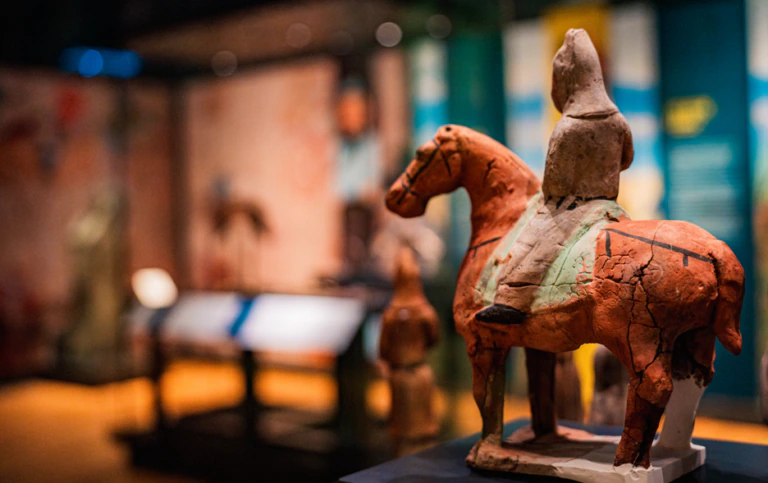
In a modern evocation of 'cabinets of curiosities' visitors can find wonderful things, such as the Eggleston urn, a Bronze Age vessel, Staffordshire and Ambleside pottery, illuminated manuscripts, 16th-century tapestries, 15th-century Flemish altar pieces and rock crystal crucifixes. Chinese patterns and doll's house furniture made from feathers vie for attention with Roman frying pans and an ancient pot with a snarling face containing the cremated remains of a dog.
Labelling is not obtrusive and the visitor needs to search for information. The aim seems to be one of gentle interrogation. What do you as a visitor make of this object, this piece of reality? It's a useful and provocative challenge.
After all, as that very curatorially minded bear Winnie the Pooh reminds us: 'When you think of things… you find sometimes that a Thing… is very different when it gets out into the open and has other people looking at it.'
I was much struck too by the involvement of Bowes with two local groups of children, the King James I Community Arts College of Bishop Auckland and Staindrop Business Enterprise College. Children from both these colleges had studied and handled objects from the main collections and had made their own works of art.
Displayed with no distinction between then and now were the most exquisite marquetry boxes, heirlooms for the future. Inspired by a 19th-century French dish with moulded decoration of fish and frogs and an 18th-century tureen in the form of a cabbage, were fabulous cast and coloured platters and pots that this reviewer both admired and coveted.
The Bowes, which previously had a reputation of genteel stuffiness, is now a much livelier place. Of course it still trades flagrantly on its Bowes-Lyon links. Watercolours and drawings from the collections of the late Queen Mother will be on display this summer, as will Rolf Harris's portrait of the Queen.
But don't be put off by over-reverential royalism. Go, take tea in Cafe Bowes, the best museum restaurant in the north-east, and do find the Streatlam Galleries and browse their displays. They stand on their own as a beautifully designed miniature museum. And at a cost of less than £500,000 they are, in these days of meaner funding for the arts, an astonishing bargain.
Peter Lewis is a writer and a past director of Beamish, the North of England Open Air Museum
Project data
Cost: £475,000
Main funders: One North East through the County Durham Economic Partnership, European Regional Development Fund, Foyle Foundation, Richard and Suzanna Tonks Fund at County Durham Foundation, Friends of the Bowes Museum, North East Regional Museums' Hub through Renaissance in the Regions and Durham County Council, Heritage Lottery Fund
Architect: Niven and Niven
Main contractor: Wood Mitchell
Under a roof of lead and slate that has perished beyond repair and needs lengthy restoration, lie a host of the most valuable collections in Britain.
It would be tempting to hold back curatorially and wait for essential restoration to be completed. Instead, under the leadership of their energetic director, Adrian Jenkins, the staff of Bowes have embarked on a programme of ambitious exhibitions, improved educational programmes and aggressive marketing. Numbers are never the only gauge of success, but over the past five years visitor figures have doubled.
Perhaps a reason for that success has been that the development work is clearly and competently explained, bears a personal signature and invites participative comment. Other museums, please note.
The great paintings, including the El Greco and the Canalettos, are still on show though in temporary galleries. Necessity has dictated that smaller pictures are hung, tier upon tier, on gallery walls, which is strange to modern tastes but an accurate reconstruction of the style of previous centuries. And the Silver Swan, though still fragile, swims on and sups on shoals of fish.
The tradition of blockbuster exhibitions has been maintained. I browsed in wonder through an exhibition of antique lace, coupled with dresses by Vivienne Westwood, which left me astounded. I had little or no previous interest in the subject, but the exhibition was simply the best designed, lit and intelligently labelled of any I have seen in the past decade.
This spring, a new suite of galleries has opened on the ground floor of the museum in space previously used as offices and storage. The intention of the Streatlam Galleries, named after the now destroyed ancestral home of the Bowes, is to introduce visitors to the fine art collections, showing how these are categorised, restored, interpreted and presented.
I must admit that reading the press releases left me agog with indifference. I have always been apprehensive when museums and galleries adopt a didactic tone, suggesting that visitors need to be tenderised or forcibly fed before being let loose on displays.
High-flown art galleries that greet visitors with gigantic labels indicating how they should be properly understood are particular hates. The aim of Bowes is to 'direct interpretation at a level based on the interaction of children with parents, grandparents etc, to encourage the act of looking, questioning and discussing'.
Displays are flexible, able to be easily changed without the need of technical support. Interactives are the simple non-breaking down sort. All very laudable. Yet despite handouts and staff encouragement, I saw little evidence that people were starting their visits in the Streatlam Galleries.
The three rooms and an introductory corridor are a total delight, not least in that some of the showcases are works of art in their own right.
These pieces of historic floor to ceiling furniture, bought by John and Joséphine Bowes in Paris, have been stripped of their inappropriate layers of paint and elegantly refurbished by a local cabinetmaker. In these and on discreet central consoles are displays on costume, carpets and textiles, on furniture and furnishings, on ceramics and fine arts.
In a modern evocation of 'cabinets of curiosities' visitors can find wonderful things, such as the Eggleston urn, a Bronze Age vessel, Staffordshire and Ambleside pottery, illuminated manuscripts, 16th-century tapestries, 15th-century Flemish altar pieces and rock crystal crucifixes. Chinese patterns and doll's house furniture made from feathers vie for attention with Roman frying pans and an ancient pot with a snarling face containing the cremated remains of a dog.
Labelling is not obtrusive and the visitor needs to search for information. The aim seems to be one of gentle interrogation. What do you as a visitor make of this object, this piece of reality? It's a useful and provocative challenge.
After all, as that very curatorially minded bear Winnie the Pooh reminds us: 'When you think of things… you find sometimes that a Thing… is very different when it gets out into the open and has other people looking at it.'
I was much struck too by the involvement of Bowes with two local groups of children, the King James I Community Arts College of Bishop Auckland and Staindrop Business Enterprise College. Children from both these colleges had studied and handled objects from the main collections and had made their own works of art.
Displayed with no distinction between then and now were the most exquisite marquetry boxes, heirlooms for the future. Inspired by a 19th-century French dish with moulded decoration of fish and frogs and an 18th-century tureen in the form of a cabbage, were fabulous cast and coloured platters and pots that this reviewer both admired and coveted.
The Bowes, which previously had a reputation of genteel stuffiness, is now a much livelier place. Of course it still trades flagrantly on its Bowes-Lyon links. Watercolours and drawings from the collections of the late Queen Mother will be on display this summer, as will Rolf Harris's portrait of the Queen.
But don't be put off by over-reverential royalism. Go, take tea in Cafe Bowes, the best museum restaurant in the north-east, and do find the Streatlam Galleries and browse their displays. They stand on their own as a beautifully designed miniature museum. And at a cost of less than £500,000 they are, in these days of meaner funding for the arts, an astonishing bargain.
Peter Lewis is a writer and a past director of Beamish, the North of England Open Air Museum
Project data
Cost: £475,000
Main funders: One North East through the County Durham Economic Partnership, European Regional Development Fund, Foyle Foundation, Richard and Suzanna Tonks Fund at County Durham Foundation, Friends of the Bowes Museum, North East Regional Museums' Hub through Renaissance in the Regions and Durham County Council, Heritage Lottery Fund
Architect: Niven and Niven
Main contractor: Wood Mitchell