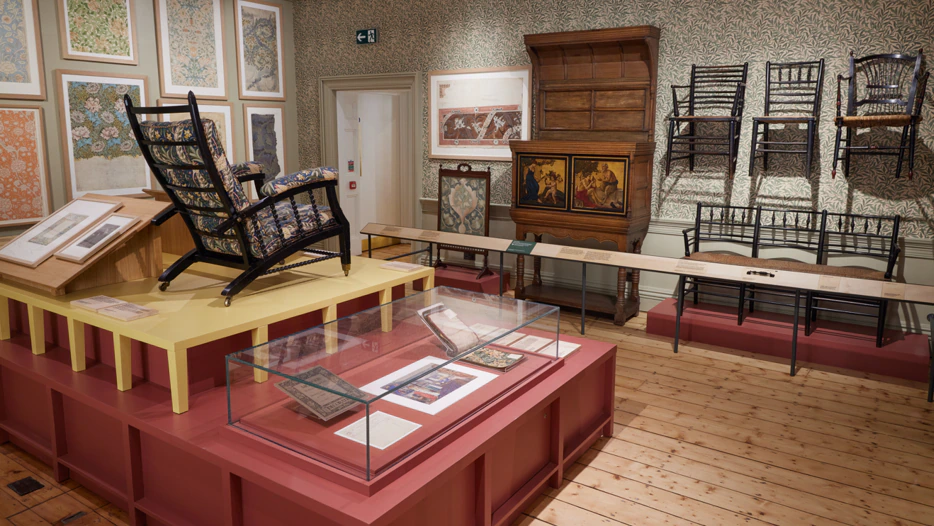
The William Morris Gallery has reopened following a major rehang of its galleries to offer “new perspectives” on the artist’s life, works and legacy.
“At a time where the national institutions continue to mount multi-million pound extensions and new glass and steel wings designed by starchitects, this is a local project that has involved many voices and practitioners from the very start,” said Hadrian Garrard, the director of the William Morris Gallery.
“We have the same level of ambition and reputation as any national museum, but in the spirit of Morris, this is an intricate and collaborative capital project that has sustainability at its heart.”
The gallery and Sam Jacob Studio have worked with local residents and community groups to foreground the contributions of women artists in Morris’s circle, such as his daughter May Morris and Arts and Crafts artist and designer Kate Faulkner.
The new galleries also explore the impact of South Asian and Islamic art on Morris’s designs, with his personal copy of One Thousand and One Nights (a collection of North African, West Asian, Central Asian and South Asian folktales) on display for the first time.
Other items from the collection now available for visitors to see are Morris’s banner for the Hammersmith Socialist League, of which he was founder and an active member, and May Morris’s flower garden embroidery designs. A lock of Morris’s hair, cut from his head after his death by his close friend and fellow socialist John Carruthers, is also on display.
Advertisement
“These new displays explore the creative collaborations, experimentation and commitment to meaningful work that sat at the heart of Morris’s vision,” said Rowan Bain, the principal curator at the gallery.
“We hope visitors leave with a deeper understanding of why Morris and his contemporaries continue to inspire us: through their belief that art, creativity and collective action can help shape a better world.”
This project was funded by the Garfield Weston Foundation and the Wolfson Foundation.
Next year, the gallery will announce the first in a series of new commissions from contemporary artists and designers who will create new works in response to Morris’s ideas and influences.
Situated in the house where Morris lived as a teenager in Walthamstow, the William Morris Gallery has welcomed more than 1.6 million visitors since it reopened in 2012.