The Public and Commercial Services (PCS) union has warned that a planned voluntary exit scheme at the Victoria and Albert Museum (V&A) could put additional pressure on employees and affect service delivery.
The exit scheme, which covers all of the V&A’s sites, was announced to staff last month. It comes amid ongoing industrial action by union members of PCS and Prospect over pay and working conditions at the institution’s London venues.
The V&A said the voluntary staff cuts are necessary to tackle rising operating costs driven by inflation, economic uncertainty and reduced visitor spending.
“While we continue to receive government support, below-inflation settlements mean a real-terms reduction in funding over the coming years,” said a statement from the V&A.
“As a result, our organisational strategy for 2026-2030 is underpinned by a cautious approach to financial planning and we’re exploring a wide range of measures to reduce costs, including launching a voluntary exit scheme.”
According to the V&A, the exit scheme is “entirely voluntary” and open to staff across the institution. Applications will be reviewed based on the skills, experience and operational needs of the V&A.
Advertisement
A spokesperson for PCS told Museums Journal that it had received little information from the V&A about the exit scheme.
The spokesperson said V&A management had cited a projected cumulative operational deficit of £19m by 2030 as a reason for the scheme, despite the institution holding £72m in its reserves.
The union warned that cutting posts would place extra pressure on staff.
“We as a union believe that reducing staffing levels will obviously place additional pressure on remaining workers, with some teams potentially unable to absorb further cuts without affecting working conditions and service delivery,” a PCS spokesperson said.
An anonymous V&A staff member who spoke to Museums Journal said colleagues were concerned that the scheme could lead to further reductions in staffing.
“We are worried that management will leap on this opportunity to cut staff even further than they did in 2021 [when the V&A restructured due to the pandemic],” they said.
Advertisement
“We just can't see where else they could possibly cut from. We are already at our absolute limit in terms of workload. We are pushed to do more and more with less staff.”
The employee said the V&A workforce had experienced significant pressure following the Covid restructure.
“During Covid we lost hundreds of colleagues through a massive redundancy process and we took two huge real-terms pay cuts when inflation was at 10%,” they said.
“Those of us that are left are having to work even harder to make up for the incredibly talented staff that we lost, with less money in our pockets. We've finally reached breaking point.”
The employee said staff were also frustrated by the timing of the announcement, which came the day before a two-day strike began at the V&A's South Kensington site on Friday 25 September.
“I understand that management say they want to cut staff to avoid possible future budgetary issues but it feels punitive,” said the staff member. “They announced it to us in an all-staff meeting the day before we were due to take strike action at South Kensington.”
Advertisement
The V&A told Museums Journal that the £72m it holds in reserves is not available for core spending.
“The £72m figure refers to our reserves, which were intentionally built up during a period of strong commercial performance to help secure our long-term financial sustainability,” said the V&A. “They are not general funds available for day-to-day spending.”
Industrial dispute
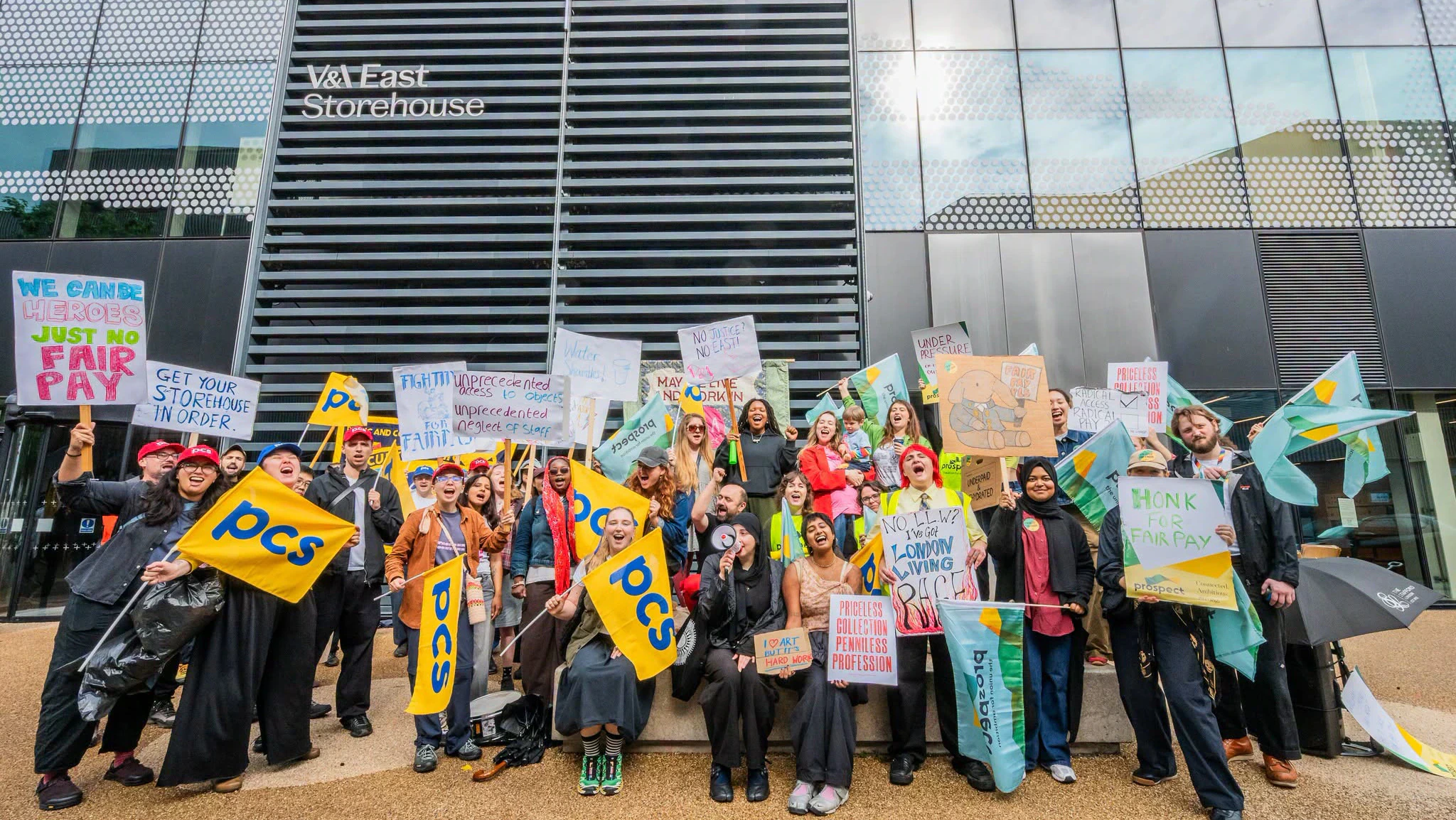
The dispute over pay and conditions has not yet been resolved. Union members have so far staged two separate walkouts at a number of the V&A's London sites, with parts of the institution closed for a total of four days during September. The most recent strike took place at the V&A South Kensington, with pickets and rallies held at the Cromwell Road entrance.
PCS is seeking a 4% increase for staff above the London Living Wage, which it has calculated would cost around £500,000 a year more than the 3.25% increase already offered.
The V&A said it had been negotiating with trade unions “in good faith” since February and had met the majority of their demands with a “fair, competitive and affordable” offer.
The institution said its latest offer represented an average pay rise of 4.18%, with a 6.9% increase for its lowest-paid staff. It also includes an increase in bank holiday pay to 1.5 times the normal rate, a bonus scheme and subsidised food at all V&A sites.
The institution is not currently accredited with the Living Wage Foundation but has committed to reviewing this by December. “All V&A staff are paid the London Living Wage and have been for many years,” said the institution.
The anonymous staff member said the dispute was about both pay and working conditions.
“We are striking because we want fair pay and safe working conditions. It doesn't feel like a lot to ask for,” they said. “Yet so many of us are struggling to cover the basics, like rent, groceries and travel costs, all the while being asked to work in unsafe environments – in extreme temperatures or without consistent access to water.”
There is also frustration among staff about the V&A's investment in its buildings and galleries at a time of increasing pressure on staffing and pay.
“We are told there just isn't any money for basic cost-of-living pay increases but there is enough money to open three new or completely refurbished museums in four years,” they said. “We are currently renovating several permanent galleries at a cost of millions but the people asked to deliver those projects are doing it with less resource and for poor pay. People are fed up.”
The V&A said the safety and wellbeing of staff was “of the utmost importance” and rejected the suggestion that employees lack access to basic facilities and breaks.
The museum said it had introduced new measures during the summer's heatwaves, including additional breaks and staff rotations.
At V&A East Storehouse, water fountains are available on every floor, while front-of-house and collections access staff have a one-hour lunch break and two additional paid 15-minute breaks each day. Both V&A East sites have air-cooling systems. Six galleries and public spaces at V&A South Kensington closed during the hottest days, while the Young V&A closed in its entirety.
The anonymous employee said staff would like to see the institution take a different approach in its relationship with union members.
“We need to see a completely different approach to engaging with staff members in the unions,” they said. “The unions are how we use our collective voice to demand the changes we want to see and it's time management realised that, stopped fighting us and started working with us.”
The V&A said it remained available for negotiations with the trade unions.
“We value all our staff enormously and maintain positive two-way communications through a variety of different means,” it said.
“Staff from across the organisation have been involved in the development of the organisational strategy, and we have been open and transparent about the need to respond to the financial challenges faced by us and the wider sector.”
Response from the V&A in full
Strike action and pay
We deeply regret that the trade unions have voted for strike action. We have been negotiating with them in good faith since February and have met the majority of their demands with a significantly improved offer, which we believe is fair, competitive and affordable.
We value our staff enormously and remain fully committed to providing safe, supportive working environments in all our museums. Our latest pay offer delivers a pay rise well above inflation for all staff, with an average 4.18% pay rise and a 6.9% increase for our lowest-paid colleagues; a bank holiday pay rate increase to 1.5, alongside a sector-leading bonus scheme and a subsidised food offer at all of our sites.
All V&A staff are paid the London Living Wage and have been for many years. The vast majority of contracted roles are also paid the London Living Wage. The V&A has already made a commitment to the trade unions that we will review LLW accreditation by December this year.
We remain available for negotiations with our trade union colleagues.
Voluntary exit programme
Like many organisations, the V&A is facing rising operating costs, driven by inflation, economic uncertainty, and reduced visitor spending. While we continue to receive government support, below-inflation settlements mean a real-terms reduction in funding over the coming years. As a result, our organisational strategy for 2026-2030 is underpinned by a cautious approach to financial planning and we’re exploring a wide range of measures to reduce costs, including launching a Voluntary Exit Scheme.
The Voluntary Exit Scheme is entirely voluntary and open to staff across the museum. Applications will be reviewed based on the skills, experience and operational needs of the V&A.
Working conditions
The safety and wellbeing of our staff is of the utmost importance to the V&A – all our staff have regular access to water, toilet facilities and breaks while at work.
V&A East Storehouse has water fountains on every floor to ensure that both staff and visitors in Front of House areas have access to drinking water throughout the building, which also has an air-cooling system. Both our front-of-house and collections access staff have a one-hour lunchbreak and two additional paid 15-minute breaks daily. If staff require a break outside of this, they can swap out with their colleagues as needed.
Extensive heatwave mitigations have also been put in place across our museums. During the recent heatwaves we implemented extensive mitigations across all sites to support staff including increasing regular breaks and staff rotations between galleries.
This included closing six galleries and public spaces across V&A South Kensington and shutting Young V&A in its entirety on the hottest days. Both of our V&A East sites, V&A East Storehouse and V&A East Museum have air cooling systems to maintain consistent environmental conditions, including maintaining a cool temperature.
Finances
The £72m figure refers to our reserves, which were intentionally built up during a period of strong commercial performance to help secure our long-term financial sustainability. They are not general funds available for day-to-day spending.
Staff and union relations
We’ve been negotiating with the trade union in good faith since February and have met the majority of their demands with a significantly improved offer, which we believe is fair, competitive and affordable.
We value all our staff enormously and maintain positive two-way communications through a variety of different means. Staff from across the organisation have been involved in the development of the organisational strategy, and we have been open and transparent about the need to respond to the financial challenges faced by us and the wider sector.