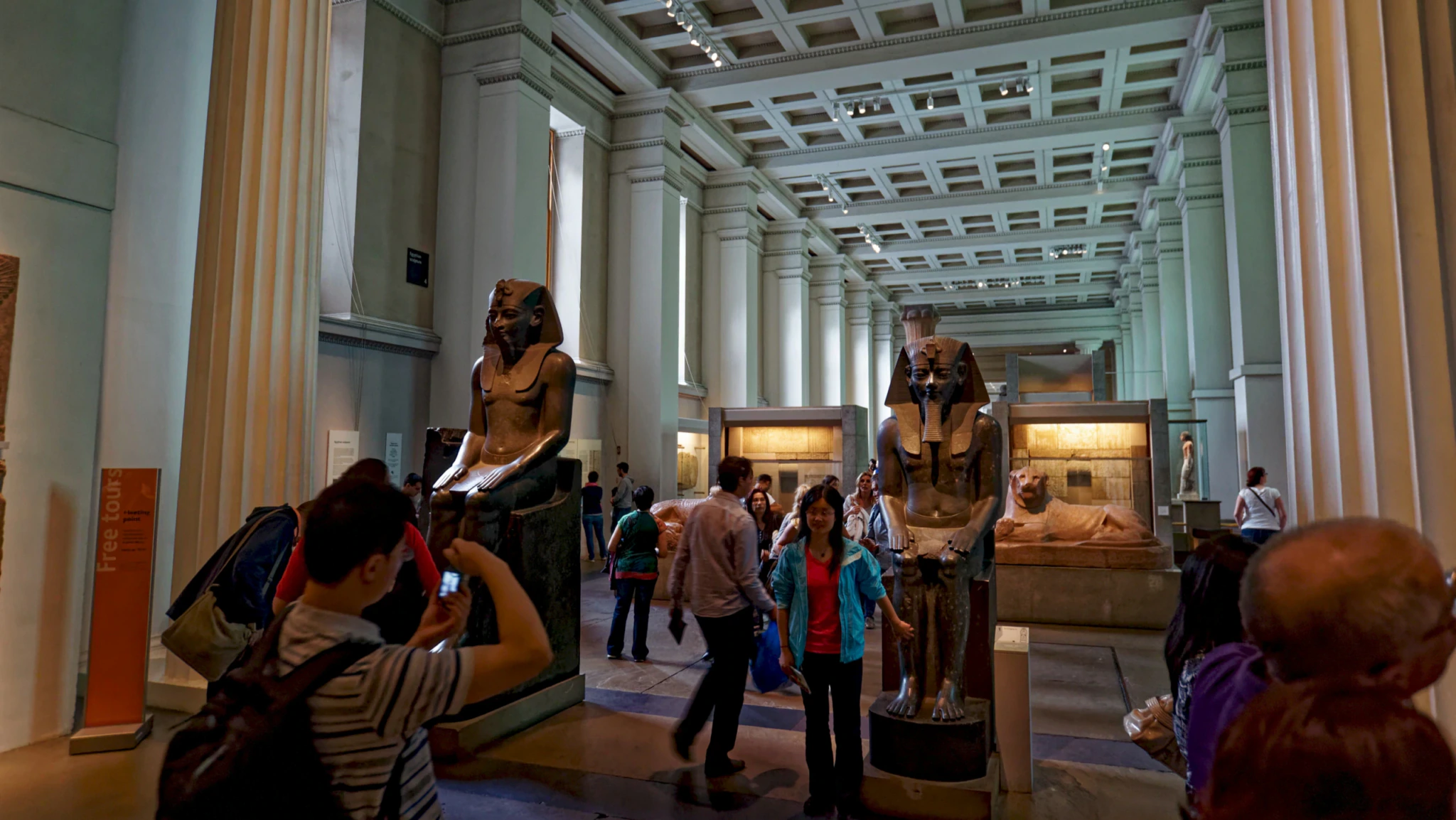
A dispute over terminology at the British Museum (BM) has taken a fresh turn after the release of internal emails under the Freedom of Information (FOI) Act.
The controversy came to light earlier this year when it was reported that the British Museum had removed terms such as “Palestine”, “Palestinian” and “Israelite occupation” from some of its displays on the ancient Middle East, including maps and information boards about ancient Egypt and the Phoenicians. In one example, the phrase “rulers of Palestinian descent” was changed to “rulers of Canaanite origin”.
The association of pro-Israeli lawyers, UK Lawyers for Israel, claimed at the time that these changes had been made after it raised a complaint that the displays featured “historically inaccurate and misleading descriptions” to “describe the region now comprising Israel and surrounding areas during historical periods when that name did not exist”.
The news prompted an outcry from pro-Palestinian campaigners and a complaint from the UK’s Palestinian ambassador.
The British Museum has strongly rejected claims that the changes came in response to external lobbying, saying they were driven by curatorial decision-making.
In a statement in February, the BM said audience testing had shown that for many visitors, the term Palestine “no longer holds a neutral designation and may be understood in reference to political territory”.
Advertisement
In a social media post at the time, the historian William Dalrymple said BM director Nicholas Cullinan had called him to say that curators “had thought long and hard” about altering the terminology, and that the changes had been made during a gallery refresh last year, before the complaint was raised. Dalrymple said Cullinan had told him that he had not seen the complaint from UK Lawyers for Israel.
However, emails obtained by the Middle East Eye via FOI show the museum received “a series of private and public complaints by pro-Israel activists” in 2024 prior to changing the displays.
The museum's FOI response showed that no specific audience testing was carried out on the term 'Palestine'. In its response, the BM said that “while we do not currently hold records of specific audience testing research on the term ‘Palestine’, a body of research, carried out over many years, has found that visitors struggle to understand historic geographical terms used by scholars”.
According to the Middle East Eye, some changes appeared to have been made in direct response to external communications and not during the process of a gallery refresh, with some changes made “hours after receiving one complaint”. The publication also reported that the UK Lawyers for Israel complaint was addressed directly to Cullinan and “flagged” by staff for his office.
The Palestinian ambassador, Husam Zumlot, and other pro-Palestinian campaigners have called on the museum to clarify the situation and restore the original labels.
Zumlot told the Middle East Eye that “from day one, the British Museum’s story did not add up”.
Advertisement
“By removing references to Palestinian history, the British Museum is betraying their commitment to history and allowing themselves to be used for political purposes,” he added.
“We will continue to work and communicate with all relevant bodies to make this message loud and clear, until the original labels are restored.”
The pressure group Energy Embargo for Palestine, which campaigns to halt energy supplies to Israel during the current conflict and has organised several protests against the BM, said the incident “[makes] a mockery of the pretense that the British Museum is in anyway impartial or apolitical”.
The anti-fossil fuel, pro-Palestinian campaign group Culture Unstained said the removal of the terminology may have been in breach of the Museums Association’s Code of Ethics, which obliges museums to resist external attempts to “unduly influence practice and strategic decision-making" for private or political interests.
The findings suggest that the museum “has been swayed by undue political influence, which appears to have then undermined ethical and curatorial practice”, said Chris Garrard of Culture Unstained.
“The Museums Association's Code of Ethics is clear that museums need to 'ensure that decision making is based on best professional practice, is open and transparent, and delivers public benefit',” he added.
Advertisement
Garrard has called for an independent investigation into the events.
Some Jewish commentators have defended the museum for making the changes, saying the previous terminology undermined ancient Jewish ties to the land. In a piece about the British Museum, the historian Keith Feldman wrote in Jewish News this week that “the very existence and authenticity of ancient Jewish history are increasingly called into question”.
A number of the complaints raised also expressed concern that the previous terminology used in the museum could put Jewish communities at risk at a time of heightened tension, particularly a statement in a permanent gallery panel on the Phoenicians saying that “Israelites occupied most of Palestine”, which one private complaint said could “justify attacks against Jews”.
The BM says the term Palestine is still in use in its galleries. A statement from a spokesperson to the Middle East Eye earlier this month said: “It has been reported that the British Museum has removed the term Palestine from displays. It is simply not true. We continue to use Palestine across a series of galleries, both contemporary and historic.”
Museums Journal has contacted the BM for comment.