
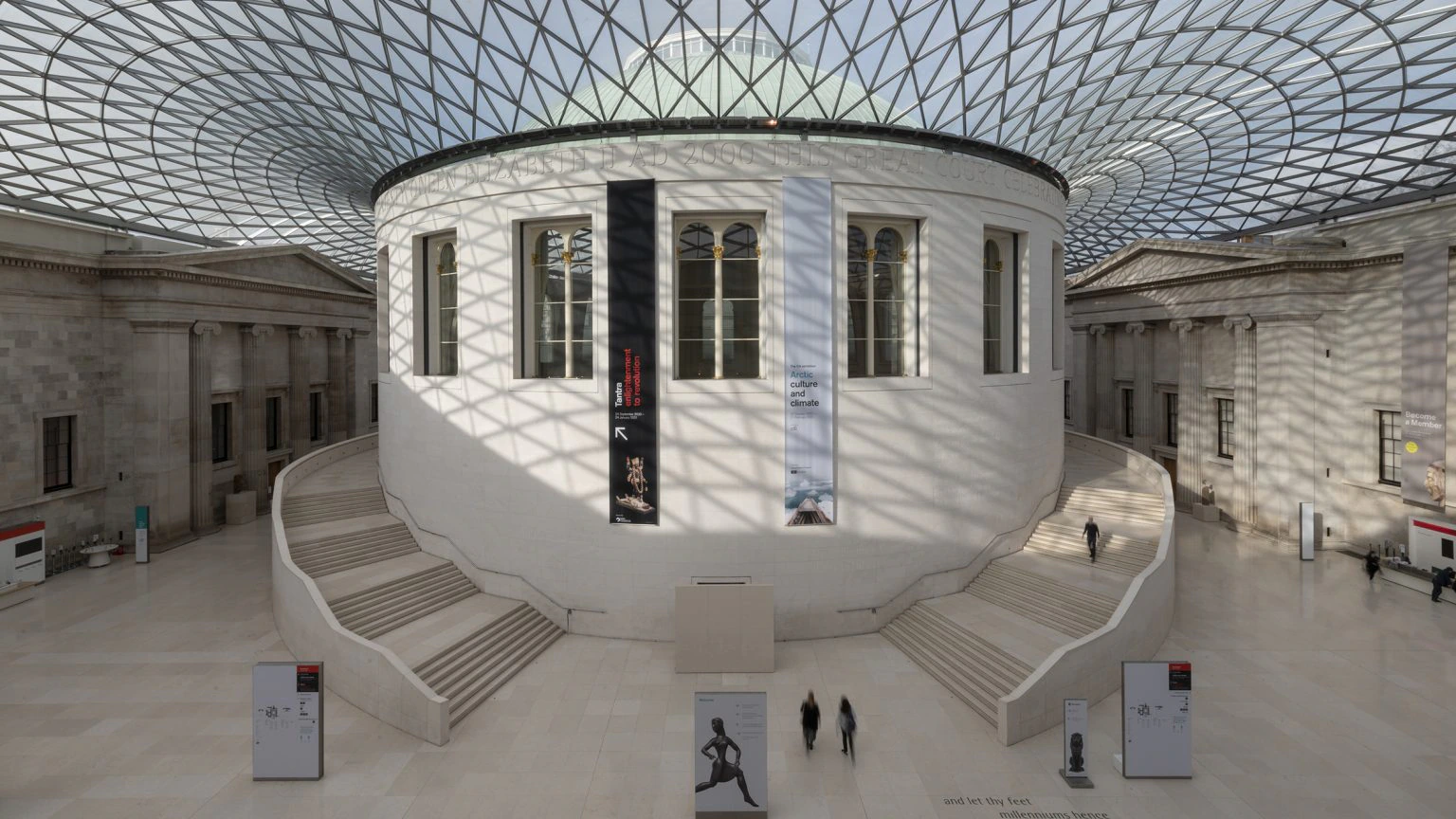
The British Museum has rejected a claim that it removed the term “Palestine” from its displays in response to pressure from a pro-Israeli lawyers group.
The Sunday Telegraph reported yesterday that the Bloomsbury museum had withdrawn terminology related to Palestine from “several of its displays” on the ancient Middle East, including maps and information boards about ancient Egypt and the Phoenicians.
The newspaper claimed the institution had done so after a complaint from UK Lawyers for Israel, an association of pro-Israeli lawyers, that the museum was using the term “retroactively” to describe regions and civilisations that existed before it was coined.
According to the Telegraph, the group wrote to the museum’s director Nicholas Cullinan stating that “applying a single name – Palestine – retrospectively to the entire region, across thousands of years, erases historical changes and creates a false impression of continuity”.
UK Lawyers for Israel said on its website that a British Museum spokesperson had told the group that it was reviewing and updating some gallery panels and labels because “audience testing has shown that the historic use of the term Palestine … is in some circumstances no longer meaningful”.
The group said in a statement that it welcomed the museum’s “willingness to review and amend terminology which is inaccurate or liable to convey an incorrect meaning today”.
Advertisement
A spokesperson for the British Museum confirmed to Museum Journal that the museum had changed a small number of panels, but made clear that no text had been altered in response to the UK Lawyers for Israel complaint, and that museum staff “began their review and update of the labelling over a year ago”.
The spokesperson said: “For the Middle East galleries for maps showing ancient cultural regions, the term ‘Canaan’ is relevant for the southern Levant in the later second millennium BC.”
The term “Palestine” is still in use elsewhere in the galleries, added the spokesperson: “We use the UN terminology on maps that show modern boundaries, for example Gaza, West Bank, Israel, Jordan and refer to ‘Palestinian’ as a cultural or ethnographic identifier where appropriate.”
The museum spokesperson said that while the term “Palestine” had previously been considered neutral for the region, for many people the term “no longer holds a neutral designation and may be understood in reference to political territory, which is why we use UN terminology”.
“Some of the BM's graphic panels date from the earlier period of the understanding of the term and these are being reviewed as part of plans for refurbishing these spaces,” added the spokesperson.
The Scottish historian William Dalrymple, who had criticised the museum’s decision to remove the term, wrote today on X that Cullinan had called him to say the Telegraph story was a “complete misrepresentation of the facts”.
Advertisement
According to Dalrymple, the British Museum director told him that the museum was “not removing mention of Palestine” from its labels and currently has a display about Palestine and Gaza.
Cullinan confirmed that the museum had altered two panels in its Ancient Levant gallery last year during a regular gallery refresh, “when some wording was amended to reflect historical terms”.
Dalrymple said Cullinan told him that the labelling change was “something our curators have thought long and hard about”.
According to Dalrymple, the British Museum director said he had known nothing about the UK Lawyers for Israel complaint until after the Telegraph story was published, and was “disgusted by the whole thing”.
A petition calling on the museum to reinstate the terminology has been signed by more than 7,360 people so far.
The petition argues that the removal of the term “is not supported by historical evidence and contributes to a wider pattern of erasing Palestinian presence from public memory”.
It adds: “If the British Museum is genuinely concerned about modern etymology, then consistency would require similar scrutiny of terms such as ‘Britain’, which is itself a relatively modern political construct. Yet ‘Britain’ remains unchallenged in the museum’s own galleries.
“This selective removal suggests inconsistency in curatorial standards and raises concerns about political pressure influencing historical presentation.”
The British Museum needs to come with a clarifying statement. If – as UKLFI claims – the decision to remove the word “Palestine” from several displays was made at its request, then this could rightly be interpreted as yielding to political pressure from a pro-Israel lobbying organisation.
I have an interest in contemporary and ancient history of Palestine going back more than 50 years. In 2018 I read “Palestine. A Four Thousand Year History” by Professor Nur Masalha, historian and academic at SOAS, University of London. It is a wide ranging book. He demonstrates convincingly that “Palestine”, indicating the geographical region in the southern Levant between the Mediterranean Sea, the Jordan River and the Red Sea is the name most commonly used from the Late Bronze Age (from 1300 BC onwards) to the modern period. The Egyptian name for Palestine (Peleset) first occurs in the 13th century BC and is not witnessed in any earlier historical source. So it would be inaccurate to use the name Palestine for the region before the 13th century. However, to be historically accurate one should point out that the name of the region of Palestine prior to the Late Bronze Age is simply unknown.
From the Late Bronze Age onwards, the names used for the region of the southern Levant, such as Djahi and Retenu (1500s-1200s BC) or Cana’an (1400s-1300s BC) all give way to Palestine, which from then on becomes the most commonly used name to the present day, including by academia.
An example of this is the posthumous publication in 1993 of “The History of Ancient Palestine”,
by Gosta Ahlstrom, a Swedish professor of Old Testament and Ancient Palestinian Studies at the University of Chicago. The research for his magnum opus extended from the earliest times to Alexander’s conquest.
The UKLFI claim of the British Museum’s terminology being “inaccurate” or conveying an “incorrect meaning” or that the term “Palestine” is in some circumstances “no longer meaningful” is in my opinion motivated by ideological, not scientific considerations.
By all means, let’s have a proper debate about ancient Palestine. But I cannot believe that the British Museum would yield to political pressure from UKLFI.
That is why a clarification by the British Museum of what actually happened with regards to changing the displays in the Ancient Middle East galleries is urgently needed.