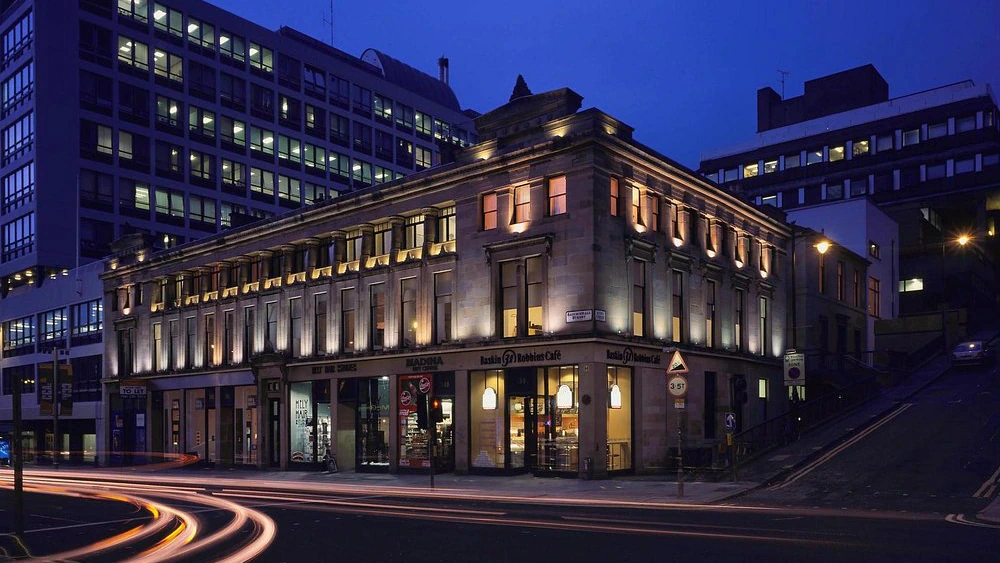
A protest took place in Glasgow last week against the proposed sale of the building that previously housed the city’s Centre for Contemporary Arts (CCA).
The CCA became insolvent and entered liquidation in January, citing significant financial pressures. All 39 staff at the venue were made redundant.
The building at 350 Sauchiehall Street is owned by the Scottish Government’s arm’s-length funding body, Creative Scotland. Before becoming home to the CCA in 1992, it housed Glasgow’s legendary Third Eye Centre, the arts and music venue credited with transforming the city’s culture scene from the 1970s onwards.
At the time of the CCA’s closure, Creative Scotland said it was exploring options and aimed to reopen the building as a cultural resource as soon as possible.
The Scottish culture secretary Màiri McAllan confirmed earlier this month that Creative Scotland was working “on an open process for [the site’s] future with the intention to sell the building as a cultural asset”.
In response to parliamentary question about the site’s reopening, McAllan said: “The insolvency of the Centre for Contemporary Arts (CCA) is an ongoing legal process.
Advertisement
“The Scottish Government appreciates the challenges that this has created for the staff affected and for Glasgow’s cultural community more broadly.
“The Scottish Government’s preference is to see 350 Sauchiehall Street re-open as an important asset to both Glasgow’s and Scotland’s culture and creative sector.”
A number of bids have been floated for the future use of the building. The group ScotsRock is proposing to transform it into Scotland’s first dedicated Rock 'n' Roll Hall of Fame, a plan backed by high-profile musicians including Midge Ure, Lulu, Jim Kerr of Simple Minds, Travis, and Del Amitri.
Meanwhile a collective of independent Scottish theatre and dance companies – including Vanishing Point, Groupwork, Shotput, and Superfan – is seeking to preserve the building as an artist-led space for rehearsals, international collaborations, and community performances.
However the planned sale of the site has been heavily criticised, with 50 artists, local residents and former CCA workers gathering outside the building in protest on 8 July.
Reflecting the concern of local residents, the Blythswood and Broomielaw Community Council said: “Glasgow is undergoing an epidemic of closures of community buildings. The CCA is just one of a growing number of spaces under threat of closure. This is undoing decades of work to build the cultural and community infrastructure that underpins civic life in Glasgow.”
Advertisement
The Save Our CCA campaign group said there was “no guarantee” that the building would continue to be used for cultural purposes after the sale.
“Arts organisations will not be able to bid competitively for the building,” said the group. “And if they remain, they will do so as private tenants, paying rent to a private landlord. Even if the building remains in cultural use, those purposes could be irrelevant to Glasgow's arts community such as the proposal to turn the CCA into a Rock and Roll museum.”
The group said the sale did not make financial sense for Creative Scotland. “Ironically, because Creative Scotland is the main funder of many arts organisations, any rent paid would ultimately be funded through Creative Scotland grants,” it said.
Save Our CCA also highlighted “strong local concern” about the lack of transparency around the liquidation of the venue.
“Thirty-nine jobs were lost, and workers were left unpaid,” said the group. “It wasn’t a consequence of a lack of funding: Creative Scotland had agreed to provide £3.4m over three years. Even worse, there has been no investigation into the board despite allegations of financial mismanagement and workplace bullying.”
The group also expressed concern about the removal of the CCA’s digital archive, which dates back to 1975 and features recordings of performances by cultural icons such as Allen Ginsberg. “This represents a deliberate erasure of the artistic and radical history of the Third Eye Centre/CCA,” said the group.
Advertisement
Creative Scotland has been criticised for failing to engage with the community following the closure.
One protester said: “There is no lack of will to reopen the space, including proposals put forward by theatre companies. It is a travesty that Creative Scotland has not actively engaged with the creative community during the process of deciding the building's future.”
Several MSPs have raised concern about the sale. A parliamentary note signed by Jackie Baillie, Katy Clark and Pauline McNeill asked that parliament “calls on the Scottish Government to safeguard the Centre for Contemporary Arts Archive collection and to ensure it is transferred into the safekeeping of an appropriate public archive”.
As an alternative to proceeding with the sale of what they described as a key public asset, the MSPs said a “clear, actionable timeline should be established to facilitate the reopening of the CCA as a vital cultural asset for Glasgow, governed by a new operating body while being retained under public ownership”.
The MSPs have called on the Scottish Government to “engage with all relevant stakeholders to ensure that the site is preserved for the public and the arts community as a functioning cultural space under public ownership”.
A spokesperson for Creative Scotland said: “We have yet to open a formal process to invite interest in the building.
“The insolvency process for the CCA organisation is still in progress, and we are ensuring that the building is safe and secure during the period of closure.
“We will be issuing a further update as soon as appropriate.”