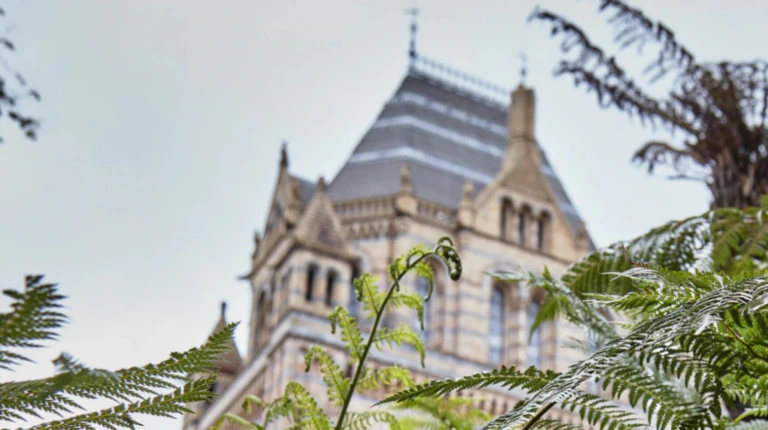

The Natural History Museum has broken the all-time record for footfall at a UK museum or gallery, attracting 7,116,929 visits in 2025.
The Association of Leading Visitor Attractions (Alva), which publishes its annual visitor figures table today, said total footfall at its 409 member attractions had risen by 2% in 2025 to 165 million.
In general, it was another variable year for visitor numbers, which remain 7% lower overall than before the pandemic. The rate of growth has slowed since the previous year, when visitor figures rose by 3.4%.
The Natural History Museum overtook the British Museum to claim 2025’s top spot, reporting a 13% increase in footfall. It is the third time the South Kensington institution has topped Alva’s most-visited list since the Covid pandemic, and the museum’s latest figures are now 31% higher than they were pre-pandemic in 2019.
The boost in visitors comes after several capital developments and innovations at the museum, including the unveiling of its reimagined garden spaces in 2024. In 2025 the museum launched Fixing Our Broken Planet, a new permanent gallery dedicated to the planetary emergency, which has since been visited by more than two million people, as well as Our Story with David Attenborough, its first ever immersive cinematic experience, which attracted more than 133,000 visitors.
The museum is currently creating more free-to-visit space for visitors through its NHM150 capital development programme, which will see a new or revitalised permanent gallery open every year until the museum’s 150th anniversary in 2031.
Advertisement
“We are thrilled to be the UK’s most popular visitor attraction, smashing all previous records for the sector,” said the museum’s director Doug Gurr.
“These exceptional results reflect our unwavering focus on delivering a fantastic day out for every visitor, as well as the dedication of our colleagues who work tirelessly to create unforgettable experiences and world-class exhibitions.”
London
The British Museum came in second place with 6,440,120 visitors – a slight drop on 1% on the previous year but 3% higher than its 2019 figures.
Tate Modern took the fourth spot, just behind Windsor Great Park, with 4,514,266 visitors – a 2% drop on 2024. The London gallery is still struggling to regain its pre-pandemic figures, with footfall remaining 26% lower than in 2019 – a drop it has attributed to the decline in overseas tourists. In 30th place, Tate’s other London gallery, Tate Britain, saw a drop of 6% on 2024 and recorded 36% less footfall than in 2019.
The National Gallery reported a significant increase of 29% to 4,147,544 visitors following the reopening of its renovated Sainsbury Wing and the closing celebrations of its bicentenary year, although footfall at the institution still remains 31% lower than it was in 2019.
Advertisement
Visits to the Victoria & Albert Museum’s (V&A) South Kensington site – in fifth place on the list – were down 5%, and remained 16% lower than in 2019. However the institution’s new open storage site in east London, the V&A East Storehouse, welcomed 416,300 visitors in less than seven months following its opening in May 2025, beating targets. Meanwhile, visitors to the Young V&A remained steady at 604,900, the same level as 2024.
The most visited paid-for attraction was the Tower of London, in 9th place with 2,817,852 visitors, a drop of 3% on 2024. The Science Museum and Royal Museums Greenwich, in 10th and 11th place respectively, also reported decreases of 5% and 7%. Both institutions saw around a fifth fewer visitors than they did in 2019.
Scotland
In 12th place, Edinburgh’s National Museum of Scotland was the first museum outside London to appear on the list, with 2,318,305 visitors, almost the same as the previous year. Footfall at the institution was 5% higher than it was pre-pandemic.
In 15th place, Edinburgh Castle remains the most visited paid-for attraction in Scotland, with a 3% increase in visitors to 2,044,96. The heritage site is gradually moving towards its pre-pandemic visitor levels, with footfall 6% under what it was in 2019. The National Galleries Scotland: National welcomed 2,004,777 visitors and came in 16th place – 27% higher than in 2019, when it was undergoing redevelopment.
Glasgow’s Kelvingrove Art Gallery and Museum saw a 3% increase to 1,219,831 and moved up one place to 26th, although footfall remains 33% down on 2019. The nearby Riverside Museum came in 28th place with 1,212,151 visitors, 7% down on the previous year and 11% below its 2019 levels.
Advertisement
Northern Ireland
In Northern Ireland, Titanic Belfast came in 35th place and continued to be the nation’s most visited attraction, reporting an 8% increase to 953,554 visitors, 15% higher than in 2019. Around 15,000 visitors came in three months to view its free exhibition celebrating on the work of Lucian Freud, which ran in collaboration with the V&A.
The HMS Caroline heritage ship in Belfast, part of the National Museum of the Royal Navy, saw the largest percentage increase of 74% to 8,888 visitors, although footfall remains a significant 81% lower than it was pre-pandemic.
Hillsborough Castle, run by Historic Royal Palaces, saw a 17% increase with 129,021 visitors to bring it to 234th place. Footfall at the site was 21% up on 2019 levels.
Wales
Recovery to pre-pandemic levels remained slow in Wales, where the most-visited attraction was Amgueddfa Cymru’s St Fagans National Museum of History, which came in 77th place with 570,207 visitors. This figure was 5% lower than the previous year and remains 24% down on 2019 levels.
Similarly, National Museum Cardiff was down 5% with 356,021 visitors, bringing it to 124th place – still 25% down on its 2019 figures. The highest percentage increase in the nation was the National Wool Museum in Carmarthenshire which saw a 22% increase in visitors to 24,915, although this was still down a fifth on 2019 levels.
Rest of England
Outside London, the most popular heritage site attraction in England was Windsor Castle in 23rd place with 1,259,964 visitors. Stonehenge, run by English Heritage, came in 25th place with 1,253,405 visitors, although its figures fell by 8% on the previous year and remained 22% below pre-pandemic levels.
In 29th place, the Sainsbury Centre in Norwich, a new member of Alva, came just inside the top 30 with 1,162,650 visitors. The University of East Anglia gallery relaunched itself 2023 with a new “living art” ethos, whereby visitors are encouraged to emotionally interact with artworks, as well as a pay-what-you-can admission fee model.
One of the largest increases in visitors in England was at the National Science and Media Museum in Bradford, which moved up 181 places to 192nd with 219,867 visitors.
The museum reopened in January 2025 following an 18-month closure for redevelopment, including the launch of its permanent Sound and Vision galleries in July, as well as hosting several special events and exhibitions to celebrate Bradford’s year as UK City of Culture 2025.
Following its phased reopening in October 2024 after a period of closure for essential maintenance, Birmingham Museum and Art Gallery saw a 305% increase to 672,391 visitors and moved up 146 places to 62nd place.
Beamish, the Living Museum of the North in Durham, which was crowned 2025’s Art Fund Museum of the Year, was the most visited attraction in the north-east, with 815,075 visitors, slightly down (3%) on the previous year. English Heritage’s Tynemouth Priory and Castle saw an increase of 73% with 52,028 visitors, due to the Mouth of the Tyne Festival.
Cambridge’s University Museum of Zoology saw an increase of 66% to 260,846 visitors – moving up 52 places to 161st place.
There were some success stories in the north-west, where the Museum of Liverpool, part of National Museums Liverpool (NML) saw a 14% increase in visitors to 949,762.
NML’s Walker Art Gallery saw a 47% increase to 258,222 visitors, while the Lady Lever Art Gallery on the Wirral rose 15 places to 202nd place with 205,355 visits.
Leeds City Museum saw a 25% rise in visitors due to its successful exhibition, Miffy's 70th Anniversary, created by Dutch artist Dick Bruna.
‘Toughest year’
Alva's director Bernard Donoghue described 2025 as “financially the toughest since the pandemic” for the association’s members, citing the impact of cost pressures combined with higher visitor expectations and growing competition from other leisure activities and streaming services.
“Visitor attractions are the places that people prize most and provide the experiences that people, even in a cost-of-living crisis, are most loathe to give up,” he said. “Our visitors want to spend special time, with special people in special places.
“In a time of unpredictable futures, uncertain economics, global insecurities, economic challenges, and an ongoing cost-of-living crisis, the UK public are more tactical than ever in deciding how they spend their leisure pounds and their leisure hours. Their expectations of a great visit are higher now than they have ever been.
“The day trip to an attraction now competes within the family budget with free things to do, as well as subscriptions to streaming channels. The competition has never been greater, the choice never so broad.”
Donoghue continued: “2025 was financially the toughest since the pandemic and many of our members have had to undergo restructuring after the increase in employers' National Insurance contributions, lowering of the NI thresholds, and the above-inflation increases in the national minimum wage, implemented in April 2025, alongside the pressures of the ongoing cost-of-living crisis.”