
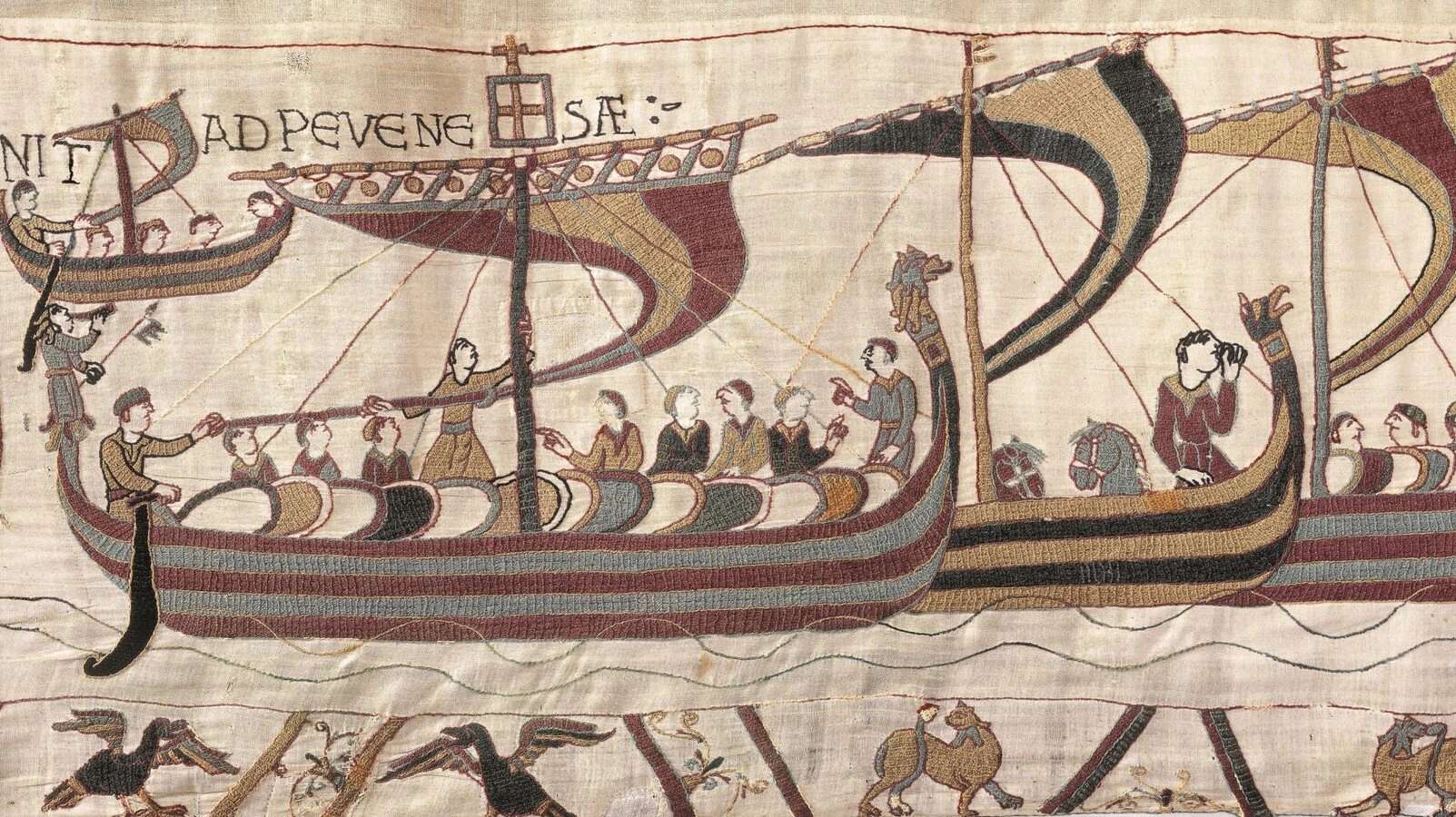
Critics of the Bayeux Tapestry loan have questioned the insurance cover provided for the artefact as part of an administrative agreement between France and the UK.
The Financial Times reported last week that the tapestry would be insured for around £800m under the UK’s Government Indemnity Scheme during its time on loan to the British Museum later this year.
The paper said the sum is more than twice the value of the most expensive artwork ever sold at auction, Salvator Mundi, Leonardo da Vinci’s painting of Jesus, which sold at Christie’s in New York in 2017 for $450m.
The indemnity valuation is yet to be signed off by chancellor Rachel Reeves.
Art experts and conservators have previously voiced concerns about the loan due to the extreme fragility of the tapestry, with more than 76,000 people signing a petition to halt the exchange.
Didier Rykner, the high-profile French art historian who set up the petition, said last week that the insurance valuation “obviously makes no sense”.
Advertisement
“Insurance must allow for the replacement of the insured object if it were destroyed. Which, in this extreme hypothesis, would obviously be impossible,” he said in an editorial in his publication, La Tribune de l’Art.
“There is nothing in the world equivalent to this work. It is not financially priceless, because, like everything, it would have a market price. But it is priceless in terms of heritage.”
Rykner said the indemnity “in no way represents real insurance” and questioned the “fine print” of the deal.
He pointed to the standard wording of the Government Indemnity Scheme, which explicitly excludes cover for damage due to “the condition of the object (including inherent vice or a pre-existing flaw) at the time of its loan”.
“It is precisely the condition of the tapestry that makes its loan impossible without major risks, and it is indeed this condition that is most likely (if one can say so) to be the cause of serious incidents it could suffer,” said Rykner.
“What would happen in such a case? The Government Indemnity Scheme could not apply. And the British Treasury would therefore be entitled not to reimburse the sums provided. Who would then be responsible, and who would pay?”
Advertisement
The English art historian Neil Jeffares, who first raised concern about this aspect of the loan agreement in December, wrote: “As is standard with the Government Indemnity Scheme there is no cover for damage from ‘inherent vice’, which of course is precisely why the insurance is unsuitable either for pastels or ancient textiles, all of whose vulnerability arises from inherent vice.”
He said his efforts to query this with the UK Government had been unsuccessful.
Jeffares added that “arrangements between DCMS and [HM Treasury] for a theoretical number have very little impact on the technical problem of avoiding damage”.
He also pointed to what he believes are several other “fallacies” being reported about the safety arrangements for the loan.
Jeffares said the stipulation that vibrations must be reduced to less than two millimetres per second during the transport of the tapestry, which “pops up… from nowhere” in the Franco-British agreement, was based on a 2022 French study that looked at “the problem from a position of the utmost generality”.
“The idea that the limit can be relied upon as a safe level for a 1,000-year-old textile is absurd,” he said.
Advertisement
Jeffares also questioned the claim that it would be safer to transport the artefact through the Channel Tunnel rather than by sea, saying “vibration studies show that sea transport is far less damaging than rail”.
He said claims that the tapestry was due to be moved anyway because of the redevelopment of the Bayeux Museum, and therefore faced the same level of risk, was also fallacious.
“Packing and repacking will be done many more times than if put into local storage, and the big risk is the long transport where vibration and shock cannot be eliminated,” he said.
Jeffares questioned whether the public benefit of the loan justified the risks involved and said these questions should be “openly debated rather than brushed under the carpet”.
French and British officials have strenuously defended the safety arrangements for moving the artefact.
British Museum director Nicholas Cullinan said last year that “experts on both sides of the Channel have been carrying out rigorous planning and due diligence to ensure the safe transport and conservation of the tapestry”.
The Franco-British loan agreement states: “It is recognised that the Bayeux Tapestry is fragile; however, advances in museum handling, preventive conservation, collection care, packing and transportation methodologies are such that risks to fragile objects like the tapestry can be managed more robustly than ever before.
“The British Museum has some of the most advanced conservation and science labs in the world, and its staff regularly care for, study, handle, move and loan organic material of equal or greater fragility than the Bayeux Tapestry, including items of some size.”
The tapestry is due to arrive in the UK this summer ahead of a nine-month blockbuster exhibition opening in September.
The Government Indemnity Scheme is estimated to have saved museums and galleries £81m compared with commercial insurance.
However the recent Hodge Review of Arts Council England called for it to be revised, finding that, since the pandemic, the scheme’s approach to risk had tightened to such an extent that “is less effective in delivering its goals”.

It would seem the loan agreement was written by government offices eager to obtain/confer prestige rather than by anyone very familiar with the condition of the object and/or importance of the tapestry to world heritage.
I was always led to believe that insurance, especially for very unusual events like this, is simply an assessment of risk. It would seem logical that the biggest risk is moving the BT at all! However, if the BM is satisfied that it can handle the move, then that’s the insurance one needs. This is a political issue driven by ego and I do ask myself who are the winners out of this ill-advised “loan”. I’m content to wait for the BT to revert to its refurbished home and visit it again then.