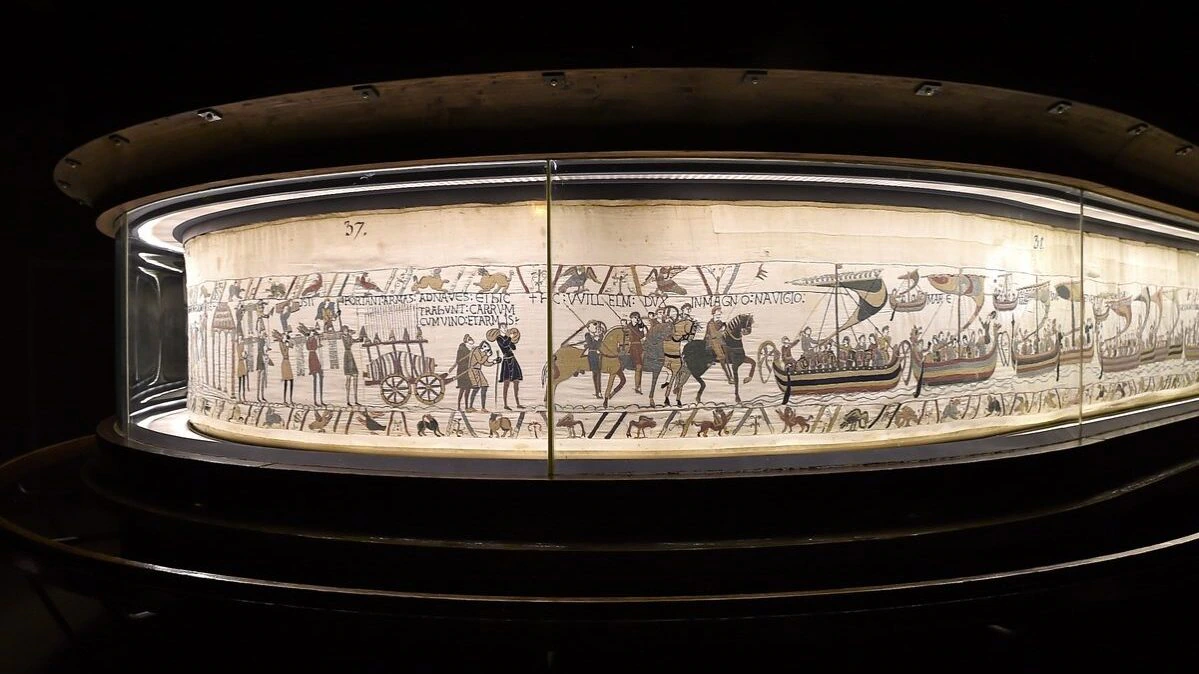
Technical experts must find a way to reduce travel vibrations to “less than two millimetres per second” during the Bayeux Tapestry’s journey to London next year, according to the terms of the loan agreement between Britain and France.
The UK Government has published full details of the administrative arrangement signed by the two countries at a Franco-British summit in July.
The document offers an insight into the complex logistical arrangements being put in place to transport the fragile embroidery to the British Museum.
According to the agreement, several chronological steps must be taken before and during the transportation process.
Prior to the 1,000-year-old artefact leaving Bayeux next year, a technical team commissioned by the French state will carry out a dry run of the entire travel route using a crate containing a facsimile of the tapestry, equipped with a vibration analysis device.
After this, the team will work to identify solutions to reduce vibrations to less than two millimetres per second, as well as creating an “international transport crate compliant with isothermal preservation standards and security requirements”.
Advertisement
The tapestry, which was packed into storage in October ahead of construction works starting at the Bayeux Museum, will be transferred into the international transport crate in summer 2026 before being handed over to an international carrier appointed by the British Museum.
The British government has agreed to provide “nail-to-nail” indemnity cover through the UK Government Indemnity Scheme, based on the value of the tapestry provided by the French state.
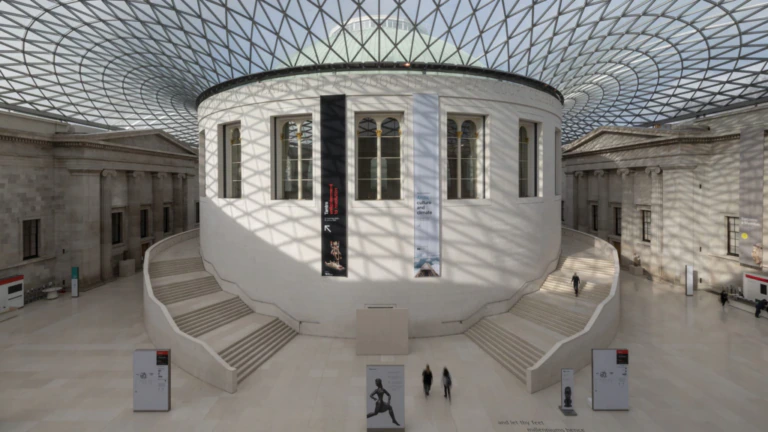
The British Museum is commissioning a purpose-built display table for the 70m-long tapestry, which will then be installed at the Bayeux Museum following the tapestry’s return to France in 2027.
The London institution will conduct a feasibility study for the table’s installation in Bayeux in coordination with the French Ministry of Culture.
The scope and cost of the technical conditions for preservation, presentation, security, safety and transport of the tapestry will be agreed between both parties.
The British Museum has agreed to meet the cost of any “studies, adaptations, and works necessary” to ensure its premises conforms to these conditions, and all other costs and expenses related to the loan and exhibition of the tapestry.
Advertisement
The installation of the artefact in London will be undertaken by a team trained by the French state and the City of Bayeux.
The loan parties will also take steps to “facilitate access by specific groups of French visitors” to the British Museum exhibition, which will run from September 2026 to July 2027.
Similar terms and conditions will apply to the loan to France of treasures from the British Museum, including the Sutton Hoo artefacts and Lewis Chess pieces. All costs and expenses related to the loan and the exhibition of those artefacts will be borne by France.
The two loans will be “undertaken in the spirit of a balanced partnership and mutual scholarly interest”, according to the agreement.
The tapestry will return to Bayeux no later than 1 September 2027.
The arrangement states that any dispute that arises between the two parties should be resolved, in the first instance, through consultations and negotiations within the framework of a steering committee.
If that fails to resolve the dispute, the parties will try to settle it “exclusively through diplomatic channels, without recourse to any international tribunal or third-party adjudication, unless mutually agreed otherwise in writing”.
The agreement was signed by culture secretary Lisa Nandy, British Museum director Nicholas Cullinan and French culture minister Rachida Dati on 9 July.