The planned loan of the Bayeux Tapestry to the UK has led to an outcry in France and sparked a debate in the cultural heritage sector over risk versus benefit.
More than 68,000 people in France have signed a petition decrying the loan as a “cultural crime” due to the fragile condition of the 900-year-old artefact.
Launched by the French art historian Didier Rykner, the petition warns that “any transport, even minimal, represents a danger” and accuses French president Emmanuel Macron of ignoring near-unanimous specialist advice and “[mocking] the experts who have the audacity to oppose his will”.
In an address at the British Museum in July, Macron acknowledged that he had overruled expert advice to push through the landmark loan agreement.
He said at the time: “I have to confess, we did our best not to be put in this situation to make the loan of the Bayeux tapestry. And we found the best experts of the world to explain in perfect detail why it was impossible to make such a loan. And believe me, we found them, and believe me, we could have found them again.”
The petition states: “This disregard for the facts and arbitrary decision pose serious threats to the work.
Advertisement
“The restorers are clear: beyond the usual hazards linked to transport (no accident can ever be ruled out), alterations already observed risk worsening, and new damage could occur. The risks identified are numerous and very probable: tears, extension of existing snags, falling material, breakage of weaving threads, etc.”
The two museums involved in the historic loan agreement, the Bayeux Museum in Normandy and London’s British Museum, have defended the plans, saying they have the expertise and skills required to safely transport and handle the medieval artefact.
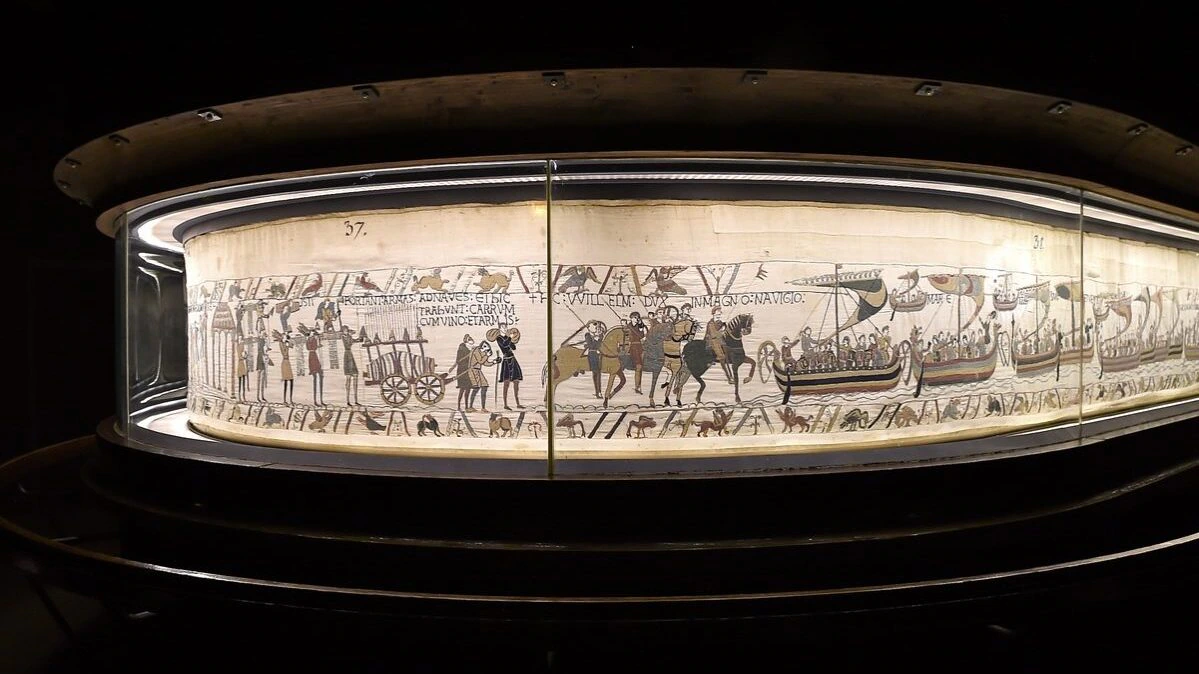
In a statement, the Bayeux Museum said: “Together, we have developed engineering solutions for its delicate handling, particularly for moving it from the vertical position in which it has been displayed since its first public exhibition in 1842 to a horizontal position for its reinstallation in the new setting.”
A British Museum spokesperson said: “The British Museum has a world leading conservation and collections management team who are experienced at handling and caring for this type of material, they are working closely with colleagues in France on the tapestry’s display.”
The Bayeux Tapestry will be displayed in a nine-month blockbuster exhibition at the British Museum, due to open in September 2026.
Sector debate
The outcry has led to debate among conservators about the balance between risk and public benefit.
Advertisement
In one such discussion on LinkedIn, Vanessa Applebaum, director of conservation at Toledo Museum of Art in Ohio, said: “In some ways it’s like every other loan of a work of art, which contends and negotiates with risk.
“We tell ourselves some outcomes are acceptable, others not, yet the line is rarely about conservation alone. For me, the real question isn’t whether there is risk, it’s who decides which risks are worth taking, and why.”
Andy Calver, a consultant at Heritage Conservation Solutions, replied: “Conservators are by nature risk adverse and textile conservators are frequently extremely conservative.
“As I understand it the tapestry has to be removed for the refurbishment of the existing display. The conservators advised that it could not be moved very far, but that's a spurious argument as the majority of risk will be when the tapestry is removed from display and packed for transit, be that distance one or 1,000 km.”
However he pointed out that displaying the tapestry at the British Museum would “double the risk involved in unpacking and packing, whatever the magnitude of that risk is”, and added that if that tapestry is cleaned, “this will result in the greatest loss of material whether this is prior to or post loan”.
Barbara Borghese, a conservator at the Victoria & Albert Museum, added: “What tips the balance is the context: political will, diplomatic value, public access, prestige for the borrowing institution, or the symbolic power of the loan.
Advertisement
“In that sense, conservation risk assessments often function less as absolute gatekeepers and more as part of a negotiation toolset. They define the thresholds of plausibility, but the decision-making authority, ministries of culture, museum directors, sometimes even heads of state, often rests outside conservation”.
The question of “who decides, and why” is key, she said: “If the ‘why’ is cultural diplomacy, national prestige, or political gesture, then the decision may be shaped by priorities well beyond the object’s long-term stability. That doesn’t make the conservation perspective irrelevant, but it shows it’s only one voice among several.”
Borghese said the “most productive discussions happen when those voices are made transparent: conservation outlines risks and possible irreversible outcomes, curators articulate scholarly/public benefits, directors weigh institutional reputation, and governing bodies or governments decide in line with broader agendas”.