Museums invited to join Accreditation redesign group
Arts Council England is recruiting eight museums to help support its redesign of the Museum Accreditation Scheme. The arts council is establishing a representative group of current Accreditation users who can support the redesign team to test emerging outputs from the programme.
The group will test content featured in the draft Accreditation Standard; explore how a museum could evidence the new standard; test elements of the new process for the scheme; and share experiences of being in the test group with the sector.
The group will be recruited to reflect the diverse typology and geography of existing scheme users across the UK, including museums that are independent, run by local authority, nationally funded, and come from single or multi-site operations.
Test group participants will be required to attend five, 90-minute online group meetings between February and April 2026.
Recruitment will be live until the 25 January. Expressions of interest can be submitted via an online form.
Advertisement
Barbican redevelopment plan approved
The City of London Corporation has approved the delivery plan for the Barbican Renewal Programme, a major investment that will secure the future of the site for the next 50 years.
The £191m City Corporation funding package – announced in December last year - aims to revitalise the centre’s creative and performance spaces to expand opportunities for formal and informal use. The Barbican’s brutalist foyers, lakeside terrace and conservatory will be restored and enhanced in this first phase of renewal, which will open up public spaces, create new experiences and upgrade vital infrastructure.
To deliver the upgrades safely and efficiently, most Barbican programmes within the centre will pause for one year from the end of June 2028 to June 2029.
Chris Hayward, City of London Corporation policy chairman, said the decision “secures the Barbican Centre’s future as a world-leading cultural and economic powerhouse.”
New home for Cosgrove Hall Films’ animation collection
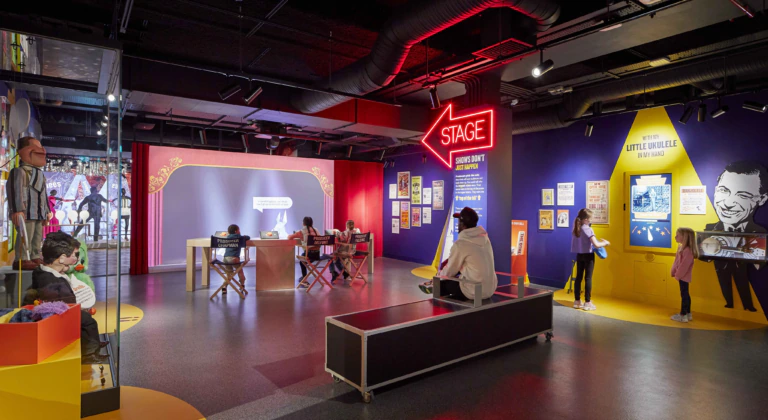
The Cosgrove Hall Films animation collection will go on permanent display in a new, purpose-built space at the refurbished Sale Library in Trafford, near Manchester.
Advertisement
From 16 January 2026, children’s characters like Danger Mouse, Count Duckula, Chorlton, Postman Pat, Noddy and the Wheelies will have a “forever home” in a dedicated gallery within library.
The collection, which is under the custodianship of Trafford’s Waterside cultural venue, features original puppets, props, sets, and script from the award-winning Manchester studio.
These will be displayed alongside the storybooks that inspired classics such as The Wind in the Willows and The BFG. Visitors will discover the history and creative legacy of the studio and explore the artistry behind the animation process.
Rosy Whittemore, the project curator at Cosgrove Hall Films Archive, says, “This is a really significant milestone for the Cosgrove Hall Films Archive. To have this incredible collection on permanent display realises an ambition the team at Waterside has held for many years.
“We know the reaction this work gets from visitors of all ages, and the power it has to ignite the imagination and bring joy. In a digital world, it’s extraordinary to be able to see the craft, dedication, and love that goes into hand-drawn and stop-motion animation.”
Courtauld unveils plans for new London campus
The Courtauld, based in Somerset House, has announced plans for a “once-in-a-generation transformation” of its London campus.
Advertisement
The £82m project, set to finish in 2029, will incorporate new teaching spaces and an underground library into the Grade I listed building. The campus will be further expanded by connecting neighbouring townhouses on the Strand to the original premises.
Sterling Prize-winners, Witherford Watson Man, will oversee the project in collaboration with architectural firms, Purcell, and Lawson Ward Studio.
The redevelopment will bring students and staff of the Courtauld Institute, whose teaching and learning have taken place in King’s Cross since 2019, together with art historians and experts of the Courtauld Gallery under one roof.
Mark Hallett, Märit Rausing director of the Courtauld, said: “We are thrilled to announce our plans for a world-class campus for the Courtauld, which will provide our students, staff and visitors with a beautiful and stimulating environment in which to learn about the visual arts.
Rijksmuseum announces new regional branch
The Rijksmuseum in Amsterdam, The Netherlands, is to open a new branch in the Municipality of Eindhoven, where future visitors will be able to see artworks from the national museum's collection. The project aims to “contribute significantly in the coming years to creating a leading cultural facility for the region”.
The Rijksmuseum in Eindhoven will be a “dynamic space that presents exhibitions from new perspectives, with a focus on creativity and craftsmanship”.
The museum will be situated in a green space on the banks of the Dommel River close to the main station.
Taco Dibbits, director of the Rijksmuseum, said: “The Rijksmuseum belongs to everyone and is open to all. It holds a world-famous collection of more than one million objects and is always seeking new ways to share the collection with people across the Netherlands. The Rijksmuseum in Eindhoven represents an important step in making the collection even more accessible in the south of the country.”
Dorset Museum & Art Gallery unsuccessful in bid for rare medieval work
A 15th century religious painting was sold for £5.7m at auction on 3 December.
The Master of the Sherborne Almshouse Triptych, an altarpiece depicting five miracles performed by Christ, had been displayed in the St John’s Almshouse in Sherborne, Dorset, for 500 years previously. The work was put on sale by trustees in order to raise money for new housing units.
The BBC reported that the painting was bought by an unnamed Christian charitable foundation, and will still be displayed publicly.
The Dorset Museum and Art Gallery had previously launched an emergency appeal to “keep this irreplaceable work in public stewardship”, attempting to raise the valuation price of £3.5. before the painting went to auction at Sotheby’s.
Appeal launched to save historic Shakespeare house
The Shakespeare Birthplace Trust - a charity responsible for the preservation of Shakespeare’s family homes - has launched a fundraising campaign to conserve the former home of Shakespeare’s daughter in Stratford, after a car crashed into it earlier this year.
The charity is seeking to raise £500,000 through its A House for All Time campaign, the proceeds from which will be used to mend damage incurred by the accident, and address underlying structural issues in the 400-year-old house.
The trust has estimated that the entire conservation project will cost £2.5m.
Donors are being invited to “adopt a beam”, symbolically funding timbers within Hall’s Croft, the Grade I listed property where Shakespeare’s daughter, Susannah, and her husband lived.
Rachael North, the chief executive of the Shakespeare Birthplace Trust, said of the building: It's not just a museum; it’s a piece of our town’s identity. We hope Stratfordians and friends around the world will rally around this campaign.”
National Trust seeks to buy land around Britain’s largest chalk figure
The National Trust has launched an appeal to help fund the purchase and care of land around the Cerne Abbas Giant, Britain’s largest chalk figure, in Dorset.
The conservation charity, backed by Stephen Fry and Countryfile TV presenter Sean Fletcher, is aiming to raise over £300,000 to purchase the 138‑hectare (340‑acre) site - equivalent to 190 football pitches - by the end of January 2026.
The landscape surrounding the Cerne Giant also houses other objects of archaeological significance, including a bronze age burial mound and earthworks for an iron age settlement.
Archaeologist Steve Timms said: “The acquisition will provide an opportunity for archaeological research and investigation on a landscape scale. This will not only help us manage the land in the most appropriate way, but also answer questions about the development of settlement and ritual activity over the area over several millennia.”
New Baltic-centred art foundation opens in London
An organisation dedicated to promoting collaboration between the Baltic and international art communities launched in London last week.
Upé Foundation will begin its work by partnering with major art institutions to host a series of Curatorial Fellowships. Applications for the first of these opportunities - one at Tallinn Art Hall in Estonia for UK-based curators; the other at Hayward Gallery for curators from Lithuania, Latvia and Estonia – open on 10 December.
Upé has further plans to partner with Camden Art Centre to host an emerging Baltic curator in Spring 2026.
Fellows will be involved in exhibition-making and public programming, and will receive institutional support and mentorship.
Adomas Narkevičius, the founding director of Upė Foundation, said: “Our vision for Upė is a channel where ideas, people and research can move in multiple directions – across different geographies and methodologies, between institutional and non-institutional settings.”
Ralph Rugoff, director of Hayward Gallery, said: ‘We are delighted to be partnering with the Upė Foundation on an initiative designed to facilitate cultural dialogue between the Baltic region and the UK. We see this as an undertaking with great potential for learning on both sides and eagerly anticipate the unfolding developments and a continued collaboration with Upė.”
Work begins to digitally preserve Antarctic expedition landmark
Digital specialists are setting out to virtually replicate the house from which Ernest Shackleton, leader of the 1916 Endurance exploration mission to the Antarctic, successfully secured the rescue of his team.
The aim of the project, overseen by South Georgia Heritage Trust and Friends of South Georgia Island, is to create a high-resolution 3D "digital twin" of Stromness Villa, South Georgia. Visitors will then be able to access the historic site in the sub-Antarctic online.
The team has partnered with the Weald & Downland Living Museum, Chichester, to test the technology before leaving for the more challenging, remote terrain.
A specialist team of heritage builders and carpenters from Norway and the UK has also been commissioned to conserve the original villa, using original craftsmanship techniques.
Alison Neil, CEO of the South Georgia Heritage Trust: “This irreplaceable piece of heritage from the heroic age of polar exploration will be stabilised and conserved for future generations.”
Clare de Bathe, museum director of Weald & Downland Living Museum said: “It’s inspiring to see how digital technology can open up new possibilities for heritage conservation. By supporting the testing of these techniques here, we’re helping make sure the story of Shackleton and the Stromness Villa can be experienced by people everywhere.”
Appeal launched to honour Scotland’s mining communities
A new public appeal in support of of National Mining Museum Scotland launched on 2 December.
The community-centred initiative aims to preserve the legacy of mining, and its role in Scotland’s national heritage.
The museum is home to the country’ last surviving colliery, and houses a number of collections significant to the history of mining in Scotland.
Mhairi Cross, CEO of the National Mining Museum Scotland said: “This initiative is vital for the museum at this moment. This appeal brings together essential strands: raising financial support we need and gathering the stories and memories that keep Scotland’s mining heritage alive.
“Together, these strands strengthen our ability to honour the past while building the resilience the museum needs now, and in the years ahead. This is about preserving the experience of mining communities and ensuring that the museum remains strong enough to carry their stories forward.”
Funds secured for permanent display of Norman coin collection
The South West Heritage Trust has been awarded a £993,345 National Lottery grant to create a permanent exhibition space for the Chew Valley Hoard, a collection of over 2,000 coins from the period following the Norman Conquest.
A new gallery will be opened in The Museum of Somerset to house the collection. The project also includes the delivery of a two-year community engagement programme, designed to spotlight and celebrate the archaeological discovery, as well as the impact the Norman Conquest had on Britain.
The project will coincide with the 1000th anniversary of William the Conqueror’s birth.
South West Heritage Trust Chief-Executive Sam Astill said: “We are tremendously grateful to have received this support from The National Lottery Heritage Fund. Thanks to National Lottery players, audiences will have the chance to explore this national treasure through an exciting and diverse programme of engagement activities.
“This award also signifies a major investment in the museum’s future, helping us improve access, broaden participation, and ensure this remarkable collection can be enjoyed for generations to come."
Over £20,000 raised for Peace Museum
The only museum dedicated to peace in the country successfully hit its fundraising target this week.
The Peace Museum, in partnership with The Big Give, had aimed to fundraise £20,000 before midday on 9 December. The final total stands at £20,203.
The money raised will be used to preserve and expand the museum’s collection of objects which tell stories of peace, as well as to develop its education and engagement programmes.
In its fundraising appeal, the Peace Museum states that its aims are to provide a “much-needed space for reflection and inspiration”, and teach “critical thinking skills which are essential for peace building”.
Since moving to Saltaire, West Yorkshire, the museum has seen a surge in visitors, welcoming over 60,000 people to its new premises.