Manchester Museum is asking visitors for their views on whether it should continue to display the mummified remains of an Egyptian woman who lived around 700 BCE.
The body of Asru, a high-status Egyptian woman believed to have been around 50 or 60 when she died, was unwrapped before being put on display at the Manchester Natural History Society – the precursor to the museum – in 1825.
The remains of Asru, along with two associated coffins, were presented to the museum by cotton traders Robert and William Garnett, the sons of a former trader in enslaved African people.
In recognition of the bicentenary since the remains were unwrapped, a panel at the museum asks visitors: “Should we continue to display the body of Asru?”
It adds: “Asru’s mummified body was unwrapped at the Manchester Natural History Society in April 1825.
Advertisement
“She has regularly been on display for the two centuries since. In that time, we have also changed as a museum and are thinking more about how we care for people.”
Visitors are invited to submit their responses in a postbox underneath.
In a blog about the consultation, Campbell Price, curator of the museum's Egyptian and Sudanese collections, said “most previous interest” in Asru had concerned the biomedical investigation of her body, with coverage focusing on her health conditions, mummification techniques or reactions to her display.
“Recently, more information has come to light about both the circumstances of Asru’s arrival and reception in Manchester and interpretations about her ancient identity,” said Price.
He added: “As Manchester Museum considers what care for people and collections looks like, and what the future might hold for engagement with Asru 200 years after her unwrapping, we are asking visitors to her to share their thoughts in gallery and online.”
Advertisement
The consultation comes amid growing debate in the museums and heritage sector over the care and display of human remains. Earlier this year an all-party parliamentary group of MPs called for the law to be changed to prohibit the display of any remains in museums “without appropriate consent”.
In response, a group of archaeological sector bodies warned that such an amendment could have “far-reaching and potentially unintended consequences” for the study, management, care, and public engagement with human remains in collections.
Decolonising practice
Manchester Museum, which recently won the European Museum of the Year Award 2025, has been a leader in the development of decolonising practice.
Its recent transformation project was informed by decolonial principles, most notably in the South Asia and Belonging Galleries, where co-production and foregrounding the voices and agency of Indigenous and diaspora communities play a central role.
Other interventions include a Decolonise! trail, which invites visitors to “critically reflect on how the collections got here, whose stories are told across the galleries and how museums shape our understanding of the world”.
Advertisement
A statement on the museum’s website says: “Manchester Museum was borne of civic pride, but like many other European museums of it’s time, it was also borne of Empire, colonial violence and extraction.
“The collections at Manchester Museum were largely accumulated within the context of Empire, through the support of donors who benefited from the practice of racial slavery, forced extraction and the systemic oppression of Indigenous Peoples.
“While the collections for many spark joy and celebration, for many others it is a source of pain and harm. It’s our responsibility as custodians of the collections, to be open about your museum’s history and to ground our work in practice that seeks justice and healing for communities who have been and who continue to experience harm.”
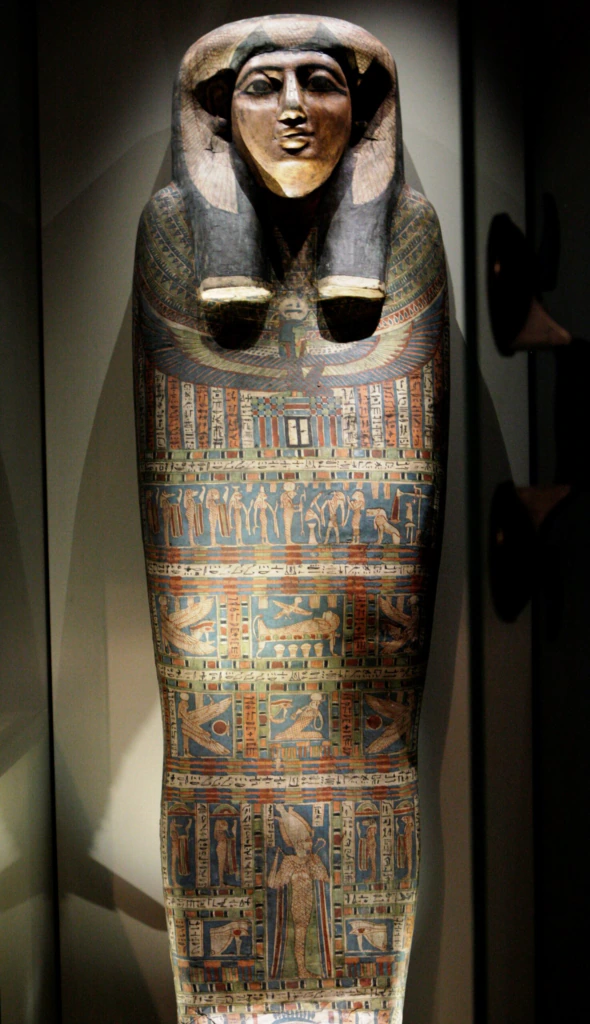
The remains of Asru, and her inner and outer sarcophagi, were the first antiquities of importance in the museum's Egyptology collection and are believed to have come from Thebes (modern-day Luxor) in southern Egypt.
Inscriptions on the coffin indicate Asru was a temple chantress, whose duties would have involved singing to accompany the sacred rituals to the god Amun.
Her mother was Ta-du-Amen and her father was her father was a document scribe called Pa-Kush, meaning ‘the Kushite Man’, indicating that he came from the area of southern modern Egypt or northern modern Sudan.