
An Italian museum made headlines around the world last week after a video of a visitor breaking an artwork on display went viral.
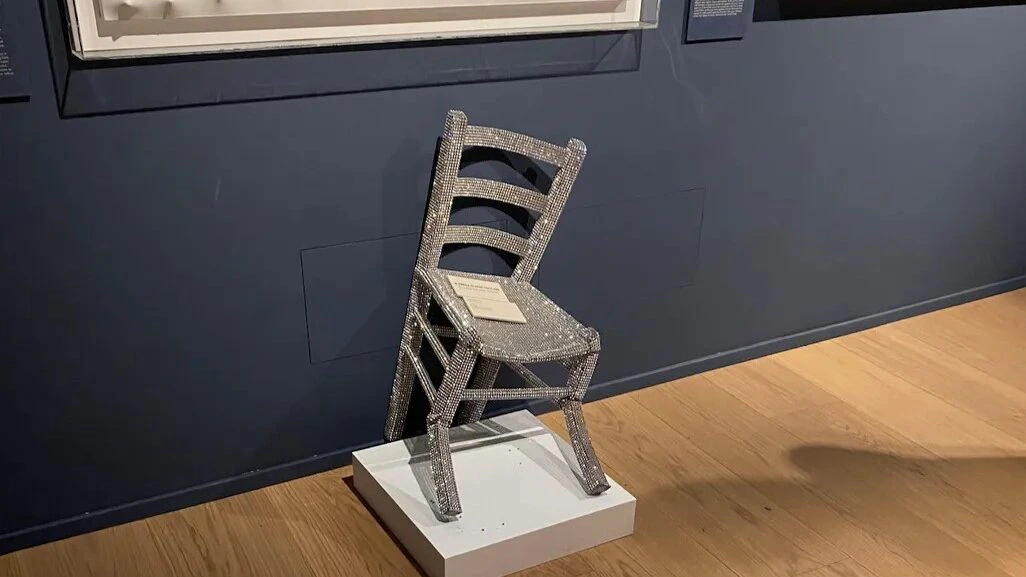
The Palazzo Maffei, a historic palace with an extensive art collection in Verona, northern Italy, issued a plea asking the public to be more respectful of art after a visitor broke a Swarovski crystal-encrusted chair on display in one of its galleries.
The Van Gogh Chair was created by Italian artist Nicola Bolla as a tribute to the 19th-century artist's famous painting of a wooden chair.
Security camera footage shows a man pretending to sit in the chair while the woman he is with takes a photo, before he slips and cracks the chair's two front legs.
The couple left without notifying the museum of the damage and have not yet been identified, according to reports.
In a separate incident, a three-hundred-year old painting in the Florence’s Uffizi Gallery was torn by a visitor who tripped while apparently trying to create a meme.
Advertisement
The 1712 painting of Ferdinando de’ Medici, Grand Prince of Tuscany, by Anton Domenico Gabbiani, was damaged by a man who lost his balance while trying to recreate the portrait's pose for a photograph. The visitor leant against the canvas, leaving a tear.
The gallery’s director Simone Verde has pledged to crack down on selfies in response.
He said in a statement: “The problem of visitors coming to museums to make memes or take selfies for social media is rampant.
“We will set very precise limits, preventing behaviour that is not compatible with the sense of our institutions and respect for cultural heritage.”
The incidents have sparked debate in the sector, with some museum workers saying they have noticed a rise in irresponsible behaviour from visitors in recent years, particularly since the Covid pandemic.
One museum professional commented on social media: “Is it me or are we seeing more and more incidents? What should/can be done to protect artefacts and heritage from inconsiderate visitors?”
Advertisement
Others believe the museums in question should take more responsibility for managing visitor behaviour.
In the case of the Uffizi Gallery, according to The Guardian, a trade union representing museum workers said the tourist had tripped on a low platform intended to keep visitors at a distance from the paintings. The union said it had previously highlighted the risk to the museum authorities after another visitor had tripped without causing any damage.
“Visitors are looking at the paintings, not at the ground. Those platforms are unsuitable and too dark,” Silvia Barlacchi, a staff representative, told the press.
Meanwhile, in a discussion on LinkedIn about the Van Gogh Chair incident, Rachel Mackay, head of Hampton Court Palace, said: “Am I the only one who thinks the museum is at fault here? The couple are clearly not trying to sit on the chair, but only pretending to: the man slipped.
“It was a genuine accident and one that could have been avoided with a barrier rather than just a small plinth. What's more, they were, in their own way, engaging with the art!”
Mackay added: “In any museum I have worked at, we would never dream of putting something that looks like a chair but is actually completely hollow on open display like this. You're asking for trouble.
"Yes, it would be lovely if visitors didn't try to sit (or pretend to) but it's our responsibility to plan for what visitors actually do rather than what we want them to do. Also, this is partially why front of house staff are so critical.
“Blaming the visitors for ‘not respecting the art’ is exactly the sort of mindset that means people are more likely to skedaddle if they make a mistake than fess up to staff.
“I'm glad the chair has been restored and is back on display - hopefully the museum [has] learnt some valuable lessons.”
Responding to Mackay’s comment, David Hingley, head of arts, heritage and culture at Peridot Partners, added: “Completely agree. If you want to display an object like this effectively out of context (we all know what you do with a chair in normal circumstances - you sit on it), you’ve got to provide a different context and give visitors that understanding. (This chair is different because… and that’s why it’s behind a barrier).
“Also.. maybe have a chair you can actually sit on nearby? That said, if as a museum, you’ve messed up your risk analysis so something got broken – don’t blame the visitor.”

I agree with my fellow museum professional – we are seeing more and more incidents of inconsiderate visitors! Even with barriers in place and areas that are alarmed visitors are still crossing those boundaries for whatever reason they believe they are entitled to do so! Challenging them often produces quite offensive responses as well. People seem to believe they have the right to do what they want. There was one incidence at our museum of visitors lifting a small japanned chair over the barrier so they could sit on it! That did not fare as well as the Swarovski crystal-encrusted chair, our chair looked like a fold-up deck chair in matchstick pieces and cost a lot to be repaired by an experienced craftsman. They also did not inform staff of the supposed ‘accident’, it was later picked up on CCTV. From people going under / over barriers or lifting their children over solid barriers to photograph them standing in (and damaging) a unique Anglo-Saxon coffin, to leaving graffiti on interpretation panels, visitors no longer have any respect or consideration for the treasures they are viewing, or even other people’s viewing pleasure.