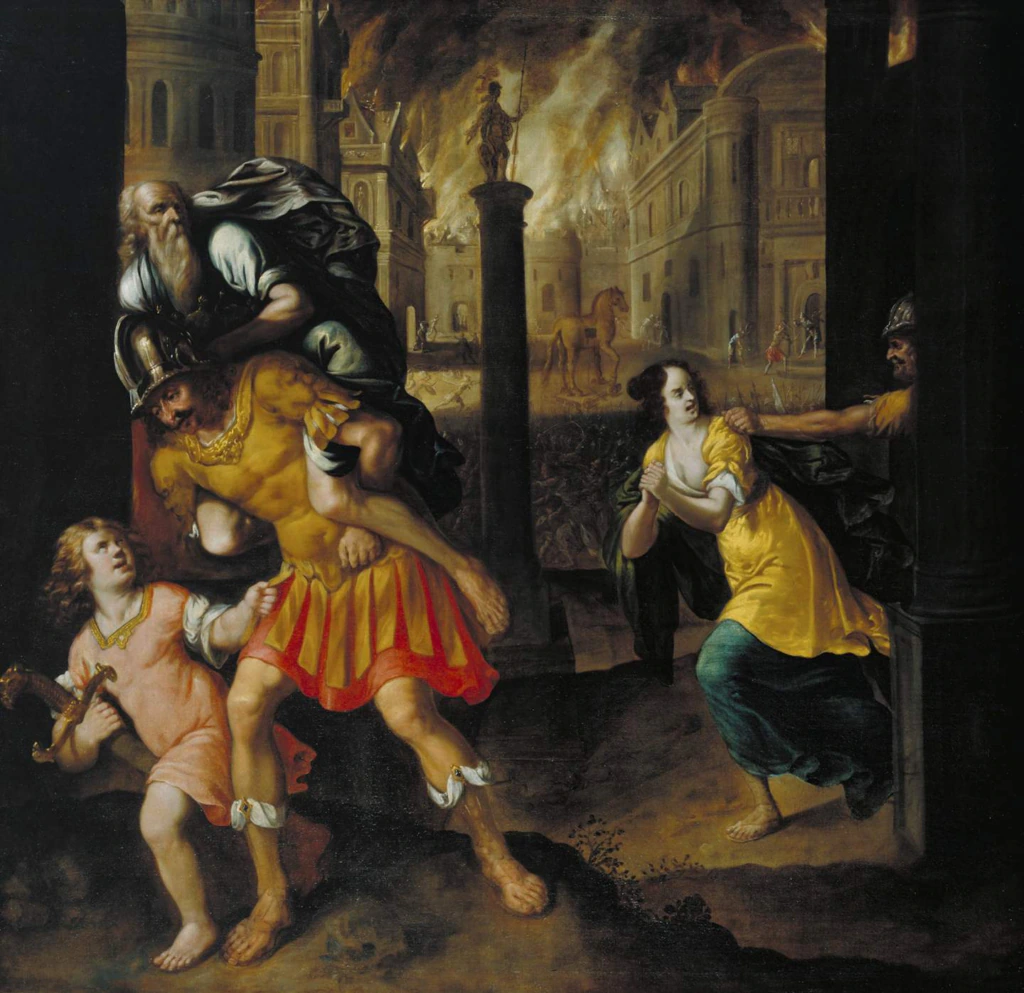
A Henry Gibbs painting that has been in the Tate’s collection for 31 years is to be returned to the descendants of the Jewish art dealer Samuel Hartveld, whose Antwerp gallery was looted by the Nazis in 1942.
Aeneas and his Family Fleeing Burning Troy (1654) was one of 66 artworks stolen from a gallery owned by Hartveld on 26 March 83 years ago.
Hartveld’s descendants’ claim for the restitution of the painting has been successful, with a Spoliation Advisory Panel report concluding that the art dealer’s property, books and art collection were looted by the Nazis as an act of racial persecution.
The role of the panel is to consider claims from anyone who lost possession of a cultural object during the Nazi era (1933-1945), or their heirs, if the object is now in the possession of a UK national collection or other museum or gallery established for the public benefit. Tate has not disputed the claim.
“It is a profound privilege to help reunite this work with its rightful heirs, and I am delighted to see the spoliation process working successfully to make this happen,” said Tate director Maria Balshaw in a statement.
Advertisement
“Although the artwork’s provenance was extensively investigated when it was acquired in 1994, crucial facts concerning previous ownership of the painting were not known."
How did the painting come to be in Tate’s collection?
Samuel Hartveld and his second wife Clara left their home in Antwerp ahead of the German occupation on 10 May 1940. They sailed via Lisbon to New York on 15 August 1940, leaving behind their property, books and art collection.
Their son Adelin Hartveld had remained in Belgium. He joined the Resistance but was caught and subsequently executed by the Nazis on 21 January 1942.
In March that year, a German office clerk Heinrich Kunst, a member of the Nazi Party, was appointed as administrator of Samuel Hartveld’s gallery. His audit of the gallery concluded there was no interest or possibility in continuing the Hartveld business and applied for immediate liquidation.
The 66 paintings were valued by a local auction house at 250,000 Belgian francs, with the painting by Henry Gibbs valued at 2,000 francs. Kunst consulted with the the Einsatzstab Reichsleiter Rosenberg, which confiscated a library of 2,000 art books, but allowed Kunst to sell the paintings.
The gallery and its paintings were bought by a Mr Van den Broek for 200,000 francs. After the war, he was discovered to have had close ties with Nazis and the Belgian fascist movement. He sold the painting to the Aramex Shipping Company.
Tate acquired the painting in 1994 from the Belgian Galerie Jan de Meere. It later formed part of a list the institution prepared of paintings with an incomplete provenance, having been alerted to its ties to Hartveld by the journalist Geert Sels.
Samuel Hartveld died in London on 1 September 1949, designating his wife Clara as his sole heir and leaving bequests of $3,000 to his three surviving children. When Clara died in 1951, she named her daughter Sonia Klein as her sole heir.
The claim was brought by the Sonia Klein Trust, established in 1986, and the named beneficiaries are her three grandchildren.
The trustees of the Sonia Klein Trust said: “The trustees acting for the Sonia Klein Trust and their counsel, Dr Hannes Hartung, based in Munich, are deeply grateful to the Spoliation Advisory Panel for their recommendation that Tate Britain restitute the narrative painting of Henry Gibbs ‘Aeneas and his family fleeing Burning Troy’ and Parliament’s ratification of that recommendation.
“This decision clearly acknowledges the awful Nazi persecution of Samuel Hartveld and that the ‘clearly looted’ painting belonged to Mr Hartveld, a Jewish Belgian art collector and dealer.”
They thanked the staff at Tate for working with them to ensure the painting was restituted, and the author Geert Sels whose work helped identify what happened to Samuel Hartveld and his family because of Nazi persecution during the second world world.
“With this restitution, the trustees acting for the Sonia Klein Trust honour and remember the life of Samuel Hartveld and his family,” the trustees said.