
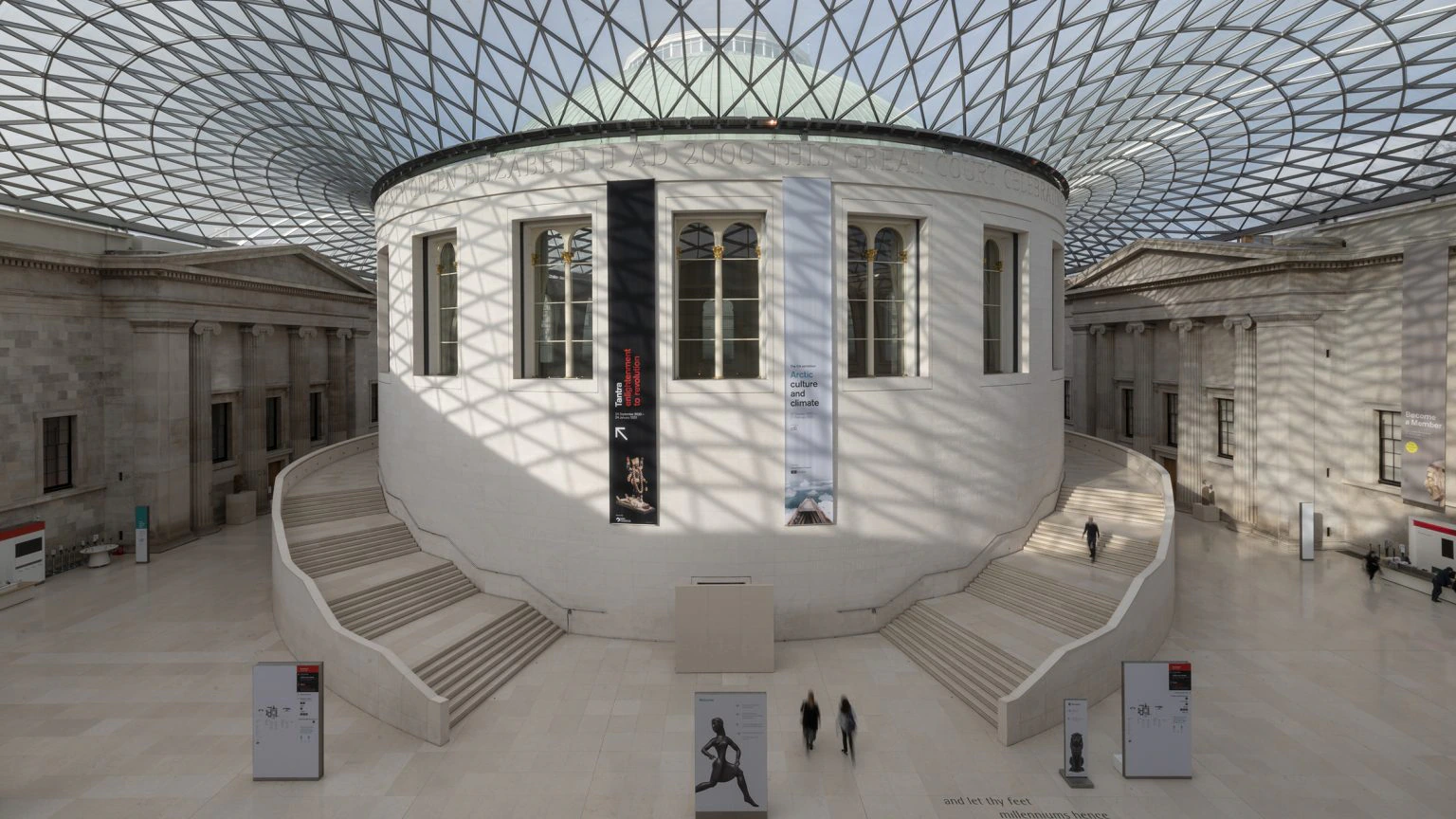
Museums’ efforts to engage with contemporary issues and the legacies of empire and slavery have come under the spotlight at an event at the British Museum organised by The Times.
The debate, Whose history: Can museums preserve the past while addressing the present?, examined the more active role the sector has taken in recent years to address societal issues and past injustices, particularly in relation to historically marginalised and colonised groups.
The event was hosted by The Times columnist Alice Thompson, who was joined by the artist Grayson Perry, the historians Tom Holland and Simon Sebag-Montefiore, and Margaret Casely-Hayford, the CEO of the Gallery of Living History.
Perry said that, although it had been necessary to rebalance how objects are displayed in museums, in some cases politics had “become the headline” and was “getting in the way” of people’s enjoyment of exhibitions.
“Quite often the tone of a lot of political engagement with the culture these days is a little bit scoldy, a little bit finger waggy,” he said.
Later in the debate, Perry said it was important for people to recognise that the “civilisations that produced all this beauty and wonder and craftsmanship [...] were all pretty brutal in many ways”.
Advertisement
“It's a safer world we live in now so we're more touchy about it, but there is a dark side. We've all got a dark side. The more we acknowledge it, the healthier it is,” he said.
Sebag-Montefiore said he felt that the focus of cultural institutions on transatlantic slavery had become “humdrum”, saying: “Everyone who was around at the time who was in the establishment, who made money, who was in the aristocracy, had some connection [to transatlantic slavery]. Does that mean one has to mention it in every single caption in every single portrait?”
In reference to research such as the National Trust's 2020 report on links to slavery and empire at its properties, he added: “This work's all been done now, and we don't need now to go into a permanent cultural revolution.”
Sebag-Montefiore expanded on his comments later in the debate, saying that having slavery as the sole focus could sometimes obscure the nuance and complexity of the people of the time.
“What you want to discover in when you when you read captions about slavery is how complicated this world was,” he said.
Sebag-Montefiore also criticised the use of “jargon” in museum labelling.
Advertisement
“I think the big danger, the big killer of entertainment and fun, is prudishness, self-righteousness, and above all, jargon,” he said.
“Jargon is all about being a sort of member of this kind of little club and, and you're showing you belong by using it. And so jargon should be banned from all captions.”
Casely-Hayford said that, for museums to engage with contemporary and societal issues, it was a question of “being grown up about it”.
“It depends how you do it of course. You don’t force it down,” she said.
Casely-Hayford referenced her own family history as the descendant of a slave trader from County Clare and a Ghanaian chieftain’s daughter.
“My family has [the slave trader], as well as the people who fought against him, as well as the anti-colonial pan-Africans. I’m quite comfortable about looking at both sides and saying ‘this is me, this is who I am’.
Advertisement
“I just think we should all be grown up about it, because otherwise, if you continually hide the reality, you'll never mature, you'll never move forward. And that is part of what this is about,” she added.
Casely-Hayford said it was vital not to suppress difficult histories. “There's something really important about allowing the door to be open to the darkness,” she said.
“And if you think about the way Bristol and Liverpool have dealt differently with their slave past, with Colston, there was a constant putting a lid on things, and then there was that awful eruption when the statue was pulled down and people pretty much rioted about it.”
Holland said he felt that museums were currently going through a “process of reformation” comparable to that of the church.
“What people are debating is the degree to which the founding principles of centuries before – how should we recalibrate them?”, he said. “It's the equivalent of [asking] how many statues should we topple? How much whitewashing should we do?”
“The reformation drew on aspects of the medieval church, but it was also conscious of, itself, overturning shibboleths, toppling icons, whitewashing where there had been paintings. And I think something similar is happening now.”
Holland said the impact museums have “doesn't always have to be fun or amusing to be overwhelming”.
He praised the current exhibition at the Fitzwilliam Museum in Cambridge, Rise Up, which explores the abolition of slavery, saying it was “full of nuance and complexity”.
“I wouldn't say it was fun, but it was powerful and stimulating. And I came out of it having had my thoughts on the process of abolition complicated and enlarged,” he said.
It is worrying to here from industry that above all, the thing to get rid of is not colonial narratives within our museum spaces and acknowledging a deeply traumatic past for our nation’s history and the millions of people affected in the past and hundreds of millions (if not billions) affected by slavery and colonialisms effects today- but instead jargon….