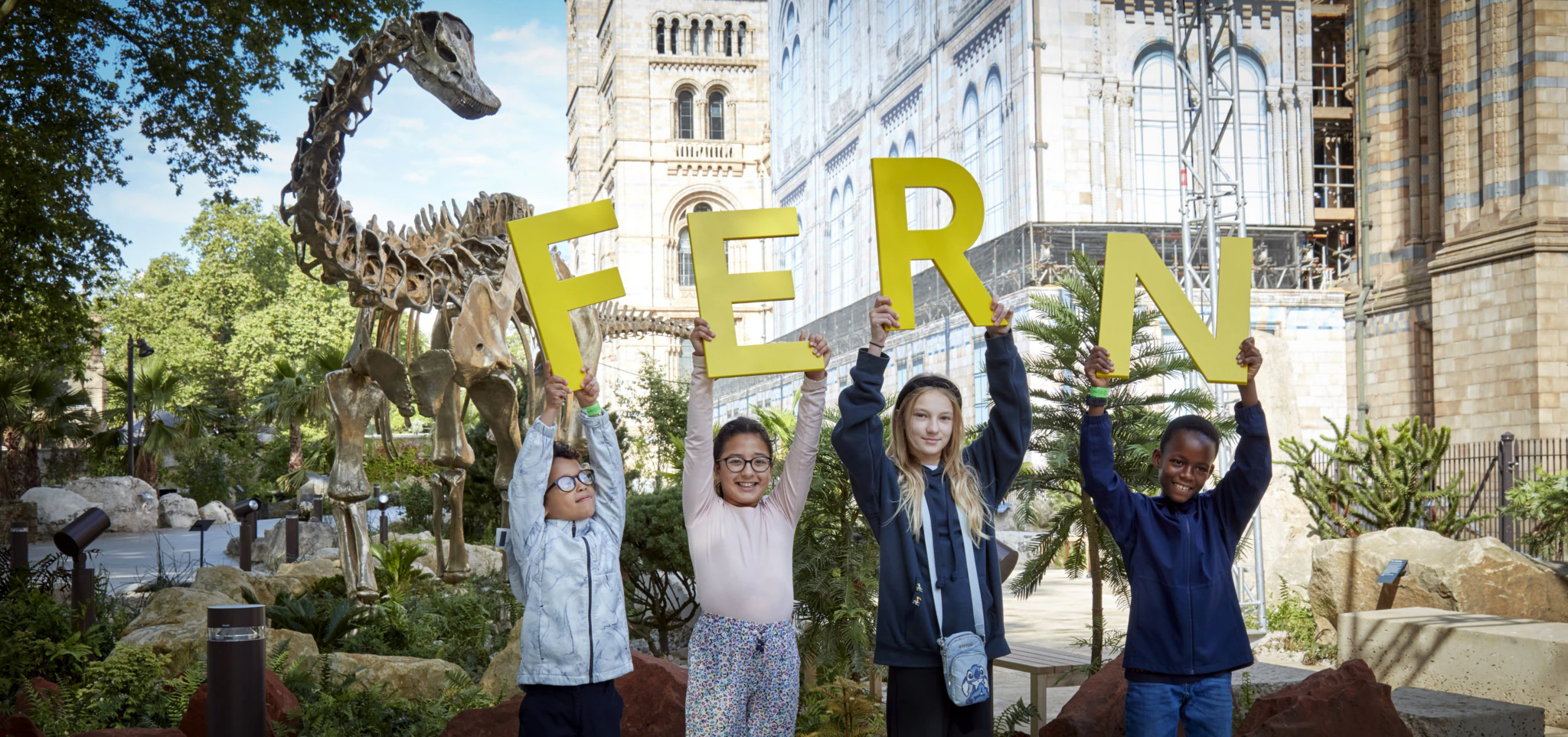
London’s Natural History Museum opened the gates to its transformed garden spaces this week, where a new bronze diplodocus cast, christened “Fern” by local schoolchildren, stands ready to greet the crowds.
Two years in the making, the reimagined gardens comprise five acres of green space around the entire building complex, uniting the east and west sides for the first time.
The transformed space features two new outdoor galleries, the Nature Discovery Garden and the Evolution Garden.
These sit alongside the museum’s existing Wildlife Garden, which has been extended to double the area of native habitats within the grounds, as well as increasing pond area by 60%.
The urban gardens will be one of the most intensively studied urban nature sites globally, as part of the museum’s national biodiversity movement.
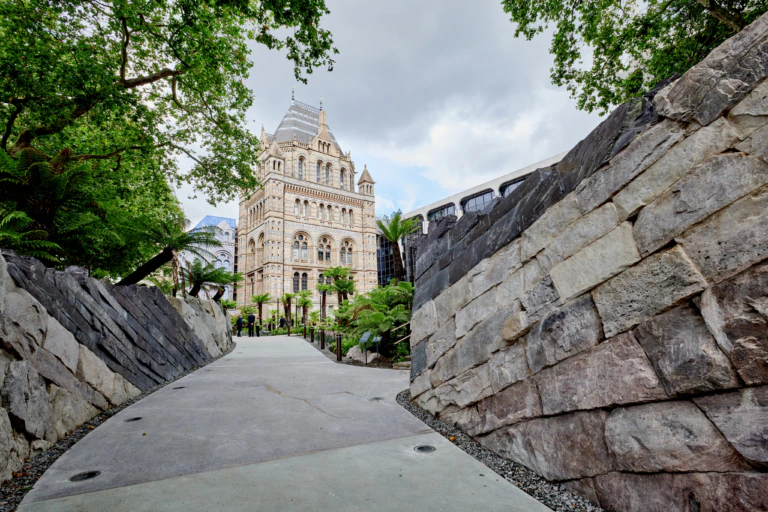
Visitors arriving from the London Underground tunnel will enter the museum through a canyon clad in ancient stone sourced from across the UK.
Advertisement
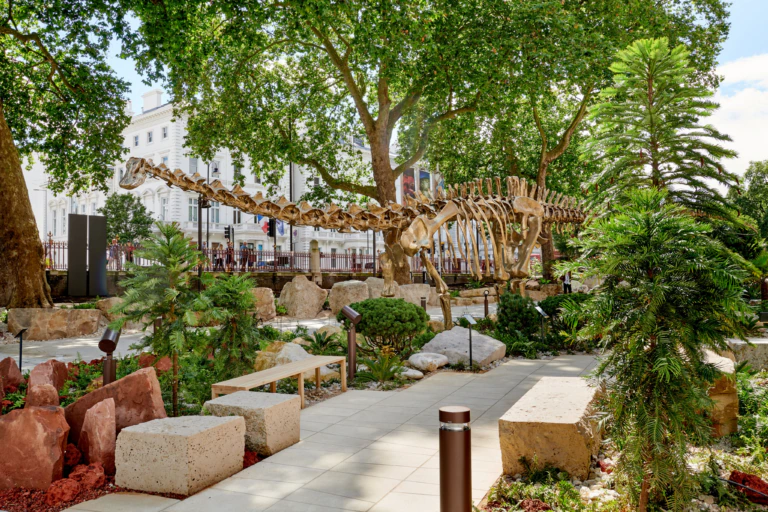
This emerges into the Evolution Garden, supported by the Evolution Education Trust, which spans deep time to modern day through an immersive timeline of plants, rocks of different geological periods from across the UK, and representations of reptiles, birds and mammals.
The new outdoor gallery features a Jurassic section, supported by the Kusuma Trust, where Fern stands alongside a second bronze dinosaur, Hypsilophodon, which was native to the UK.
The Garden Kitchen, a new café opening later this year, will sit within the arches in the museum's 1970s extension, the palaeontology building.
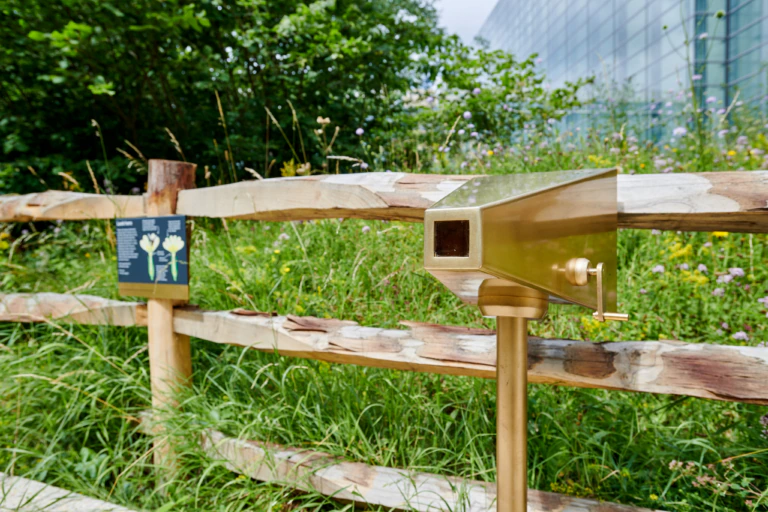
The Nature Discovery Garden provides a space for both visitors and scientists to find out more about local urban wildlife.
Different habitats represent the biodiversity that can be found in the UK’s urban spaces, which can be seen via an accessible sunken pathway that winds between the ponds, where frogs, newts, dragonflies and mandarin ducks have already been spotted making themselves at home.
Advertisement
The Nature Activity Centre, supported by Amazon Web Services (AWS), a purpose-built space for learning about urban nature, combines facilities for scientific work, a training space for future urban ecologists and a hub for school workshops and family activities in the gardens.
The transformation project has taken an ambitious approach to sustainable construction; the site is diesel-free and no waste was sent to landfill. Rainwater will be harvested for the plants.
The gardens will host a range of activities this summer for all ages, including pond dipping to garden trails. An audio guide of the gardens features interviews with scientists and poetry co-produced with blind and partially sighted young people.
“We are incredibly excited for visitors to get lost in nature and the story of our planet, stretching back 2.7 billion years, as they explore our completely transformed gardens this summer,” said NHM director Doug Gurr.
“Beneath the graceful gaze of our newest dinosaur Fern, two immersive outdoor galleries are already teeming with wildlife. It’s the perfect place for all to connect with and learn about the nature on our doorsteps.
“We know that for people and planet to thrive, we must act to support urban nature recovery. As well as a new way for visitors to engage with the museum, our reimagined gardens will play a vital role in understanding how nature in our towns and cities is responding to a changing planet, and how we can better safeguard it.”
The project was overseen by architects Feilden Fowles, working in collaboration with landscape architects J & L Gibbons and alongside a multidisciplinary design team, including Gitta Gschwendtner, engineers HRW and Max Fordham. The scheme has been delivered as a net zero carbon and zero waste project by contractor Walter Lilly.
The transformation is part of the museum’s ongoing Urban Nature Project, which responds to the urgent need to monitor and record changes to UK urban nature and support its recovery.
The gardens will act as a living laboratory, where scientists will observe wildlife and collect eDNA samples from the gardens.
A network of 25 scientific sensors will also gather environmental and acoustic data – from underwater recordings in the pond and the buzz of insect wings to bird calls to traffic noise – to help them understand how urban nature is changing and what we can do to support its recovery. Once fully installed, the network of sensors in the gardens will collect up to 20 terabytes of audio data in the first year.
The museum is working in partnership with global cloud provider, Amazon Web Services (AWS), on this work. The data collected from the gardens will be fed into the museum’s new Data Ecosystem, a cloud platform built using AWS technologies.
The Data Ecosystem helps the museum’s team of scientists to collect, enrich and share multiple biodiversity data types alongside environmental data such as water chemistry rapidly and accurately, from a range of sources.
To date, 57,000 visual wildlife observations have been uploaded to the Data Ecosystem, from historic data from the museum’s wildlife gardens since 1995 up to the transformed gardens opening in July 2024.