

The outgoing interim director of the British Museum, Mark Jones, has called for Britain’s national institutions to be allowed to charge overseas tourists for admission to their permanent collections.
In an interview with the Sunday Times this week to mark his departure from the museum, Jones said that although he believed UK taxpayers should not have to pay an entry fee, “it would make sense for us to charge overseas visitors for admission to museums as they charge us when we visit their museums”.
“The biggest visitor attractions in Britain are our great museums and galleries, yet that does not translate into the resources needed to maintain them,” he added.
Jones, who came out of retirement to lead the institution following last year’s stolen objects scandal, said a reasonable price to enter the British Museum would be £20.
This compares to the entry fees for high-profile museums in other countries, which range from €15 (£12.70) at the Prado in Madrid to €22 (£18.60) at the Louvre in Paris and $30 (£23.70) at the Metropolitan Museum of Art in New York.
In addition to funding the British Museum’s redevelopment project, which is reportedly expected to cost between £400m and £500m, Jones said charging entry would help reduce ticket prices for special exhibitions, fund projects outside London, increase pay for staff and reduce overcrowding.
Advertisement
He said an entrance fee would also support partnerships and loans, and improve relationships with overseas parties seeking the return of cultural artefacts.
Jones told the newspaper that he supported sharing the Parthenon Sculptures with Greece, but said it would be expensive to develop and maintain such partnerships.
“The way we are going to benefit from — rather than falling out over — the different claims to different objects is by creating partnerships around them, instead of creating conflicts around them,” said Jones.
“That’s expensive. At the moment, that work is entirely funded by private philanthropy, but in the long run, it would make more sense to use some of the funding that would come in from charging overseas visitors to create a better funded system of global partnerships. If we were ever to find a way to create a partnership with the Greeks over the Parthenon Marbles, we would need to find a way to fund it.”
Jones said that raising money via private philanthropy brought its own set of challenges, pointing to recent controversies and protests over cultural institutions accepting sponsorship from Baillie Gifford and BP.
“Museums already raise money from trusts and companies and do it very successfully, but the experience of Baillie Gifford and BP is that that kind of funding acts as a lightning rod for campaigners,” Jones said. “But I also wonder if it is really a good thing that so much philanthropic money should be needed by — and therefore spent by — London institutions, when relatively little is spent in other parts of the country.”
Advertisement
He added: “Either a major part of the funding has to be found out of taxation, which is difficult as the public finances are very stressed, or we need reasonably to charge [tourists].
“Why is it more equitable that all of the money should come from British taxpayers, when actually the benefit is enjoyed equally by overseas visitors?”
Jones’s comments reflect a growing debate in recent months over the free admission policy, which was introduced for the UK's national museums by the last Labour government, starting in 2001.
In a comment piece in the Art Newspaper earlier this year, art critic Ben Lewis called for free admission to be scrapped, saying entry charges would solve many challenges facing the sector, from low pay to sponsorship.
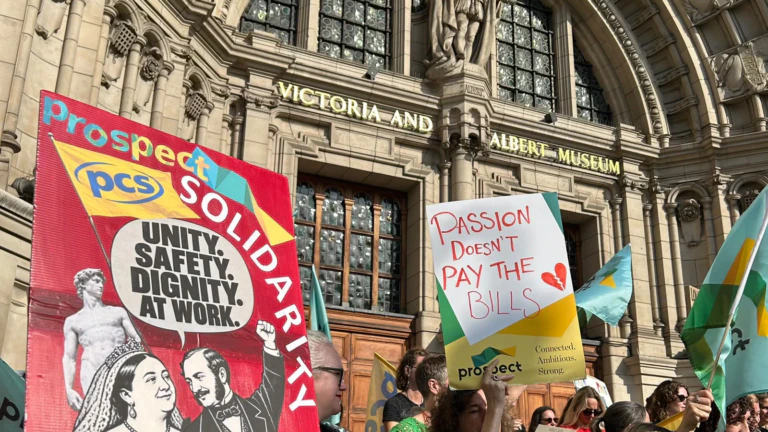
However, Tristram Hunt, the director of the Victoria and Albert Museum, continues to back the policy, and has instead called for a hotel tax for overseas tourists that would be ringfenced to support cultural institutions.
He told Apollo magazine earlier this year: “At the V&A, the trustees and I have no desire to return to charging entrance fees. With improved visitor numbers, we see a successful financial return in secondary spend across our shops and cafes, as well as the purchase of special exhibition tickets and, crucially, memberships.”
Advertisement
A YouGov poll taken this week following Jones’s comments shows that a majority of the public (51%) still support free entry for all, with 31% supporting a charge for overseas tourists and just 6% supporting admission fees for everyone.
Neither Labour nor the Conservatives cited a specific commitment to free entry in their manifestos for the General Election 2024, but the Liberal Democrats and the Green Party have pledged to maintain the policy.
The Museums Association (MA) continues to strongly support free entry. In its Museum Manifesto, published earlier this year, the MA says free admission “has been a major cultural policy success which delivers a huge range of cultural, learning and economic benefits and should be retained”.
Jones stepped down as interim director of the British Museum at the end of June, handing over to new director Nicholas Cullinan, who joined from London’s National Portrait Gallery.

I mean, Tristram Hunt once raised it!….
I visited a number of free to enter museums in Chile a few years ago. Personally, I see think it’s better to make them free as visitors drawn to the museums will spend their money in the wider economy, including attractions that have to charge. Think of it as an investment or loss leader. Free entry supports a bigger economy.
I think charging for international visitors and retaining free entry for residents is a fair model. It keeps it accessible to people who may not be able to afford it and who subsidise it with their taxes, whilst international visitors who would expect to pay, as with most of Europe, would still be willing to pay. They must have some disposable income if they are taking international flights for leisure.
If we believe museums are part of the public realm, then they have to have free access, like parks, or town-centre squares and plazas. When a museum charges for admission it is part of the attractions/entertainment sector, and visitors are consumers rather than citizens. There’s nothing wrong with that, but charging makes museums private rather than public, so it’s about fundamental issues of purpose.
To say “as they charge us when we visit their museums” is disingenuous as others have pointed out. It also does not make it the best way to do things just because some do. While he states what he sees as the benefits you can see it a mile away as just another way to cut funding in the longer term. 20 quid is not an insignificant amount. “Sir” Mark Jones tells you where he sits at the table. He is an EX-interim director. Let it stay so.
In the US, the Met is not comparable to the British Museum. The Smithsonian museums are the equivalent as national museums and they remain free to all.