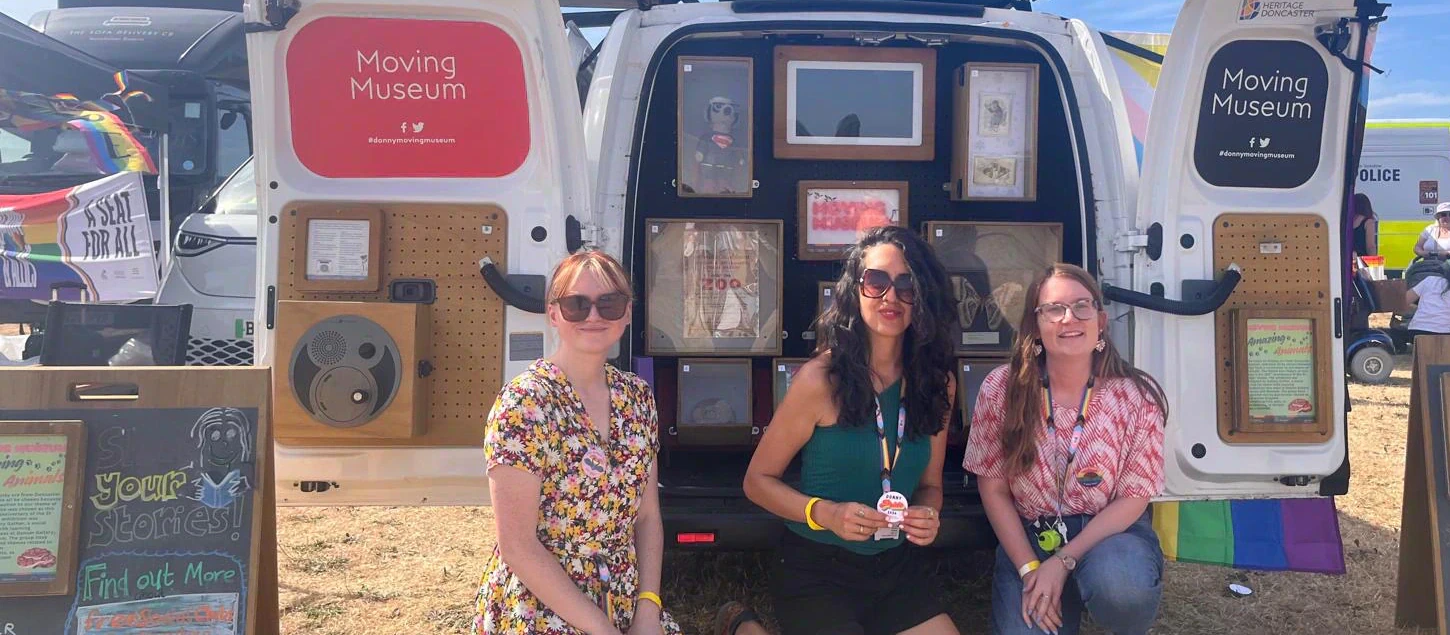
The Moving Museum has been a key part of Heritage Doncaster’s outreach strategy for the past five years. Funded by Arts Council England and Doncaster Council, every summer our electric van, with 11 cases installed in the back, is taken on a tour of the borough, clocking hundreds of miles and being seen by thousands of visitors. Each case contains one or two objects from our collection, chosen by a group of community co-curators to form an exhibition.
The theme changes every year, but always links to a wider topic shared across our service. This year’s exhibition is animal themed to link up with a larger National Lottery Heritage Fund-supported project celebrating the 250th anniversary of the St Leger Stakes – Doncaster’s most famous horse race.
We tour our exhibition around Doncaster over the summer, attending events such as Pride, local festivals and school fetes, as well as visiting shops, medical centres and libraries. The aim is to share our collection with as many people as possible, especially local residents who may not have used our services.
By bringing our collections out into the places where people live, work and play, we hope to connect with our communities on their “home turf”, getting conversations started away from museum buildings where there are more barriers to access.
The Moving Museum’s cases are made of wood, with a clear plastic front. They are mounted in such a way that they are visible when both of the van doors are open, to limit access issues that would result from people having to get into the van.
We can adjust the depth of each case, but they are otherwise fixed. They are all quite small (the largest being just over 35cm in height and width) which limits our co-curators to choosing smaller objects.
Advertisement
We cannot choose any objects that might be especially delicate or vulnerable to environmental conditions such as heat or humidity.
We must also consider security and the potential for theft, since the case locks are not substantial.
These limitations are communicated to the co-curators as part of the co-production process, for them to take into account when shortlisting objects. While they can be frustrating, the limitations encourage creativity.
The cases’ portability makes for an exhibition that is far more shareable and versatile than something within a building.
The items are seen by several thousand people in our community, many of whom have never visited one of our sites. The items spark conversations and memory-sharing, both among families and with staff. Feedback from visitors is almost always positive.
Many discussions end with people saying that they are excited to come and see other objects from our collection in our museum building.
Eleanor Beestin-Sheriff is community curator at Heritage Doncaster