When Brooklands Museum, Surrey, began developing Britain’s First Grand Prix, an exhibition exploring the story of the 1926 race and its lasting significance, we knew the display cases would play an important role in shaping the visitor experience. Like many museums, we needed to deliver an ambitious, high-quality exhibition within a limited budget.
Rather than purchasing an entirely new suite of display cases, we chose to reuse and adapt existing ones. It reduced our costs, supported a more sustainable use of our resources and challenged us to think creatively about how familiar furniture could meet modern standards for presentation, access and care.
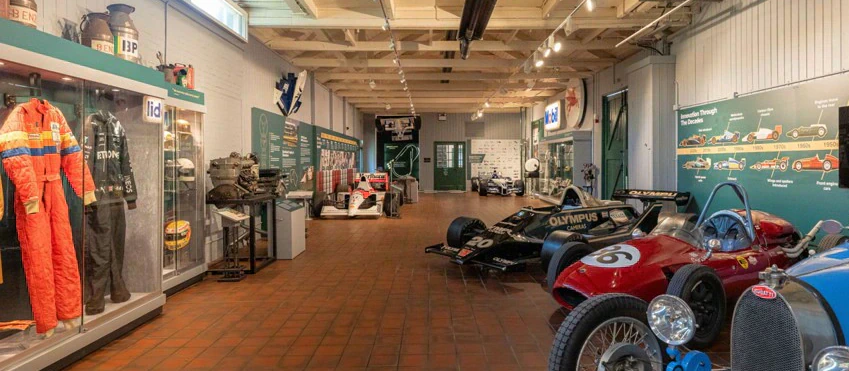
The exhibition brings together race suits, trophies, helmets, photographs, programmes and personal memorabilia. Instead of organising them by object type, we use the cases to support a chronological journey, beginning with the 1926 race and continuing through to modern-day Formula 1. This structure helps visitors follow a century of technological, sporting and cultural change.
Fashion parade
One of the greatest challenges was displaying the racing suits. These large, 3D objects needed to show how race wear has evolved from relatively simple protective clothing into highly engineered safety equipment. Placing suits from different eras near one another allows visitors to compare changes in materials, construction, sponsorship and safety technology at a glance.
Creating these displays required careful planning. Each suit needed internal support to achieve a natural appearance while avoiding strain on the fabric, seams and fastenings. Positioning was equally important: mannequins were arranged to create clear sight lines, make best use of the available case space and encourage comparisons across different periods of Grand Prix history.
Advertisement
Lighting is another significant part of the project. The original case lighting produced bright displays but was not ideal for the long-term care of light-sensitive materials such as historic textiles, photographs and paper archives. As part of the redevelopment, we introduced lower-level lighting throughout the exhibition, creating a better balance between conservation requirements and the visitor experience.
The softer lighting protects vulnerable collections while also changing the gallery atmosphere. Rather than overwhelming visitors, it encourages them to slow down, look closely and focus on individual objects and their stories. Subtle adjustments to lighting direction also highlight key artefacts without increasing the overall light levels.
Interpretation was designed to complement the objects, rather than compete with them. Historic photos, concise text panels and carefully selected artefacts work together to provide context, while allowing the collections to remain the focus.
Organising the cases chronologically helps visitors understand how Grand Prix racing developed over the past century, and how Brooklands contributed to that story.
Institutionally, the project has changed how we approach display planning. It has highlighted that conservation, interpretation, access and sustainability should be considered together from the earliest stages, rather than treated as separate workstreams. Decisions about case reuse, lighting, object support and text were strongest when curatorial, collections and visitor-focused priorities were discussed collectively.
Sustainable approach
For future exhibitions, this learning gives us a more confident model for working within constraints. Reusing and upgrading existing cases is not simply a compromise – it can be a sustainable and effective approach when supported by careful planning. By considering object placement, lighting and interpretation together, we created displays that protect nationally significant collections while helping visitors connect with British motorsport history.
Ultimately, the project reminded us that display cases do more than house museum objects. When thoughtfully designed, they become active tools for storytelling, shaping not only what visitors see, but how the museum makes decisions about care, interpretation and resource use.
Lisa Oxborough-Cowan is the collections and interpretation manager at Brooklands Museum, Surrey