“Never underestimate how powerful the simple act of unlocking a museum case can be,” writes Mary Beard in the opening chapter of her 2026 book Talking Classics, in which she traces her fascination with the ancient world back to a childhood visit to the British Museum.
Tantalised by a hunk of 4,000-year-old bread, little Mary struggled to get a good glimpse of it within its tall display case. A curator happened to notice and opened the case so she could see. Though this is a happy memory for Beard, when I read it, I couldn’t help thinking of all the children who visited the museum and didn’t get this special treatment.
All children should have visual access to objects in museums, not only during special programmes or when a kindly curator happens to stop by. As a designer specialising in learning environments for children, this value permeates all my work. One example is the display system I designed for Let’s Play: New England Toy Stories at Heritage Museum and Gardens in Sandwich, Massachusetts, in 2020.
The exhibition told the story of toy manufacturing in New England and the toys themselves were the stars of the show. As such, curator Amanda Wastrom anticipated the exhibition would be popular with families.
To encourage multigenerational groups to linger, chat and share stories, I designed the space for comfort and familiarity. I drew inspiration from mid-century design, furnishing the space with sofas and chairs featuring angled, tapered legs and a groovy colour palette of tomato red, sunshine yellow, avocado and teal.
We also included opportunities for visitors to play board games together and design their own toys.
Whenever possible I try to re-purpose cases, especially for temporary exhibitions, but none of the cases in storage were low enough for optimal viewing by our intended audience.
Instead, we created new bases for the museum’s supply of acrylic bonnets, re-installing them at a lower height using tapered, angled furniture legs. After conservators deemed it stable enough for open display, a nearly 150-year-old wooden marble run was presented on a low, uncovered platform so visitors could try it out.
Advertisement
For the display of a more delicate toy microscope, we positioned the eyepiece close enough to the wall of its acrylic case so visitors could peer through.
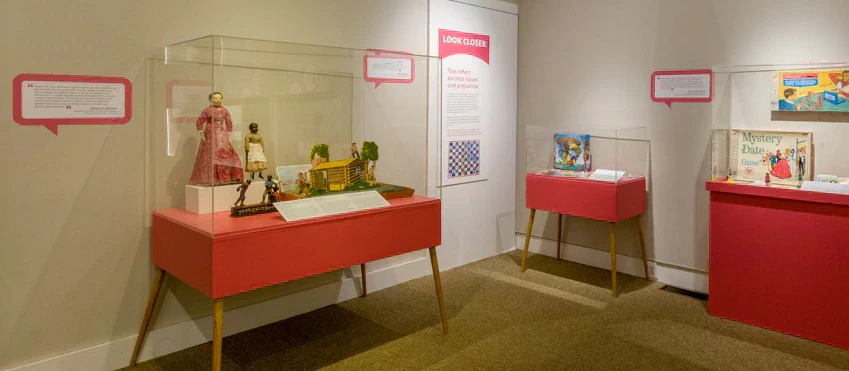
Most of the objects in the exhibition needed more traditional treatment. For these, I designed a set of wide, squat rectangular cases with angled feet, reminiscent of 1950s television cabinets. I used colour to demarcate the themes of the exhibition and colour-coded the cases accordingly.
The cases were built by 42 Design/Fab who engineered them to be easily opened and secured by museum staff and to maintain an airtight seal when locked. They also integrated a motion-sensor system that activated internal lighting as visitors walked by.
This magical effect was a personal invitation to look closer, but it also kept the objects inside from excess light exposure, preserved the longevity of the bulbs, and meant museum staff would not need to remember to turn the case lighting on and off each day.
Most importantly, the decks of the cases were about 60cm from the floor meaning young children could view the objects inside without assistance from a grown-up or use of a step stool. This scale also served wheelchair users and adults of short stature.
Museum staff reported that visitors, especially families with young children, were thrilled by the exhibition and many stayed for hours. Never underestimate the power of exhibition spaces that prioritise visual access for young visitors. You never know who you may inspire.
Margaret Middleton is an independent exhibition designer