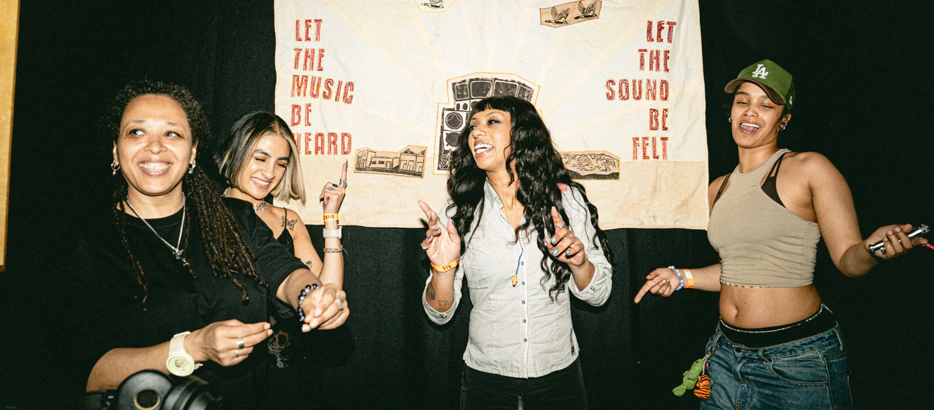
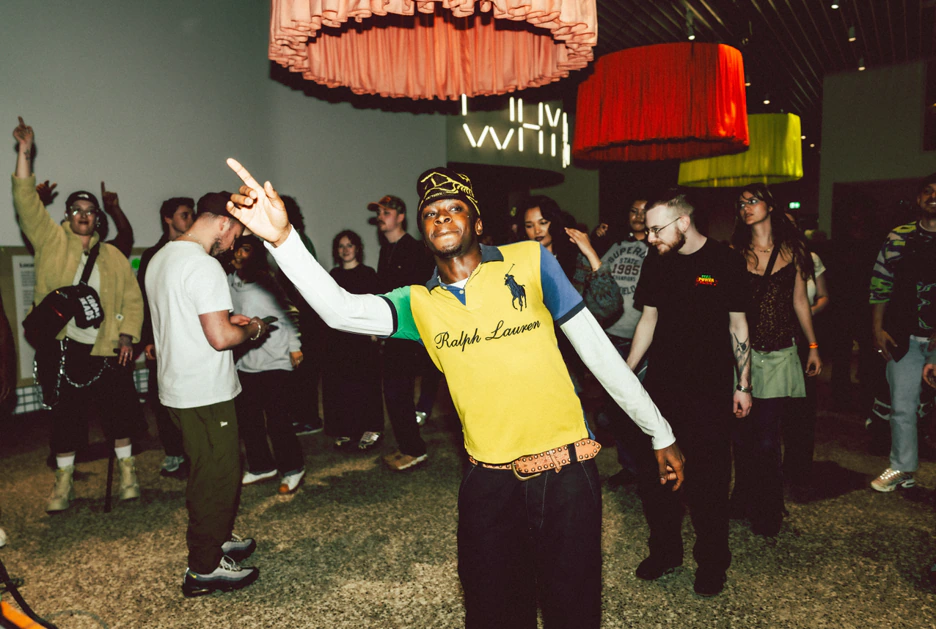
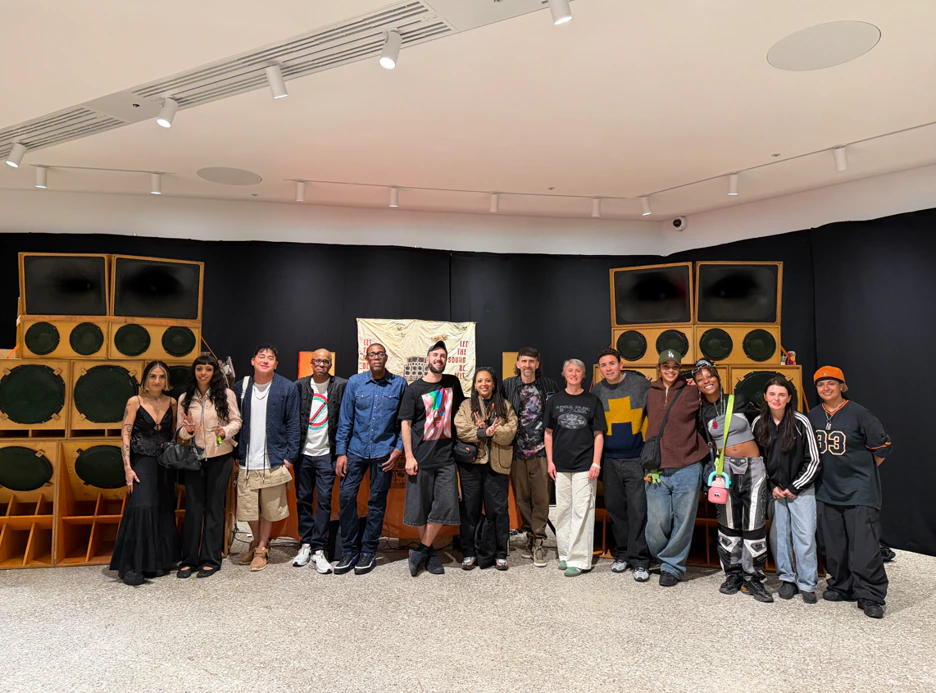
At 9pm on 16 May this year, around 300 people were dancing inside V&A East Museum to a closing jungle set from Nia Archives, DJ Flight, NAINA and Selecta Cee.
The all-female line-up brought together multiple generations of jungle culture behind the decks and on the dancefloor. It was one of those moments where a museum suddenly stopped feeling entirely like a museum.
Across V&A East Museum and Storehouse that day, similar scenes were unfolding. Young people sat designing cassette covers and compiling imaginary mixtapes in a workshop led by artist Cassia Clarke, exploring pirate radio aesthetics and DIY music culture through collage, drawing and storytelling.
Producers including Bizzy B, Equinox and Dlux demonstrated how jungle was made in the early 1990s using Commodore Amigas and OctaMED software, affordable domestic technologies that became central to jungle’s development in East London precisely because they were accessible to working-class young people without access to professional studios.
A reconstructed Deja Vu FM studio recreated the pirate radio station that once broadcast from a rooftop almost directly opposite the site where V&A East now stands. Visitors who had listened to the station as teenagers stood alongside younger audiences encountering that history for the first time.
Huge hand-painted rave banners hung across the museum. A 360-degree immersive film explored the history of Forest Gate’s De Underground Records, one of the most important but overlooked jungle record shops and studios in the UK.
Advertisement
By the afternoon, queues had formed outside the building. Across V&A East Museum, Storehouse and the David Bowie Centre, the programme attracted more than 8,400 visitors.
Addressing missing stories
The event, back2back: Up Ya Archives x Rendezvous Projects, formed part of the public programme around The Music is Black: A British Story, V&A East’s inaugural exhibition exploring Black British musical histories and their global influence.
The Music is Black generated a great deal of feeling among many people connected to various music scenes in East London. The exhibition covers 125 years of Black British music history across four rooms.
That is an extraordinary ambition, and in some respects a near-impossible task. But for communities whose culture developed in the streets, tower blocks and pirate radio stations within walking distance of where V&A East was built, on land cleared for the Olympics where many of those infrastructures once stood, the absence of their specific histories felt like erasure repeated.
Deja Vu FM was literally across the road and instrumental in the development of UK jungle. It was not in the exhibition. Neither were many of the artists, venues and scenes that had shaped the culture from the ground up. Across the LED displays during the takeover day, we listed many of the names of those who had been omitted: women, and those who had passed.
Advertisement
Up Ya Archives is the platform of Nia Archives, one of the key figures in the current resurgence of jungle music. Nia was approached by V&A East to develop the takeover day, clearly with an eye on attracting a younger audience to the show. She wanted the day to to feel grounded in the actual communities and histories that shaped the culture, so approached Rendezvous Projects, having followed our work for a while.
Having already worked with many of East London’s jungle originators, we both delved into our archives and worked closely with people including Dlux and Sting, who carried real anger about their exclusion from the main exhibition.
It was important that the day brought those voices into the space on their own terms, with real ownership, rather than having their histories absorbed into a broader institutional narrative.
Dlux worked closely with us to recreate the Deja Vu studio installation and curate the LED displays. By the end of the day he felt genuinely good about what had been made.
The V&A East curator of the back2back programme, Ruben Salgado Perez, showed real openness and trust throughout. A national institution cannot go to the depth, the specificity, the granular detail of a single pirate radio station or a single record shop on a specific street in a specific borough.
Advertisement
That is not a failure of ambition. It is a different kind of work. The work we do, the slower, longer, more embedded work, is not supplementary to institutional heritage. It is often the only place where these histories survive at all.
Current debates in museology are rightly asking why working-class cultures remain so poorly represented in our institutions. Much of the discussion centres on definitions: what counts as working class, how to measure it, whether self-identification can be trusted.
These are not unimportant questions. But in practice, they can also become a way of indefinitely deferring the harder work of building relationships, listening properly and allowing communities to shape how their histories are told.
I grew up in a working class community in East London, I’m embedded in these communities, and I’ve spent many years working in and with public museums and galleries. That position, inside both worlds, is part of what makes this work possible.
Our experience has been that if you open the door and genuinely listen, communities define their own histories with remarkable precision. The problem is rarely that communities don’t know what their stories are. The problem is that institutions haven’t created the conditions for those stories to be heard.
Sound Waves
We saw that very clearly through Sound Waves, a large-scale community heritage project in Newham in 2025 funded by the National Lottery Heritage Fund, exploring the music heritage of the borough from the 1960s onwards through oral history interviews, archive research and community-led documentation.
We didn’t decide in advance what the story of music in Newham would be. We had broad areas of interest. But the themes that eventually shaped the exhibitions, book and website came from the interviews themselves.
Over the course of the project we recorded 69 oral history interviews with people aged between 18 and 95, spanning six decades and a wide range of communities and musical styles. What struck us was how the same themes kept resurfacing across completely different interviews, from people who were strangers to one another with no connection beyond the borough itself.
Migration. Youth culture. Political resistance. DIY creativity. The transformation of everyday spaces into places of music-making.
These weren’t themes we had identified in advance and gone looking for evidence to support. They surfaced repeatedly, across different decades and completely different communities, as public narratives that had shaped people’s relationship to music-making in Newham.
When it came to structuring the book and exhibitions, we built around those themes rather than imposing a chronological or genre-based framework from the outside. That is a very different process from imposing a framework onto communities and then asking them to illustrate it. The shape of the history emerged from the interviews themselves.
This matters particularly for working-class culture, which can become flattened quite easily once it enters institutional spaces. Scenes that were fragmented, improvised and collectively built get rewritten into smoother narratives. The messiness, the informality, the contingency disappear. And with them, often, the politics.
One of the things oral history does well is allow history to remain slightly untidy. Different people remember things differently. Stories overlap or contradict each other. One interview suddenly changes how you understand another. That complexity is often where the most important material sits.
Many of the music cultures we work with developed through informal infrastructures that were never designed to last. Pirate radio stations operated illegally from tower blocks and rooftops. Clubs appeared and disappeared. Record shops closed. Youth clubs lost funding. And across East London, many of the physical spaces connected to those histories have disappeared entirely within a generation, cleared for development, priced out, built over.
Often by the time institutions begin formally collecting these histories, the original places and many of the communities connected to them have already gone. That is partly why oral history has become so central to our work.
People carry huge amounts of social and cultural history that has never been formally documented anywhere else. A conversation about a pirate radio station becomes a conversation about housing, policing, race, migration and technology.
The music is often just the way into much bigger social histories. It also matters that we deposit these interviews with local authority archives, where they remain publicly accessible long after the funded project has ended.
One of the strongest responses we hear from participants is surprise that their experiences are considered historically important at all. People often assume history belongs somewhere else: in major institutions, official archives, famous figures. Many of the cultural movements that shaped modern Britain were built collectively through local scenes, ordinary spaces and informal networks, by people who never expected anyone to come and ask.
What back2back and Sound Waves both point toward is the value of genuinely bottom-up history, where the questions being asked, the themes being followed and the shape of the final work come from the communities themselves, rather than being handed down to them. That is a different kind of heritage practice. Communities are shaping what the story actually is, in their own voices, for their own record.
That kind of work can feel uncomfortable institutionally because it means accepting that histories are sometimes unresolved, contradictory and difficult to package neatly. But if museums want to work seriously with communities, particularly working-class communities, that complexity has to be allowed in.
The main feedback from 16 May was that it was a shame it was just a day.
That feels like the right place to end. Not because the work is finished, but because it points to how much more there is still to do, and to how much is lost every year that we wait.
Katherine Green is a heritage producer, curator and social documentary photographer from East London, and a director of Rendezvous Projects