Trails are popular among visitors to many museums. These self-guided tours can enrich temporary exhibitions, reveal hidden histories, highlight overlooked objects and open up opportunities to engage new audiences – particularly children, families and carers. Building a successful and impactful trail is about creating a narrative that gives visitors new access points and encourages engagement.
A trail is formed of two parts:
- Content – the objects, ideas and themes that the museum wants visitors to experience.
- Format – how this information is delivered by the museum.
The latter might be a sheet of A4 paper that leads visitors to different collection items or an audio guide that plays sounds in order to enrich a display. Or it could be a mascot that appears in different areas of
the site, signposting that there is something to touch.
When developing a family-friendly trail, here are some key points to consider.
Your audience
It is essential to define the audience for the trail. Age brackets are a key concern when it comes to children, particularly in terms of use of language and tone of voice. It is important to remember that visitor groups often include mixed ages and a variety of carers.
Advertisement
“Sometimes, I’ll design two versions of the same trail – one for younger children and one for older ones,” says Jessica Hartshorn, an illustrator and consultant who specialises in museum trails and other resources.
“Then I’ll add an extra layer of challenge tasks on top, so that families can stretch it depending on their age and ability.”
In some instances, the child is going to be the one with the authority and the agency to follow the trail.
“But other times, you want to have the caregiver and the child doing something together, or to communicate directly with the caregiver,” says Su Hepburn, head of learning and engagement at Brighton & Hove Museums.
This was the case with the Baby Colour Trail at Brighton’s Royal Pavilion, which was designed in collaboration with Sussex Baby Lab.
Using heat maps to trace where babies focused, the team identified areas of most interest and concentrated on creating an inclusive space for both carer and baby, which focused on ideas and making suggestions, as oppo0sed to issuing instructions.
Advertisement
This trail directs visitors to collection “hot spots” and outlines practical concerns and issues, including the locations of changing facilities, toilets, catering outlets and quiet spaces. It demonstrates how a trail can function as a tool to facilitate an inclusive visit.
“It has to be a part of your family offer,” says Hepburn. “It can’t be used on its own to make a gallery family friendly.”
What is your format?
Before you take on the challenge of designing a trail, it’s important to spend time in the relevant galleries observing how families engage and use the spaces. Nothing should be taken for granted, particularly when it comes to a child’s understanding of a space.
“If you are working with something object based, you need to make sure it is easy for children to see and engage with,” says Hartshorn. “And there are other considerations, such as the flow and pace of the trail.”
Choosing a particular object near a gallery entrance could create a crush point, for example, but this can be overcome by including a quick activity that keeps people moving.
Advertisement
Forging a non-linear route will always be more appealing than a straight line. Hartshorn often works with school groups, getting children to help her select objects for a trail and then testing out what they chose. Inviting children to become co-collaborators is a great way to get tangible insight into how they experience a museum.
Deciding on how a trail will be delivered is just as crucial as the content it contains.
Digital trails delivered via a standalone app or website browser can allow for audio or visual content functions – which can, in turn, make your content more accessible to some visitors.
But Sarah Shaw, the director of Museum Tales, a consultancy specialising in family engagement, interpretation and learning, says museum professionals shouldn’t overlook the simplest formats.
“A paper trail can be just as effective as anything else, and it is quite manageable and achievable,” she says. “Digital trails are often grant funded and there’s not necessarily the budget to maintain or update these.”
It is worth bearing in mind that plenty of families and carers also want to avoid screen time.
“I may be a bit traditional in my thinking, but I believe a museum visit is about the powerful connection of meeting an object in the space,” says Samantha Bowen, founder of SEND in Museums. “Low-tech trails help navigate that space without the distraction a digital offer creates. They also don’t break.”
Make your offering unique
Trails are an opportunity to showcase what makes your site unique.
“A trail is a shop window – it’s a great way for museums to highlight their collections and to encourage visitors to find out more,” says Shaw.
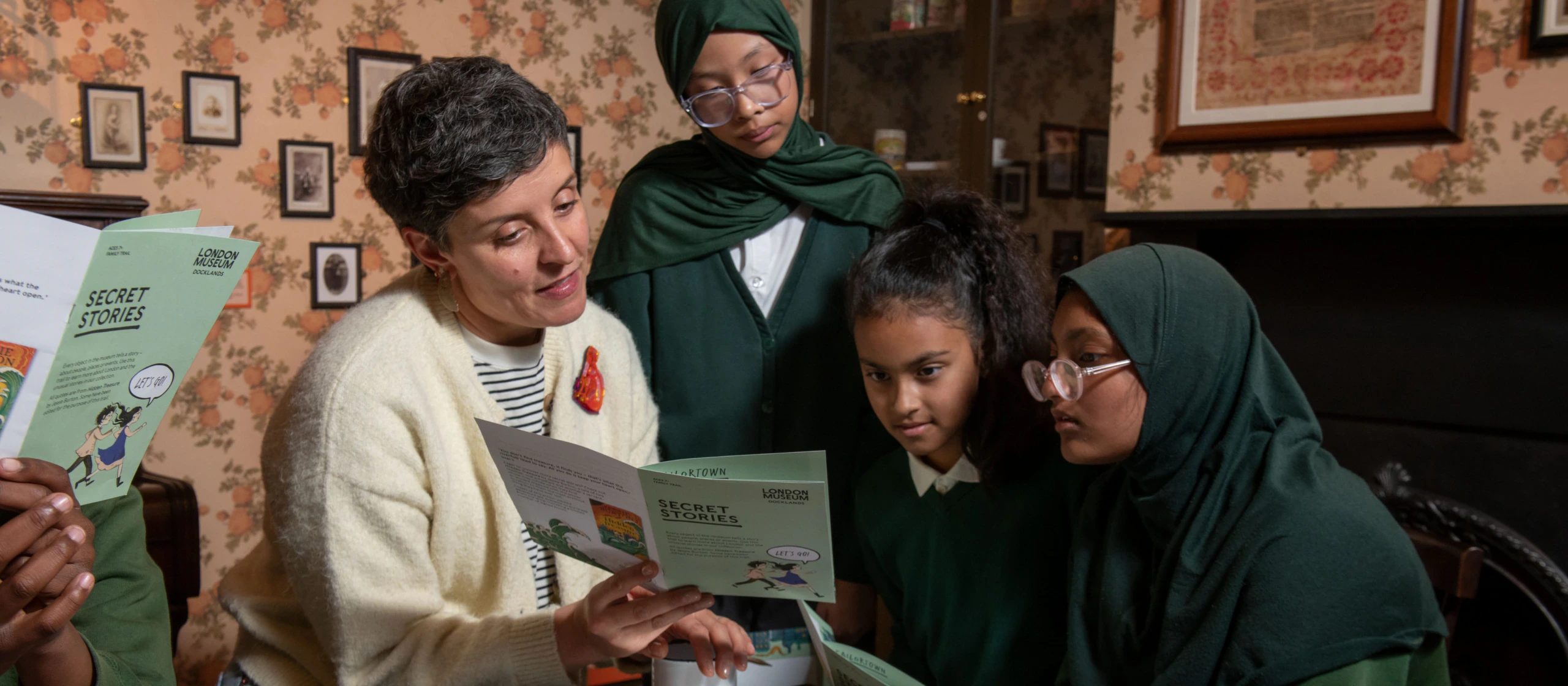
This might involve asking an illustrator to develop a narrative character or mascot that embeds storytelling within the museum. The London Museum Docklands developed a trail for under-12s with author Jessie Burton, based on the characters from her children’s book Hidden Treasure, which coincided with the Secrets of the Thames, an exhibition about mudlarking.
The museum’s learning manager, Cassandra Tavares Alen, says the aim was to create a tangible link between objects on display and characters in the book. All the objects featured were part of the museum’s permanent galleries, to give the trail longevity and ensure that entry to the ticketed exhibition wasn’t a barrier for anyone.
While a single, permanent trail might suit a site where objects are rarely moved, several offerings built around a temporary exhibition or individual themes can encourage return visits.
Permission to play
Embedding variety within a trail encourages visitors to use their imagination, while ensuring that it appeals to different age groups and abilities, and creates an inclusive space to promote play – cultivating a sense of belonging in what can be an intimidating space.
Although “find the object” tasks are a hallmark of most trails, there are other things to consider. You could ask users to search for specific shapes or colours, or inspire them to imagine and imitate the sounds a particular display might make.
While working at English Heritage, Shaw developed trails that encouraged new ways of engaging with the space.
“We might ask: ‘Are you going to creep up like a spy, or charge like an attacking army?’,” she says. “It gives permission to play.”
By encouraging activities such as drawing and physical movement, there is less pressure on families to “complete” a trail, which might seem overwhelming for children and carers alike. It also encourages adults to unlock their own creative imagination.
The People’s History Museum in Manchester developed a trail as part of its 2019 exhibition The Past, Present and Future of Protest that invited visitors to take photos of objects that inspired them or strike a pose in the gallery.
“It encouraged older children and teenagers to take part, while leaning into the fact they might want to be on their phone,” says Shaw.
Be visible
Ensuring that a trail is easily accessible and visible to prospective visitors is just as important as its creation.
At Brighton & Hove Museums, resources such as trails are displayed on A-boards at the ticket desk, while London Museum Docklands has a permanent family welcome desk where visitors can access a range of printed resources on entering the site.
Having a dedicated landing page on the museum’s website will highlight a trail’s availability, allowing families to plan ahead. Producing a downloadable option also means that visitors can either print a trail themselves or access it via their phone on site (which can also be advertised within the museum via a QR code).
The British Museum in London hosts eight activity trails on its website, with easily digestible information concerning age suitability and theme. These can be downloaded and accessed within the galleries as physical and digital copies.
To promote a trail beyond the museum’s own marketing channels, reaching out to local family groups, schools and social media influencers can prove an excellent way to get the word out. These groups could also be invited to test trails ahead of their official launch, which might offer useful feedback.
Know your limits
Planning a trail demands a clear budget and realistic goals for its implementation. Freelance designers and illustrators often provide a series of packages – ranging from a few hundred to thousands of pounds – that provide anything from basic illustration for a pre-planned trail to consultation and building a trail from scratch.
Hartshorn says many freelancers will offer a suite of images that can be used in different situations. “People might not always have a big budget, so I offer images on a programme like Canva,” she says. “Members of the team can then utilise and develop them in the future.”
Working on projects in-house is also possible. There are plenty of resources available online that will help you build a trail, including on the Kids In Museums website, which was developed in conjunction with Shaw.
Royalty-free imagery and assets are also available through a variety of platforms, including Canva and Adobe Express. Tapping into the knowledge of staff and volunteers, who are familiar with audiences, can be fruitful when brainstorming ideas and troubleshooting a trail’s development.
It is also important to get the basics of a museum visit right. “It doesn’t matter how much you’ve spent on a trail if it’s not supported by a great welcome,” says Shaw.
To help future-proof your work, consider setting aside a budget to reprint single-use sheets if they run out, as well as offering laminated ones. Training staff is also important. And don’t forget to factor in additional materials such as colouring pencils and felt pens – and perhaps even sensory backpacks.
“When a trail is done well, the feedback we receive is ‘it shows me you’ve thought about me, you want my family to have a great day and we’ve made the right decision to come’,” says Shaw.
Holly Black is a freelance journalist


This is a great article! Will refer back to this when creating trails. 🙂