Is it possible to creae a zero-waste exhibition? A decade ago, the answer was probably not.
But museums and designers have upped their ambitions in the past few years, experimenting with different materials, circular economies and radical new ways of working to reduce the waste produced by temporary exhibitions and ensuring that any new display – even “permanent” ones designed to last for 25 years – have sustainability built in from the offset.
Museums Journal spoke to exhibition designers to discover how they are working to improve the environmental sustainability of their shows.
Interested in the latest approaches to exhibition design?
Join us in London on 18 March for Show Time: Designing Great Exhibitions
Material Cultures
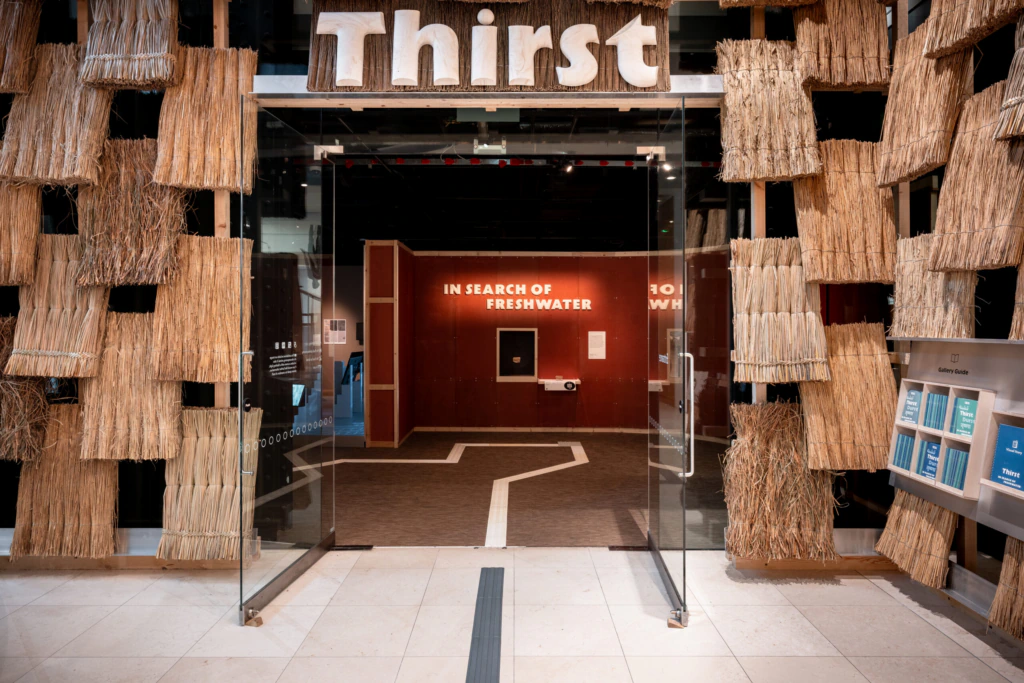
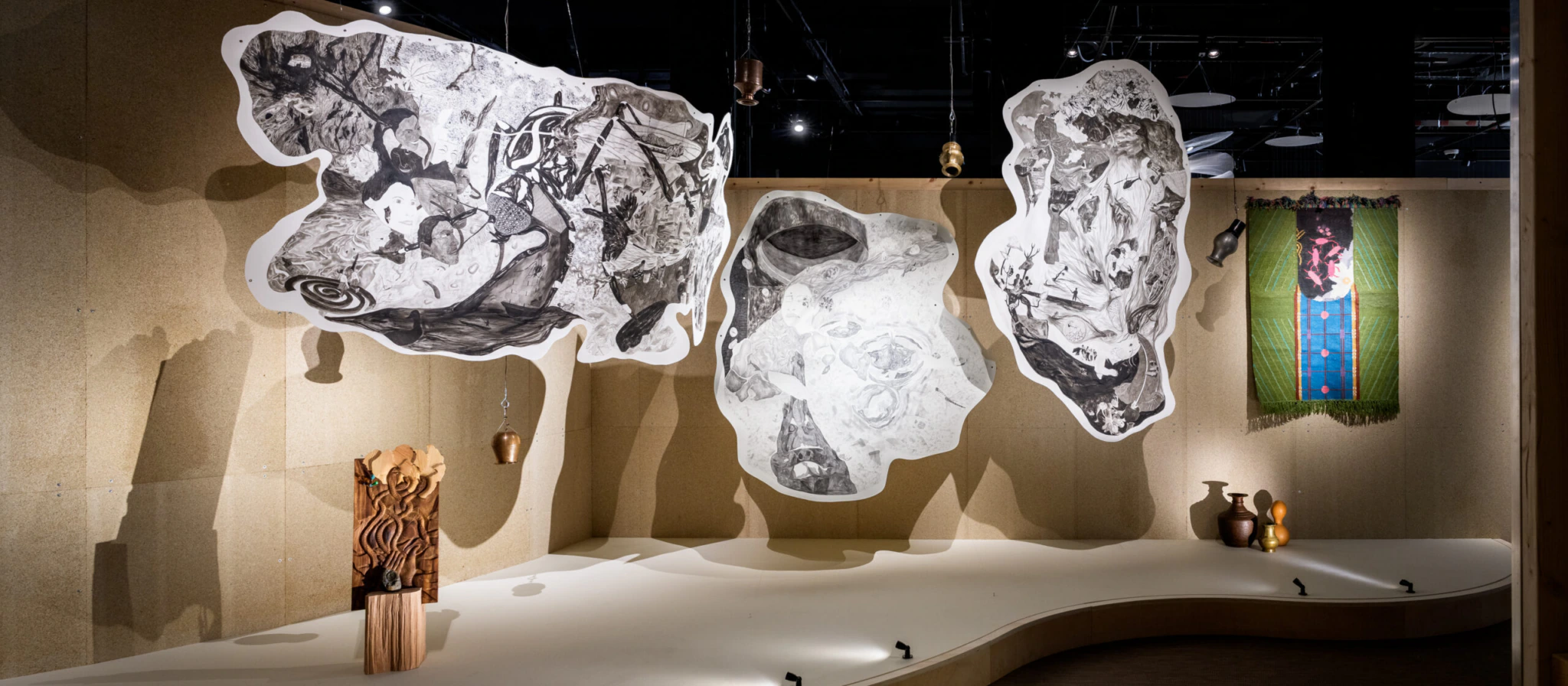
Material Cultures is a not-for-profit design and research organisation working with natural materials, low embodied carbon construction and construction technology. In 2021, it acted as the spatial designer for the Waste Age exhibition at London’s Design Museum, and last year worked with the Wellcome Collection on Thirst: In Search of Freshwater (until 1 February).
Advertisement
“It’s interesting to work with institutions that are open to dismantling old systems and bringing in processes that move away from the culture sector’s high levels of waste [from temporary exhibitions],” says George Massoud, a director at Material Cultures.
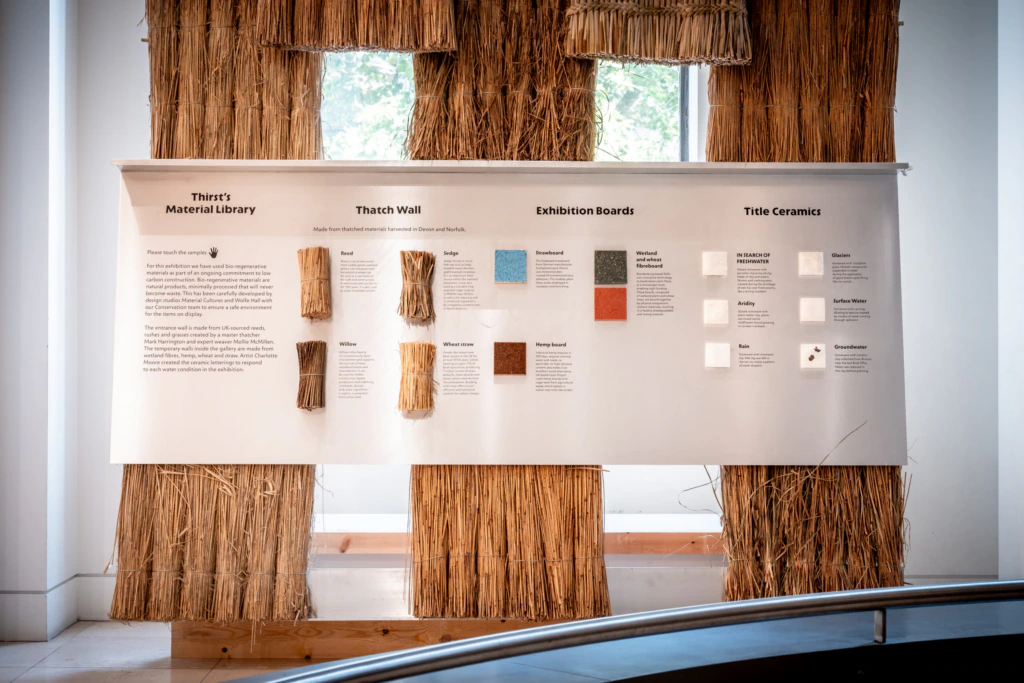
A lot of the material deployed in Thirst is reused from previous exhibitions (the Wellcome Collection benefits from spacious storage), but the team wanted to move away from using new MDF, plasterboard and plywood. It focused instead on regenerative resources including:
- Biobased strawboard from German manufacturer Strohplattenwerk Müritz, which uses mineral binders instead of synthetic adhesive.
- Wetland and wheat fibreboard produced by German-based Zelfo, which are bound together by physical compression and are free of any chemical binding agents.
- Hemp bio-resin board made in the UK by Loam Project.
Working with natural materials throws up many challenges, such as a potential lack of certification, and they often come from small or micro businesses.
Massoud says: “It’s hard to move away from traditional materials. They are part of a global supply chain and institutional in themselves.”
There is also a perception that they cost more.
Advertisement
“We factored this in from the start, but in the end, they didn’t cost that much more than plywood – but they are significantly less environmentally damaging,” says Massoud.
The team is working with the Urge collective on a full environmental impact assessment of the exhibition, including the carbon cost of transport materials from Germany.
But Massoud says carbon should not be the only measure of sustainable exhibitions and hopes that Thirst demonstrates a different model produced in a more circular and regenerative way.
“These materials are not a silver bullet, and [as designers] we had to change the way we worked and plan differently in order to use them effectively,” he says. “One of the challenges is that we factor that development into our design proposals, so it means we come across as more expensive. Museums’ budgets need to change to reflect the radical work that is needed.”
Casson Mann
The museum and exhibition designer’s recent work, such as Showtown in Blackpool and the Musée National de la Marine in Paris, have focused on fun, engaging and immersive experiences.
Advertisement
This approach is not incompatible with having an environmental stance.
Over the past year, the agency has also worked with Urge to develop and run a bespoke green-skills training programme for its team of exhibition designers. Sessions have covered carbon literacy, the impact of materials, writing specifications and working with clients and contractors – topics that the team felt would have the most impact on their work and help shore up existing skills.
A recent survey of Casson Mann’s designers revealed that 91% feel confident in knowing what materials to choose. But building specialist skills and knowledge is an ongoing process and the challenges of industry standards, limited project budgets and conflicting client priorities remain.
The company has created a green-skills training manual featuring a range of resources and tools that can be used to inform decision-making on projects.
This manual is being piloted for an ongoing exhibition project at the Royal Observatory Greenwich. The scheme includes the Longitude gallery, which will get visitors thinking about the wonders of astronomy and time.
As Casson Mann wants to make the project a benchmark for sustainability, it designated one of its designers a sustainability champion, tasked with measuring designs against sustainability priorities agreed with the Royal Observatory.
It also created a decision-making tool that guides designers towards suggested actions based on the project’s core priorities (durability, adaptability, reuse and reduce).
“For each proposed design material, we are evaluating alternative options using material databases and conducting thorough comparisons,” says Izzie Cullen, content developer at Casson Mann. “We are exploring using the same materials across many spaces but with different finishes to give the galleries a varied look and feel while also benefiting from economies of scale and reducing waste.”
Future reuse is also factored into the designs.
“Instead of seamless surfaces and invisible joints, our designs show the junctions between parts, giving the exhibition furniture a ‘constructed’ look,” says Cullen says.
“We have opted for exhibition furniture that is mechanically fixed – not bonded or glued – so that it can be dismantled and reused to a significant extent whenever the exhibition closes.
“Our experience on the Royal Observatory Greenwich project goes to show what a difference having a strategy and a shared vision can have. Practical solutions, devised early in the process, combined with a commitment to do things well makes sustainable design wonderfully possible.”
Unknown Works
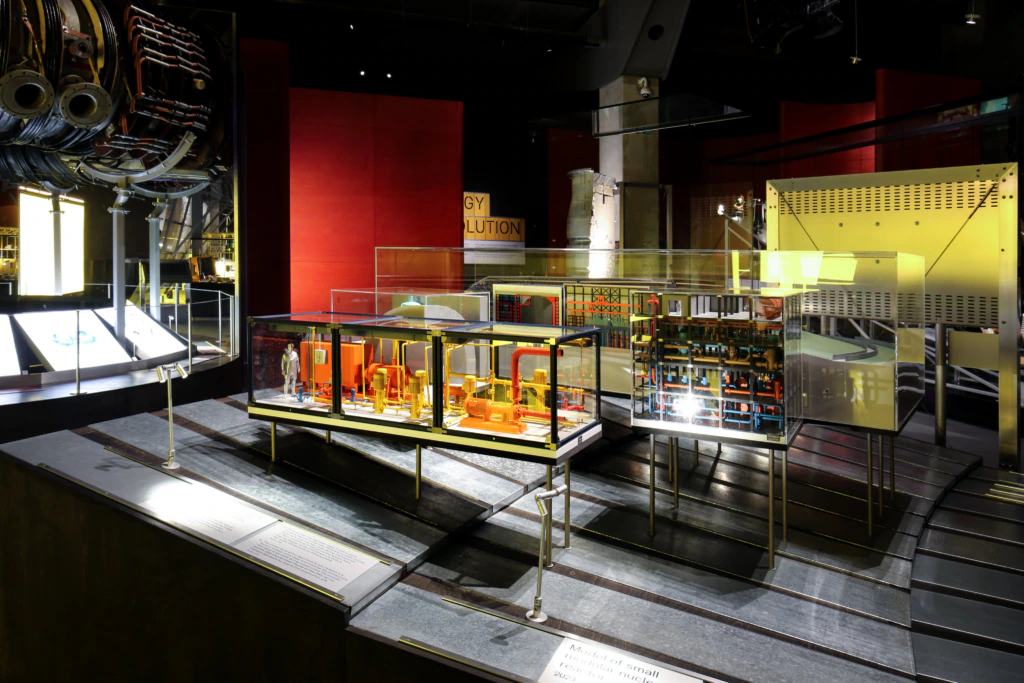
The Energy Revolution Gallery at the Science Museum is a permanent exhibition that examines the rapid energy transition and the decarbonisation of systems and means of production needed globally to limit climate change.
Conceived as a benchmark for the production of low-carbon exhibition spaces, exhibition design company Unknown Works used circular material principles to echo its decarbonisation focus. The most notable example in the case of Energy Revolution is the repurposing of 225 redundant galvanised-steel shelves and associated steel structures – previously held at the Science Museum’s Blythe House object storage facility – into sleek display plinths.
Elsewhere, materials with low or negative-embedded carbon were prioritised, such as recycled aluminium and Marmoleum flooring.
Sustainable timber was sourced and certified, where appropriate, to reduce the embodied impact, including in the curved walls of the threshold spaces and the plinth side panels. Low-carbon materials, such as prototype hydrogen-fired bricks, were integrated in a bench.
The carbon impact of materials was key to how they were sourced. The shelf structures, for example, moved solely between Kensington and Surrey, and 96% of materials were procured from within 100km of the site. Other KPIs were set as part of the tender process for contractors, to ensure energy use, transportation, carbon and waste were kept to a minimum.
These can now be benchmarked against in further fit-out projects at the museum.
The design also showcases new manufacturing techniques, such as roboforming. A topographic model demonstrating the Orkney Islands’ hydrogen and wind technologies was created by utilising low-energy, robotic sheet metal-forming fabrication technology on the repurposed shelves.
The studio collaborated with Thomas Pearce, professor for emerging technologies and design at the Bauhaus-Universität Weimar, and the Architectural Association’s Hooke Park digital fabrication resources, to prototype and manufacture this.
Unknown Works’ website says: “The design was developed using whole-life carbon assessment as a design tool to reduce the design-stage carbon footprint, supporting the Science Museum’s pathway to becoming net zero by 2033. This approach also addresses the highly wasteful nature of exhibition design and aims to set a new benchmark for sustainability in large-scale cultural production.”
Nissen Richards Studio
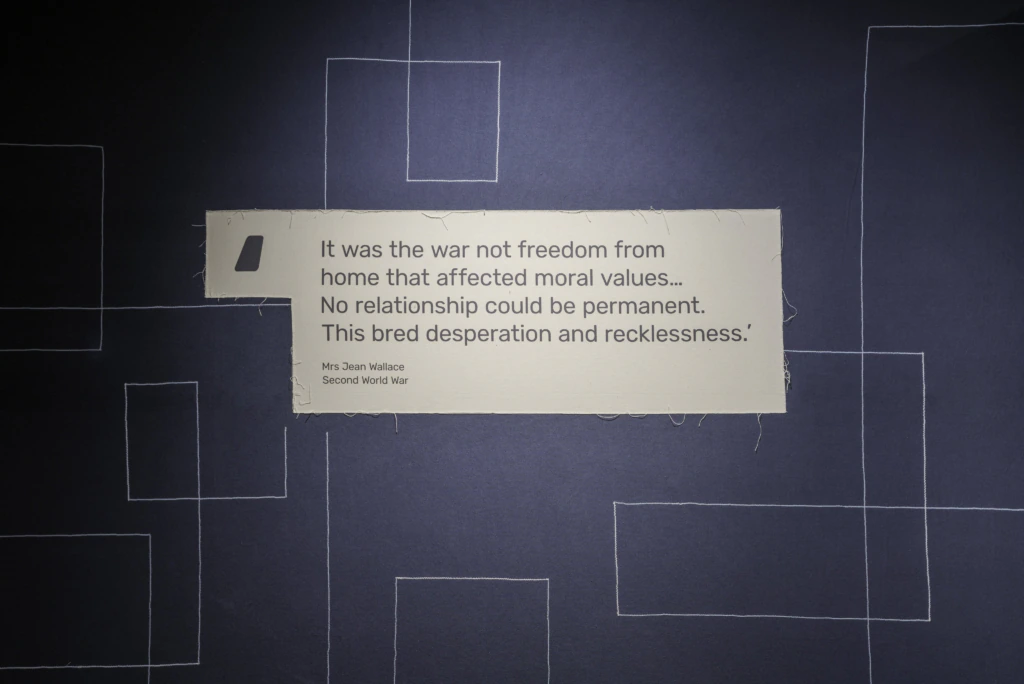
The Imperial War Museum London’s Unsilenced: Sexual Violence in Conflict (23 May-2 November 2025) addressed a subject that inevitably shaped the design approach.
Pippa Nissen, director at Nissen Richards Studio, says: “The subject – sexual violence in conflict – demanded a design language that was restrained, respectful, and human. Nothing could be overblown or theatrical – clarity and sensitivity had to lead every decision.”
This approach dovetailed with sustainability, which Nissen explains asks for “restraint and economy of means”. One area in which this was realised was through the choice and use of materials.
“We ‘de-walled’ the exhibition wherever possible, replacing solid partitions with fabric stretched over lightweight frames,” says Nissen. “This immediately reduced the amount of material required and generated far less waste, while giving the space a crafted, humane quality.”
The main challenge was balancing conservation and the subject matter with sustainability. Fragile artefacts, for example, required highly controlled environments and robust display solutions that were
less recyclable.
Nissen says: “Rather than seeing these as failures, we treated them as necessary trade-offs. Sustainability is not perfectionism; it’s about pushing forward where possible, while accepting the limits of reality.”
The team didn’t employ formal measures or tools but used sustainability as a lens through which it considered the entire process, not just the physical build.
This included transportation and logistics, with the aim of reducing site deliveries, limiting unnecessary physical visits and handling information exchanges digitally.
“Success was judged on whether we had managed to reuse rather than replace, reduce rather than multiply, simplify rather than overproduce, and build with quality,” says Nissen. “While we lacked hard data, the ethos was clear: doing more with less and embedding care into the making of the exhibition.”