According to the National Autistic Society, 700,000 people in the UK are on the autism spectrum. When family members and carers are taken into account, the total number of people affected is close to three million.
Autism is characterised by trouble with social interaction and communication, issues with certain social norms, and a preference for order over chaos.
As places with a range of audiovisual stimuli and often large crowds, museums are full of potentially upsetting situations for an autistic child. A report by the National Autistic Society showed that 50% of autistic people and their family members are so worried about other people’s reactions to their autism that it sometimes or often stops them from going out entirely.
It is easy to see that a museum might not seem like an easy place for a child with autism to visit, but museums have a responsibility to make themselves as accessible as possible to all.
Relaxed atmosphere
One way that museums can offer a solution is to offer relaxed openings outside normal opening hours, giving families a chance to enjoy the museum with fewer visitors and exhibits that could be overwhelming turned off or removed from display. One museum offering relaxed openings is Bletchley Park’s National Museum of Computing. Even with a relaxed opening, however, the difficulties of autism are evident.
“At one of our relaxed openings, we had had to move some exhibits around to accommodate other things that were happening, and one of the kids reacted badly to this because the VR activity he was used to wasn’t set up in the place he was expecting,” says Anne-Marie Sandos, the head of learning.
In a smaller space such as the one at the National Museum of Computing, changes to the museum’s layout are often necessary to mitigate the impact of events. The museum has a chill-out zone with beanbags and subdued lighting where visitors can relax. In Halifax, Eureka! The National Children’s Museum has a similar space, although it doesn’t do relaxed openings.
“Because of our core audience, if you’re holding relaxed openings during the week after hours you’re impacting on their day and on school and the rest of the week,” says Trizia Wells, Eureka!’s inclusion manager.
Eureka! is very much a leader in providing disabled access, as a purpose-built museum for children aged 0-11.
“That demographic is our core audience, but because of this we have always been popular with groups of learning and physically disabled young adults,” says Wells. “So, it’s really been in our DNA from the beginning.” The museum’s other naturally inclusive attributes include its wide pathways for buggies and wheelchair users.
Clear signage is an obvious step, but the National Museum of Computing has avoided using autism-specific language such as Makaton, the programme designed to help people who can’t communicate effectively by speech.
“I know other settings will use Makaton, but we haven’t gone down that road,” says Sandos. “With autism being a spectrum disorder, we don’t want to pigeonhole autistic people and say, ‘an autistic person is like this’.”
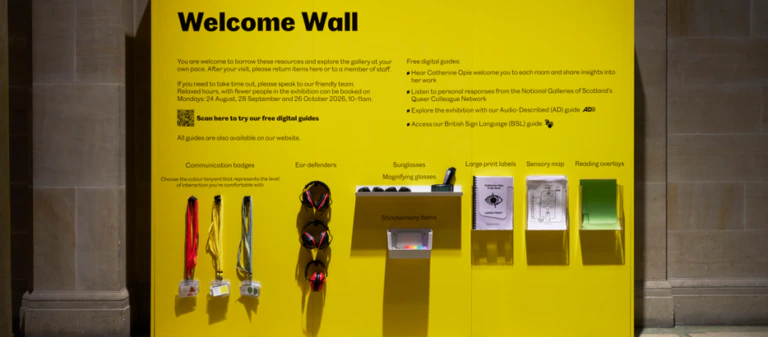
It also helps families to have as much information as possible available prior to a visit. To that end, many museums (from the National Museum of Computing to the Metropolitan Museum of Art in New York) now provide pdf-format sensory maps on their websites. These highlight what each area is likely to contain in terms of lights, sounds and crowd footfall.
Another useful pre-visit amenity is a “visual story”, which is a step-by-step guide to visiting the museum for the first time, with pictures. The NMC has one on its website, and Eureka!’s visual story includes specifications to the millimetre about how large its lifts, doors and routes are – as well an Access All Areas YouTube video that explains the museum’s areas and attractions, and how they and its staff cater to children with disabilities.
These maps and visual stories are particularly important at Eureka!, where nothing is in cabinets: the museum is completely interactive.
Museums can also help by employing front-of-house staff who are themselves on the autistic spectrum. Due to the difficulty of social interaction for many people with autism, it can be hard for adults to get a job – but the onus is on employers to get a better grasp of the condition and work on making the workplace more amenable to people with autism.
Staff training enables the museum to better assist people with learning disabilities (Eureka!’s front-of-house staff are trained in British Sign Language and are called Enablers), but by employing people with autism in both voluntary and paid positions, museums can highlight and improve their level of accessibility.
The Museums Association will be running a one-day conference next year as part of its Future of… series. The Future of Museums: Learning and Engagement will take place on 27 March 2019 at the National Museum of Scotland, Edinburgh. Speakers will include, 20 years after the publication of the influential A Common Wealth: Museums in the Learning Age, its author, David Anderson. Click here for more.