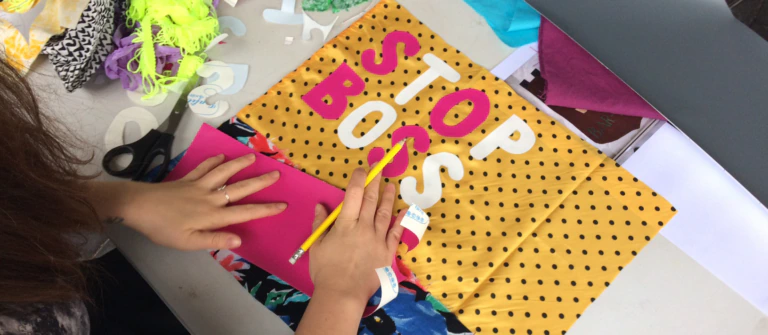
Textiles are closely bound up with the human experience. Whether clothes, furnishings or works of art, they reflect many aspects of our lives and heritage.
Various museums in the UK and worldwide have been founded solely to collect and display textiles, but many more museums and historic houses have examples in their collections.
These range from 15th-century tapestries, embroidered shoes and Navajo rugs to Victorian wedding gowns and wartime uniforms.
Textiles are popular with visitors, increasingly so due to the resurgence of interest in related crafts such as weaving, spinning and dyeing, and in modern fashion pieces.
Two exhibitions last year showed that textiles can be a big draw for vistors. A newly-commissioned tapestry, The Caged Bird’s Song, by the artist Chris Ofili at the National Gallery in London (April-August 2017), and Entangled: Threads and Making (January-May 2017) at Turner Contemporary in Margate both achieved high visitor numbers.
Taking care
Of almost any category of museum object, old or new, textiles require the most care in terms of storage, conservation, display and interpretation.
Those responsible for their care need to know the complex terminology of weaves, threads and techniques, and must understand the chemical and biological processes that cause damage and deterioration.
But the rewards are high. Many textile items are masterpieces of craftsmanship, beautiful in their own right. Others may be plainer, yet offer a unique way to convey aspects of social, economic, cultural, political and industrial history.
American fashion historian and academic Chloe Chapin has studied how museums around the world interpret their textile collections.
“Many exhibitions tend towards appealing to the middle road, while ignoring those who know nothing about fashion and textiles, and those who know a great deal,” she says. “It’s not only possible but vital to address the needs of these three categories of visitor.”
Providing context helps to engage reluctant visitors. “Say you have a very old and rare priest’s chasuble,” Chapin says. “So what? Tell us a story. Tell us how much it cost or who wore it or how uncomfortable it was to wear.”
Related objects, such as photographs, illustrations, oral history, film and other media, can all help with interpretation – especially where textiles lack immediate impact.
“Visitors will gravitate towards the elaborate silk ball gown, bypassing the linen bedsheets, even though the bedsheets might have a richer history,” says Valerie Wilson, the curator of costume and textiles at National Museums Northern Ireland.
“This is where the personal stories of usage, repair and manufacture can be explored to good effect.”
This view is shared by Dan Coughlan, the curator of textiles at Paisley Museum in Renfrewshire, Scotland. The museum is soon to undergo a multimillion pound transformation, with textiles at its heart.
“The redisplays will be object-based, bringing out the social history and global connections of the town resulting from its textile industry,” Coughlan says. “Although the Paisley pattern is well known, the weavers themselves were noted for their self-education and literacy, so their story needs to be told.”
Please touch
The desire to involve audiences more effectively has led to many museums offering textile handling opportunities.
Even couture exhibitions, such as the Christian Dior: Couturier du Rêve staged at the Musée des arts decoratifs in Paris in 2017, may have areas where visitors are allowed to touch or try on clothes.
“Touching or wearing textiles allows a greater sense of connection to the object,” says Julia Cort, the community learning manager at the Horniman Museum and Gardens in London. “Our Hands On Base handling gallery breaks down some of the barriers to visiting that some of the more marginalised members of the community face.”
Textile items in the Horniman’s handling collections come from donations, field trips or are created as project work.
“Authenticity is vital; this doesn’t mean it must be very old or from very far away,” Cort says. “We recently bought a shirt from Brixton market with a design derived from Kente cloth, traditionally made for Ashanti kings and queens.
“This can allow visitors to think about where the designs for modern fabrics have come from and reflect on their own cultural heritage.”
Get connected
Caring for textiles is challenging at a time when resources are increasingly stretched. But links between textile curators are strong, and professional expertise can be found online or through networks.
Advice on all aspects of care is available from large organisations such as the Victoria & Albert Museum in London and Museums Galleries Scotland in Edinburgh. There are also UK-wide groups such as Dress and Textile Specialists (DATS), the Textile Society and the Quilters’ Guild, as well as international forums such as the ICOM Costume Committee.
“Staff at smaller local museums should be proactive about joining networks and using them for information and resources,” says Valerie Wilson. “Take institutional membership of as many textile groups as possible and attend conferences if you can. If the cost is prohibitive, online resources and social media become especially valuable.”
Various museums in the UK and worldwide have been founded solely to collect and display textiles, but many more museums and historic houses have examples in their collections.
These range from 15th-century tapestries, embroidered shoes and Navajo rugs to Victorian wedding gowns and wartime uniforms.
Textiles are popular with visitors, increasingly so due to the resurgence of interest in related crafts such as weaving, spinning and dyeing, and in modern fashion pieces.
Two exhibitions last year showed that textiles can be a big draw for vistors. A newly-commissioned tapestry, The Caged Bird’s Song, by the artist Chris Ofili at the National Gallery in London (April-August 2017), and Entangled: Threads and Making (January-May 2017) at Turner Contemporary in Margate both achieved high visitor numbers.
Taking care
Of almost any category of museum object, old or new, textiles require the most care in terms of storage, conservation, display and interpretation.
Those responsible for their care need to know the complex terminology of weaves, threads and techniques, and must understand the chemical and biological processes that cause damage and deterioration.
But the rewards are high. Many textile items are masterpieces of craftsmanship, beautiful in their own right. Others may be plainer, yet offer a unique way to convey aspects of social, economic, cultural, political and industrial history.
American fashion historian and academic Chloe Chapin has studied how museums around the world interpret their textile collections.
“Many exhibitions tend towards appealing to the middle road, while ignoring those who know nothing about fashion and textiles, and those who know a great deal,” she says. “It’s not only possible but vital to address the needs of these three categories of visitor.”
Providing context helps to engage reluctant visitors. “Say you have a very old and rare priest’s chasuble,” Chapin says. “So what? Tell us a story. Tell us how much it cost or who wore it or how uncomfortable it was to wear.”
Related objects, such as photographs, illustrations, oral history, film and other media, can all help with interpretation – especially where textiles lack immediate impact.
“Visitors will gravitate towards the elaborate silk ball gown, bypassing the linen bedsheets, even though the bedsheets might have a richer history,” says Valerie Wilson, the curator of costume and textiles at National Museums Northern Ireland.
“This is where the personal stories of usage, repair and manufacture can be explored to good effect.”
This view is shared by Dan Coughlan, the curator of textiles at Paisley Museum in Renfrewshire, Scotland. The museum is soon to undergo a multimillion pound transformation, with textiles at its heart.
“The redisplays will be object-based, bringing out the social history and global connections of the town resulting from its textile industry,” Coughlan says. “Although the Paisley pattern is well known, the weavers themselves were noted for their self-education and literacy, so their story needs to be told.”
Please touch
The desire to involve audiences more effectively has led to many museums offering textile handling opportunities.
Even couture exhibitions, such as the Christian Dior: Couturier du Rêve staged at the Musée des arts decoratifs in Paris in 2017, may have areas where visitors are allowed to touch or try on clothes.
“Touching or wearing textiles allows a greater sense of connection to the object,” says Julia Cort, the community learning manager at the Horniman Museum and Gardens in London. “Our Hands On Base handling gallery breaks down some of the barriers to visiting that some of the more marginalised members of the community face.”
Textile items in the Horniman’s handling collections come from donations, field trips or are created as project work.
“Authenticity is vital; this doesn’t mean it must be very old or from very far away,” Cort says. “We recently bought a shirt from Brixton market with a design derived from Kente cloth, traditionally made for Ashanti kings and queens.
“This can allow visitors to think about where the designs for modern fabrics have come from and reflect on their own cultural heritage.”
Get connected
Caring for textiles is challenging at a time when resources are increasingly stretched. But links between textile curators are strong, and professional expertise can be found online or through networks.
Advice on all aspects of care is available from large organisations such as the Victoria & Albert Museum in London and Museums Galleries Scotland in Edinburgh. There are also UK-wide groups such as Dress and Textile Specialists (DATS), the Textile Society and the Quilters’ Guild, as well as international forums such as the ICOM Costume Committee.
“Staff at smaller local museums should be proactive about joining networks and using them for information and resources,” says Valerie Wilson. “Take institutional membership of as many textile groups as possible and attend conferences if you can. If the cost is prohibitive, online resources and social media become especially valuable.”