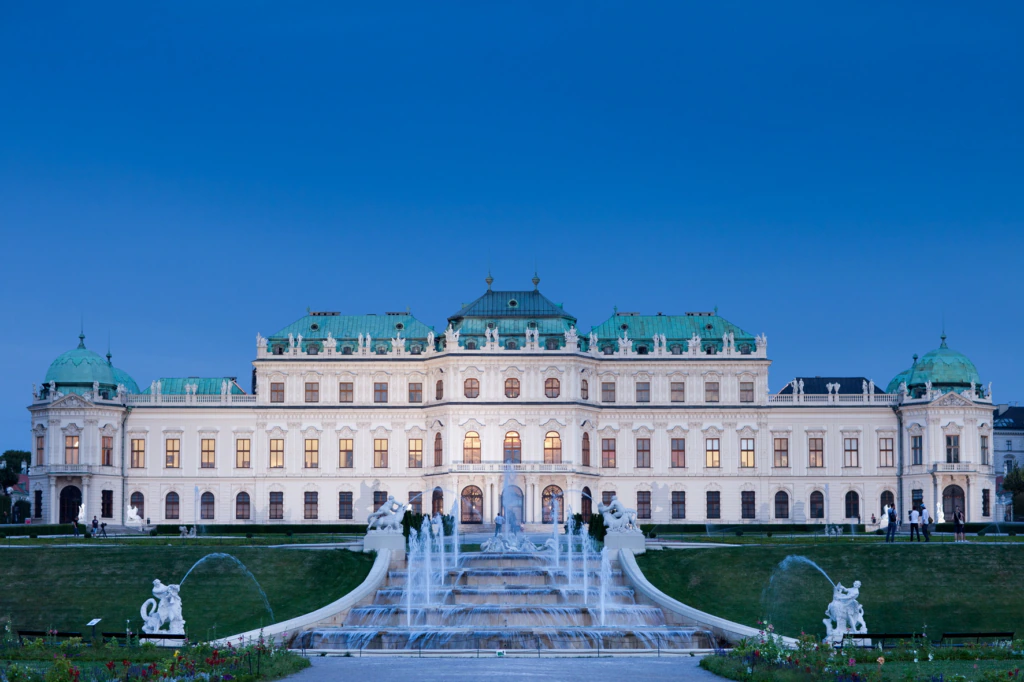
At Vienna’s Belvedere Museum, in the Upper Palace, hangs a portrait of Prince Eugene of Savoy, by Johann Gottfried Auerbach, from the early 18th century.
The prince, in his later years, stands in a pose of a commander, wearing gold-encrusted ceremonial armour and pointing a commanding stick towards a battle in the background while staring directly at you.
None of these elements are particularly unique for a Baroque portrait of a commander, but with so few artistic depictions of the prince – who once owned the palace – from this period, it is a celebrated piece in the collection.
However, the first time I saw it something else about the picture caught my eye and stuck in my mind. Standing next to him is a young Black man wearing a turban, a golden cape and an indigo suit while holding Prince Eugene’s helmet.
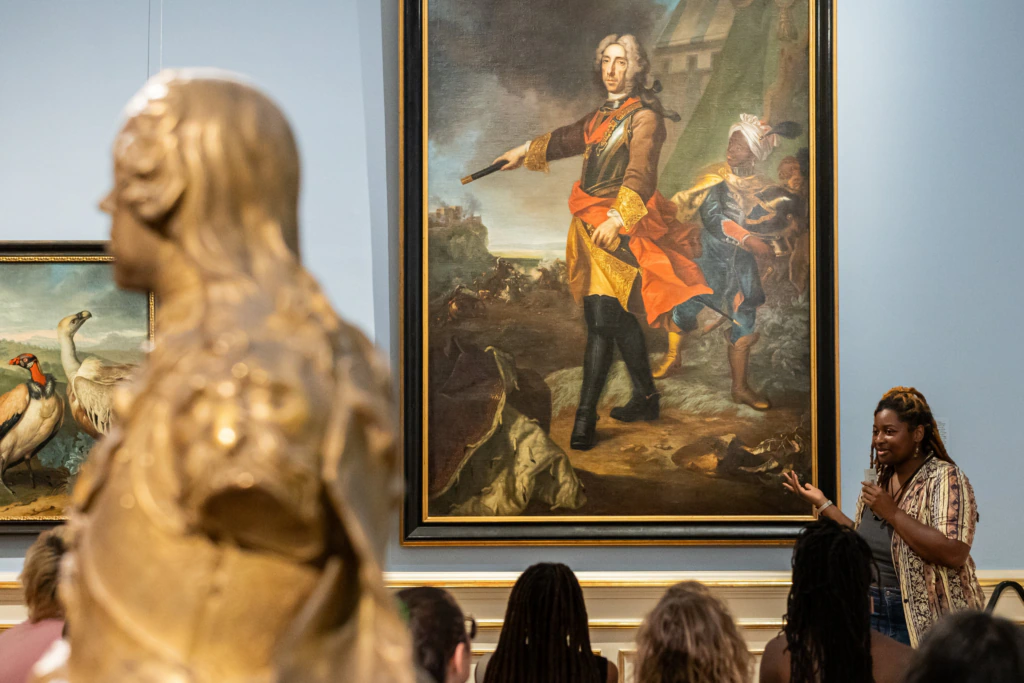
The man is gazing pensively at Eugene, as though waiting for an order. At first glance, he could be someone of a high status because of his fine clothing, or maybe a servant because he is assisting the prince. But if you look closer, you can see his neck is enclosed with an iron collar.
Advertisement
There was, at the time, no information on the label about who this young man was or what his depiction represented. His name, where he came from, why he was dressed the way he was – all this was a mystery.
It only stated: “The presence of the dark-skinned page is interesting, as there is no record of any such members in the Prince of Savoy’s household.” I was eager to know more.
Slavery in Austria’s artwork
A few years later, giving a publicly guided tour at Belvedere, entitled In Focus: Turning the Page, Representations of Blackness, it became apparent that not everybody shared my curiosity.
The tour explores the themes of Black iconography in European artwork, the historical presence of Black people in Austria, Austrian colonial history, biological racism and genocide.
As we approached Prince Eugene’s portrait, I gave a brief overview of Austria’s Black presence in the 18th and 19th centuries and the role of enslaved Black people in Vienna, who were primarily purchased by aristocrats for the purpose of not only labour, but entertainment, too – often as decorative accessories to communicate the wealth of their enslavers.
Advertisement
We discussed how the portrait related to perceptions of Black enslaved people at the time and the ways in which those perceptions influenced how Black people were represented in the artwork of this period.
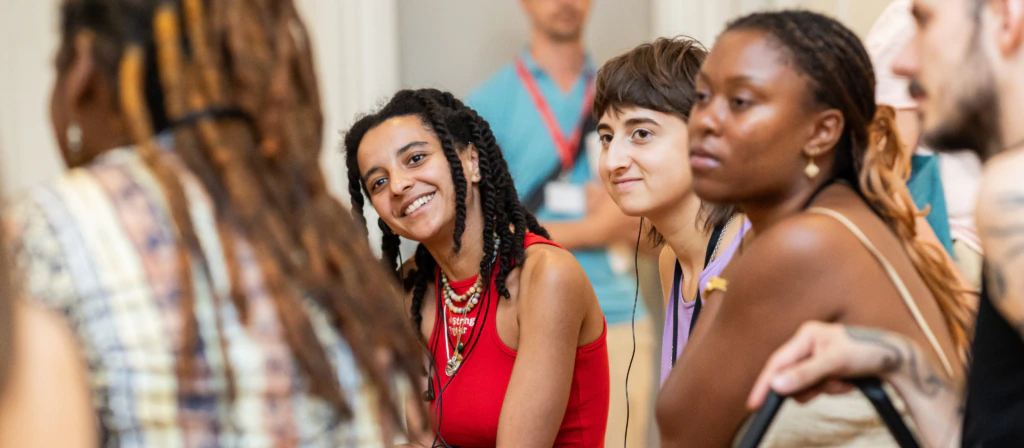
When we moved on to the discussion portion of the tour, a white American woman could not contain her frustration.
Complaining that I was “imposing” a racist analysis on the artworks and demanding to know why I had not addressed the enslavement of the Irish and the Germans, she launched into an invective of whatabouttery.
I asked her how describing a historical reality was “imposing” an analysis. She struggled for a rebuttal but remained adamant that we “shouldn’t make everything about race”.
Other, younger attendees, responded, unleashing a robust discussion before things calmed down. The young attendees spoke with passion and slight impatience, frustrated that they have to debate whether the depiction of an enslaved Black person is racist.
Advertisement
I recall the air of discomfort in the space. Black history is an uneasy topic, even in Austria.
As an African American born and raised in Georgia, I’m used to difficult conversations about race and racism. My move to Vienna had not been intentional. I had applied to the comparative history master’s programme at Central European University (CEU) in Budapest.
But when the CEU refused to shut down its Gender Studies Program at the behest of Hungarian prime minister Victor Orbán, it moved to Vienna and so did I.
Engaging minorities
Always more interested in the marginal than the powerful – I had previously focused on Europe’s Romani communities – I helped develop strategies to encourage more minoritised people to visit the palace as part of a curatorial and community engagement fellowship with the museum in 2023. It was after this fellowship that I began giving the Representations of Blackness tour.
The Belvedere was clearly already on a journey. By the time I started working there the labelling of Prince Eugene’s portrait had been changed to read: “Functioning as an exoticised secondary figure, a black page appears at his side who holds the helmet of the ceremonial armour and whose stereo-typical depiction, from today’s perspective, belongs to a racist pictorial tradition.”
But that still left questions, such as what exactly was this “racist pictorial tradition”? I was asked to develop a concept for a way to intervene and historicise the representation of the young, enslaved page, which is where the idea of the Representations of Blackness tour was born.
In the tour I begin to untangle how Black people are depicted in the works of the Belvedere’s collection.
So, we contextualise pieces such as Johann Knapp’s 1821-22 painting Huldigung an Jacquin (Homage to Jacquin), a piece that shows reverence to Carl Linnaeus, whose work as a biologist and botanist contributed to the origins of scientific racism; The Golden Cabinet, a gold-encrusted room with racialised depictions of the four continents, which helps us to contextualise Austria’s colonial entanglements; Freundinnen (Friends), a 1938 work by the Austrian artist Hans Böhler that depicts Selma Burke, an African American sculptor of the Harlem renaissance who studied in Vienna in the 1930s, and many more.
Since September 2023, I have given at least 50 Representations of Blackness tours to the public and to middle school, high school and university students, community organisations and other groups.
The tour was originally only slated for two specialised public tours, but due to significant interest, the project continued and expanded. To date, the tour has spawned variations including a poetry tour, a lecture series, and an audio version that visitors can listen to from home.
Initially, there was doubt among the team about how interested the public would be on this topic and a concern that people may be offended by the exploration into this history.
Nothing could have been further from the truth. I was not surprised, as I know communities of colour in Austria have yearned for programming that critically engages with this country’s history.
Adding to the debate
Reflecting on the discussion that almost derailed the tour, I felt as if it was emblematic of the current debate on how and if we should discuss the history of racism and colonialism, – and its sensitivity – in public forums.
I also thought about my role as a Black person giving this tour. Do people take me seriously or just see me as a roaring activist cosplaying as a historian? Would they take it more seriously if a white person gave the tour?
But these thoughts are often combatted by the many people of colour who have attended the tour and said this was the first time for many of them to be guided in an exhibition by a Black person, and how it is important in terms of not only learning the history, but the feeling of representation.
“Communities of colour in Austria have yearned for programming that critically engages with this country’s history”
One of my fondest experiences was giving the tour to a group of 13- and 14-year-olds from a school in Baden, on the outskirts of Vienna. The students represented diverse religious, migrant and ethnic backgrounds and were shocked at the information about violence , colonialism and biological racism.
When I give this tour to an adult audience, they ask questions about how the tour was initiated and more historically pointed questions.
However, these students took the content of the tour and used it as a lens to understand their own experiences of racism in Austria. One even brought up how the tour made him think about his family who support the far-right Freedom Party.
The discussion with these students was empowering and helped me to understand the necessity of history-telling in this format and of having candid conversations about racism, representation and exclusion.
Black history in the context of Austria is often glossed over, but this tour can bring a much neglected and avoided discussion to the public, which is essential in an era of historical revisionism.
Europe after empire | Tayla Myree
Tayla Myree is an independent cultural worker, artist and historian based in Vienna, Austria.