As a child, I never gave much thought to my name. My father was Ghanaian and my mother British, yet we lived in neither country.
I spent my childhood in Singapore, surrounded by friends who, like me, were “mixed” in a range of ways: our phenotypes did not always reflect the origins of our surnames. I did not find this exceptional.
Later, in adulthood, however, my surname began to draw attention, particularly in Europe and North America. My identity, once unremarkable, now required an explanation.
I’d say: “My father says our ancestor was a Danish missionary who lived on the Gold Coast,” to which they would respond: “The name doesn’t sound very African.”
“It’s not African. It’s Ghanaian,” I’d point out wearily. “In Ghana, lots of people living along the coast have European names.”
I never set out to work in heritage – yet accidentally, it became my second career. I went to university in the US to study a BA in anthropology and then an MA in museum studies before doing a second MA in archaeology, and then a PhD in archaeology. What began as unplanned and unexpected became purpose.
Carl Engmann
Quest for answers
While in Ghana, during university holidays, I visit my aunt. As we sit at her dining table to share some tatale (spicy plantain fritters), she tells me: “Go to the castle and see your name inscribed on a wall.”
Advertisement
My aunt says “your name”, but she means our shared surname, Engmann.
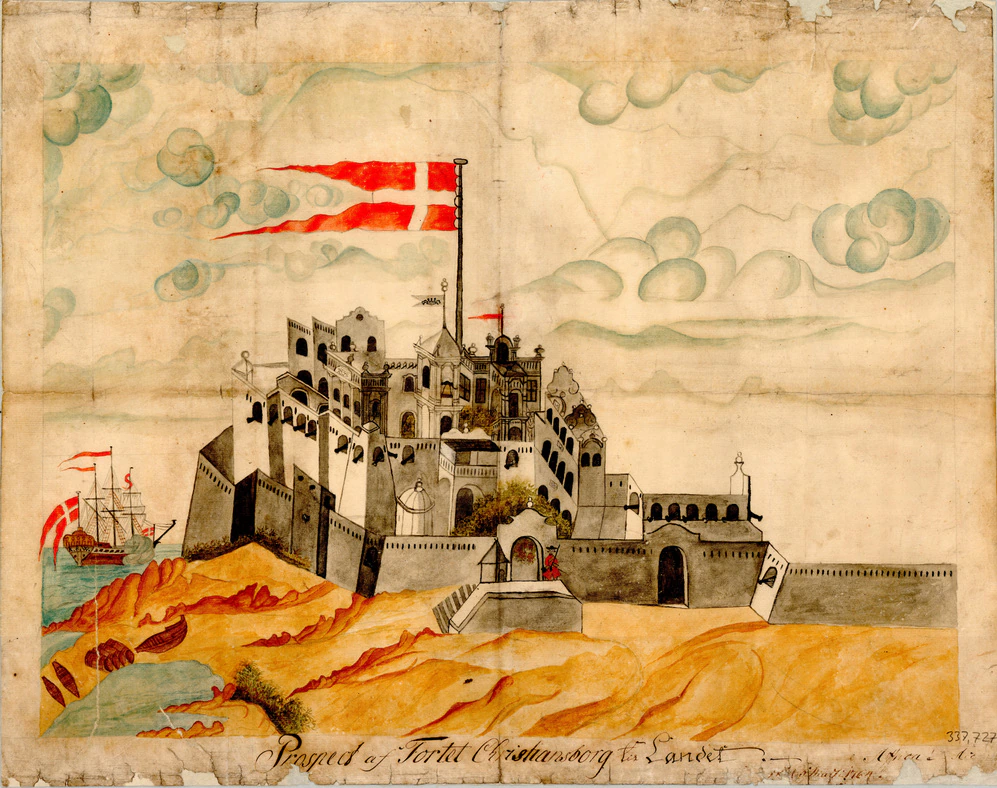
Why would our name be on the castle wall? I had never been to the castle. But I knew about it. It is Christiansborg Castle, Ghana’s most important heritage site.
Located in the capital, Accra, it is a former 17th-century Danish trading post, seat of British colonial administration and, after independence, Office of the President of the Republic of Ghana. It is also a Unesco World Heritage Site and its image features on Ghana’s coat of arms and currency.
Yet I knew it was one of almost a hundred lodges, forts and castles used to incarcerate captive Africans prior to their forced journey across the Atlantic Ocean during the Middle Passage before being enslaved on plantations in the Americas. Between 1650 and 1800, an estimated one million captive African men, women and children were trafficked from what is now Ghana through sites like these.
Today, African-descendant people living in the diaspora visit Christiansborg Castle. It acts as the symbolic and material embodiment of the horror, violence and brutality of the transatlantic slave trade and slavery on both sides of the Atlantic.
It forms part of a collective memory of capture, detainment, forced migration, and enslavement.
Advertisement
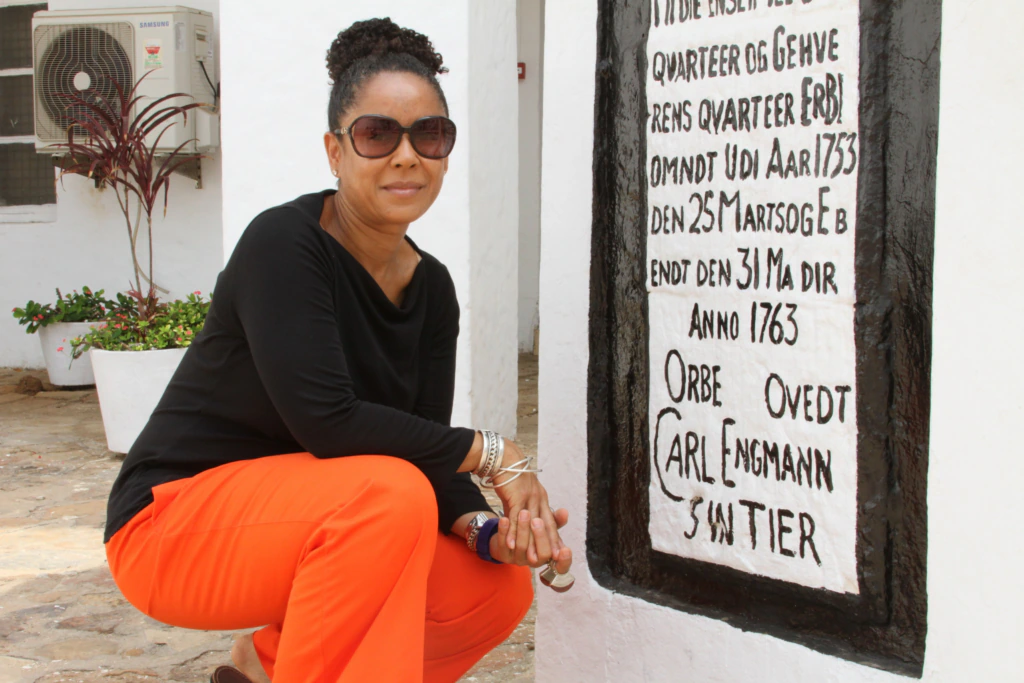
I make an appointment and meet the president’s special adviser at the castle. We tour the premises. Sure enough, my aunt is correct – in the castle’s courtyard, I discover a water cistern inscribed with the name Carl Engmann.
Later, I am seated with my great uncle, my grandfather’s youngest brother, an elegant man with whom I like spending time. Advanced in age, he is mentally sharp yet softly spoken.
He presents me with a file containing photocopied sheets of white paper; our family tree that he has compiled over the years. He has carefully collected the stories of family elders, transforming oral histories into written archives.
I look closely at his hand-typed family tree – so often photocopied that the ink is faint. He points: “Carl Gustav Engmann came to the coast in 1742. He was a surgeon. In 1752, he became a governor at Christiansborg Castle.”
He adds: “Carl married Ashiokai. She was the daughter of a Ga chief.”
Excavating the Danish Archives
Finally, I arrive at Rigsarkivet, the Danish National Archives, in Copenhagen. I walk up to the counter to check in. I sign in, noting my name, the date and time. The security man behind the counter checks my entry. He looks down at my surname and then up again at my face – my brown face.
Advertisement
He remarks upon my surname, my Danish name. I nod and smile.
Once inside the reading room, I head straight to the reference desk to enquire how the research process works. I explain the purpose of my visit. The archivist behind the desk smiles and says: “Yes, I know Carl Gustav Engmann.”
I collect the big, brown-coloured boxes full of documents that I have requested, select a workstation and open the first box.
It contains a thick pile of slightly yellowed papers, each composed in cursive black ink script. Official papers penned at Christiansborg Castle on the Guinea coast and sent via slave ship to the Danish West Indies, and then to Copenhagen.
I pick up the first document. It is written by my great- great- great- great- great-grandfather. I turn cold. I look up and furtively glance around the room. Do others know what these archives contain? I take a breath. I steady myself. I must continue.
I pore over Carl’s correspondence, reports, trade journals, inventories and expense accounts. I am unable to read the gothic Danish script (only a few scholars can), but can identify some words: slav (slave), arve-slaver (hereditary slaves), negotie (trade), mækler (broker), rigsdaler (type of currency), cassare (marriage)…
My eyes are drawn to the ledgers. The pages are divided into columns. On one side are names: Amma, Ammeni, Kokoy, Frempong… Most misspelt, but I recognise the names just the same. On the other side, a number. Human “value” measured in cowries, gold and guns.
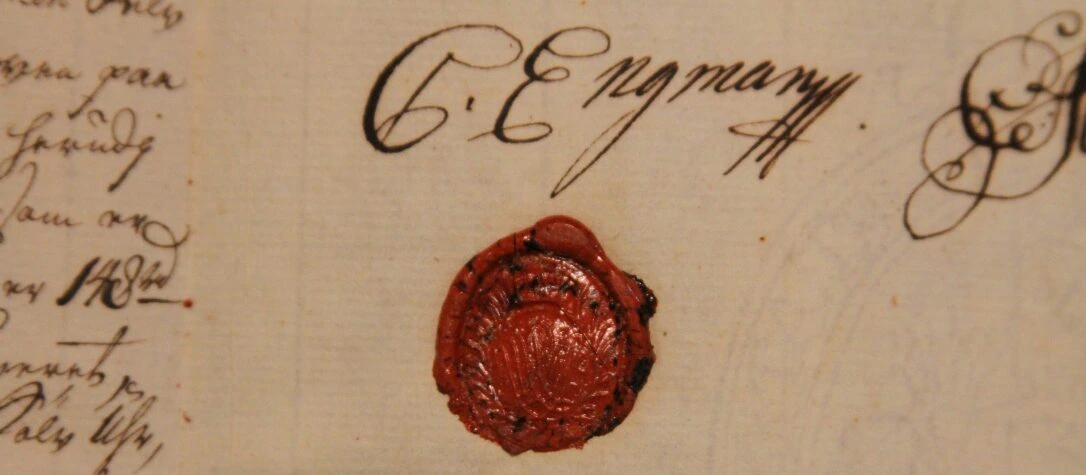
At the bottom of countless documents lies Carl’s signature and his distinctive embossed crimson wax seal – artefacts signifying the historical and bureaucratic processes concomitant with the Danish coastal administration, but also underscoring my ancestor’s authority as governor at Christiansborg Castle.
The crimson wax seals are still smooth and glossy. I delicately touch them.
Their edges, swollen under my fingertips, caused by the process of impressing seal stamps into warm, molten wax, and then onto paper. The centre of the seals are finely textured due to the designs of their insignia. This act of touch connects me to my great- great- great- great- great-grandfather.
Bitter discovery
My great- great- great- great- great-grandfather, Governor Carl Gustav Engmann, was a slave trader and slave owner.
It is only much later, I will come to realise another truth: Carl’s wife Ashiokai was also a slave trader – participating and profiting from the transatlantic slave trade – challenging conventional historical and popular narratives around women as solely passive observers.
So, my great- great- great- great- great- grandmother, too, was deeply complicit and benefited from enslavement.
I spend several days at the archives. Fortunately, a Danish historian has translated some of the documents from 1657 to 1754 into English. I read about nikɛninn, the Ga word for “gifts” or “gratuities” (colloquially called “dashes”).
An entry reads:
For gifts. To the King of Assiante, Aqqvamboe and Ackim Caboceers, who now intend to come to their country again, we now most humbly ask for four red velvet and four damask pantjes, set with golden galloons and with golden fringes around them, as well as golden tassles in the four corners, so that there may be two pantjes for each.
6 hats with point d’Espagne and beautiful white feathers in them.
12 hand-staffed, lacquered, some two ells tall, with beautiful embossed thin silver bosses four inches in length.
4 extra beautiful, fine guns with some chased silver work on the butt and stock, as well as beautiful high-relief embossed barrels.
The fort of Christiansborg, 3rd May, 1753
Carl Engmann, C.M.L. Schmidt, C. Jessen
I read “beautiful” twice and “extra beautiful” once and am struck by Carl’s attention to the objects’ aesthetic details. I note the minutiae of European refinement coveted by Africans and Eurafricans, a minutia that signifies a coastal cosmopolitan community’s power, affluence and opulence.
Slave trader and thief
I read that in 1757 Bundo Kwei ran away from governor Engmann due to mistreatment.
And one day, the kindly archivist tells me that he recently found a document involving Carl and a court case that alleged that he had stolen money from the Danish king. The archivist is factual yet gentle in the relaying of this information.
How many times has the archivist had to share stories like mine?
Carl. A slave trader. And a thief?
I am unable to stay for long periods in the archives. Each day, after researching the documents, I walk around the city, trying to process what I have seen, what I have read, what is confirmed.
This afternoon, I visit Copenhagen’s Christiansborg Palace, colloquially known as the Borgen, somewhat unexpectedly, the same name as “our” castle. I am the only non-white person in the palace – not even a security guard looks like me.
I meander through the royal palace’s highly gilded rooms and overly decorated salons. From corner to corner, I gaze at the luxurious, large wall tapestries that I’m told chronicle the breadth of Denmark’s history.
Yet, on the entire facade – names, labels, images – replete with riches, built in part on the transatlantic slave trade and slavery, not one mention of Denmark’s role in enslavement is made.
I leave.
It is still sunny outside the archives. I do not feel like going back to the where I am staying since I do not want to be alone with my thoughts. However, I am unsure what to do. Ordinarily, I like to walk with purpose but today is different. I decide to wander around the city and see where it leads me.
I find myself at the Schimmelmann Mansion. Heinrich Carl von Schimmelmann was a Danish merchant, banker, politician and nobleman. A slave owner, he owned several of the largest sugar plantations in the Danish West Indies (now the US Virgin Islands).
It is likely that enslaved men, women and children that laboured on his plantations were trafficked through Christiansborg Castle in Osu.
Schimmelmann also owned a sugar refinery in Copenhagen, a fleet of slaving ships, and acted as a financial adviser to King Frederick V of Denmark, a bust of whom was thrown into the Copenhagen river after George Floyd’s murder.
The Schimmelmann Mansion, inherited by Heinrich’s son, Ernst, is also the same house that Hans Jonathan, born into slavery in 1784 on the island of St Croix, was brought to work. Before escaping to freedom in Iceland, he lived in the dark space beneath the staircase.
I stand in front of the mansion. The plaque outside reads: “Immigration Office, Danish Ministry of Welfare.”
Finally, I locate the place where Carl lived with his new family, his second family; his Danish wife and their adopted daughter. Today, it is an upscale shop in a fashionable area in Copenhagen.
Standing across the street, staring at the house, I feel ill at ease. I do not want to get too close. It is as if getting closer to the house brings me closer to Carl.
I find myself imagining what life would have been like in Denmark – for Carl and those like him – who had spent years on the West African coast.
What were family conversations over the dinner table, a table unburdened with Ghanaian dishes such as kenkey, kelewele, and the local spirit akpeteshie? Did Carl speak about his experiences on the coast? Did he tell his second wife about Ashiokai, his first wife, an African wife? Did he tell his daughter about her two Eurafrican half-brothers, Eric and Fredrick? Did they suspect but never ask or not want to know?
A small voice inside me asks: “Should I enter and ask what this building remembers?” That same voice replies: “What would I say?”
A history shared by many
The story of Christiansborg Castle, the Danish transatlantic slave trade, and the Danish-Ga families who participated as slave traders – both directly and indirectly – and sold Africans into slavery is not just the story of my family.
It is one shared by many families who lived along the coast – the other Danish-Ga (Eurafrican) direct descendants of slave traders, owners and others that participated in Atlantic systems of enslavement.
This includes the direct descendants and local communities (many with limited formal education) whom we at the Christiansborg Archaeological Heritage Project have trained in archaeological fieldwork and research.
“Names are fundamental to our identity”
We work collaboratively to study the history and afterlives of the Danish transatlantic slave trade at Christiansborg Castle. I call this decolonising approach to heritage work “autoarchaeology”.
At the castle, we have excavated an extensive pre-colonial settlement, including house foundations and a kitchen.
We have also retrieved a large collection of local and foreign manufactured objects, including “African trade beads” (made in Europe), European and Chinese ceramics, local pottery, African and European clay smoking pipes and European glassware. Other small finds include writing slate, faunal remains, seeds, metals, stone, daub, cowrie and other shells.
With the assistance of local fishermen, we excavated a cannon immersed in the sand that had fallen from the castle above on to the beach below. Under the castle, we also discovered the entrance to an underground tunnel that led to the nearby Richter House, formerly owned by a Danish-Ga slave trader.
Unearthing slave trading inheritance
Names are fundamental to our identity. They carry deep personal, social, cultural, historical and ancestral connections. They give us a sense of who we are, the communities in which we belong, and our place in the world.
In the African Atlantic, Eurafricans, as the progeny of European men and their African wives, carried European names. Families living in communities surrounding the Dutch fortifications had Dutch names, the English fortifications, English names, and the Danish fortifications, Danish names.
As descendants of slave traders and slave owners, we still carry the names of our ancestors. We are obliged to move around in the world explaining the reason for our names.
Today, many people (strangers too), ask me, “What does it feel like to have an ancestor who was a slave trader?”
Of course, this question assumes that their ancestors did not participate in Atlantic systems of enslavement.
My throat, tight. My tongue, dry.
I witness a flicker of disappointment when I do not have the words.
Europe after empire | Rachel Ama Asaa Engmann
Rachel Ama Asaa Engmann is an associate professor and director of the Christiansborg Archaeological Heritage Project. She is currently a visiting scholar (2025-2026) at the Getty Research Institute, Los Angeles, US.