
Emma House
Curator at the Garden Museum, London
“The idea for this exhibition – Cecil Beaton’s Garden Party – formed when we bought one of his paintings which, on the reverse, was titled The Cutting Garden.
We knew that Beaton was an amazing fashion photographer and designer, but finding out he was an artist utterly obsessed with gardening was a surprise.
Our later research showed that he lavished just as much money and attention on his gardens as he did his houses in the country. We also discovered the extent to which, in particular, flowers played a significant role in all Beaton’s artistic endeavours.
He loved to grow his own flowers to decorate sets for his photography. When he went to Buckingham Palace to capture the Queen Mother on film, he took along his own flora in order to create bespoke backdrops.
Advertisement
Beaton also worked closely with the florist and author Constance Spry, particularly for the society wedding of his sister, Nancy, during which the bridesmaids were linked together by long, flowing garlands that wound around them and ran the entire length of the bridal party.
The exhibition’s many set and costume designs include those Beaton created for Giacomo Puccini’s opera Turandot, initially for New York’s Metropolitan Opera and later for the Royal Opera House in London in the 1960s.
His use of the curve and fan of banana leaf for the palace garden scenes was inspired by the plants he saw during a stint as a war photographer for the UK’s Ministry of Information, documenting war efforts in China during the 1940s.
For Apparitions, Frederick Ashton’s 1936 ballet starring Margot Fonteyn, Beaton came up with dazzling gowns with wonderful floral embellishments for the story of a character who experienced alarming, laudanum-inspired ballroom dreams.
The sketches simply show swirls in the dresses but, in the accompanying notes, Beaton carefully details which flowers, colours and materials were to be used.
Similarly, those black-and-white costumes from the racing scene in My Fair Lady are so iconic but, if you look at them closely, you’ll see that every detail in every hat and dress has floral flourishes.
Advertisement
Beaton could be snappy but he was well known as a playful host of house parties that attracted the Bright Young Things in the 1930s.
For his ‘fête champêtre’ in 1937, he devised a flower-filled fancy-dress party based on a French idyll, with garlands cascading from the windows and a carriage filled with meadowsweet.
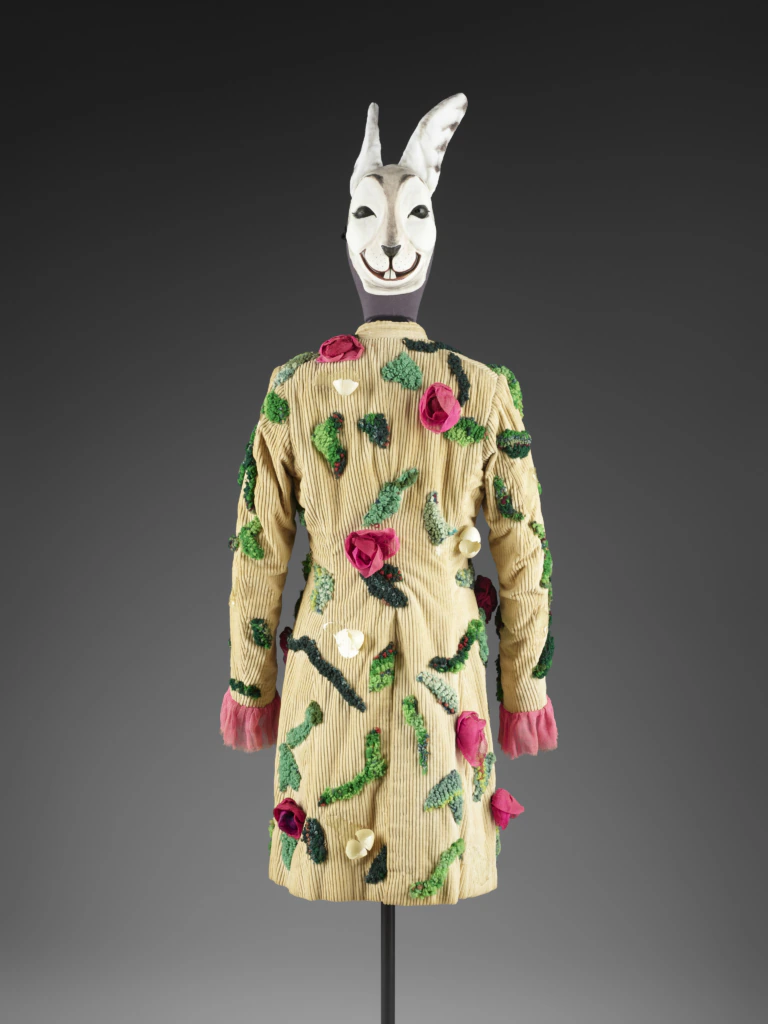
Beaton himself wore this wonderful creation, which was made by the Oscar-winning film and theatre costumier Barbara Karinska.
At the time, Salvador Dalí was a regular house guest and you can see his influence on Beaton’s design on the back of this corduroy concoction, complete with applied muslin roses, irregular-shaped woollen yarn patches and plastic eggshells, all of which he topped off with a rabbit mask, the one shown here based on the one he wore. It is beautifully tailored, playful and quite surreal.”
Interview by John Holt. Cecil Beaton’s Garden Party is at the Garden Museum, London, until 21 September