
Kirstie Meehan
Senior archivist at the National Galleries of Scotland in Edinburgh
“Our show marking the centenary of the birth of Ian Hamilton Finlay features 19 sculptures, 14 works on paper, an installation and some 87 archive objects.
It draws on the richness and depth of our collection of work by the artist – probably best understood as a poet, printmaker, provocateur and gardener – and highlights all facets of his output and his personality.
A major part of his practice was collaboration with craftspeople; he was reliant on the skills of everyone from stone cutters to embroiderers. He always properly credited their contributions – a generosity of spirit that was representative of his work.
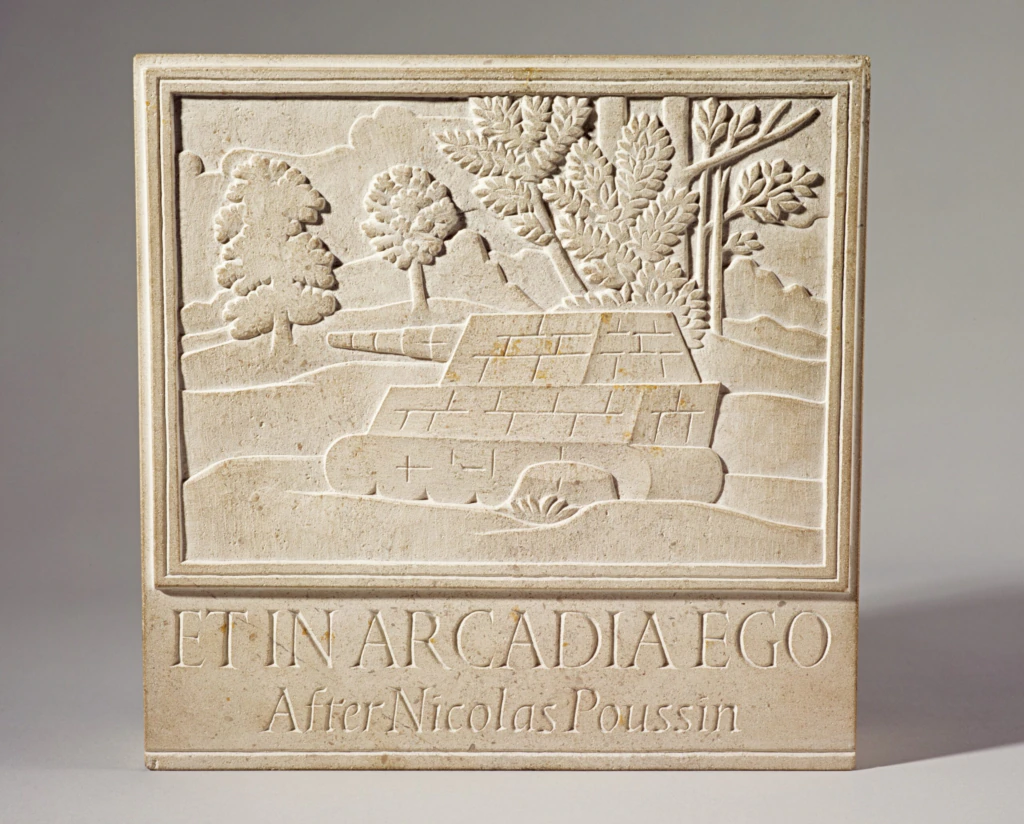
This stone carving, produced by his collaborator John Andrew, is one of many works across different media from the 1970s onwards that played on the theme of ‘et in Arcadia ego’. I think the idea appealed to him because of the potential for layering many different references and inspirations.
Advertisement
Finlay had a deep understanding of and fascination with the classical world; the phrase – which means ‘even in Arcadia, there I am’ – was originally coined by the ancient Greek poet Virgil and adopted by painters in the 17th century to express the idea that death and destruction were present even in the most perfect paradise.
The piece also references the painting of the same name by the French painter Nicolas Poussin – which dates from the late-1630s and is now in the Louvre – updating its message for a 20th-century audience that had grown up in a time of massive conflict.
Poussin’s idealised rural scene features a group of shepherds who have come across a tomb bearing the Latin inscription. Finlay has reinterpreted the moment as a modern memento mori with the famous phrase now adorning a tank roaming through the pastoral idyll.
Finlay first achieved success in the 1960s with his concrete poetry – poems that eschew traditional forms in favour of a reliance on rhythm and sound – and went on to exhibit his wide range of work around the world.
I think, however, that his somewhat cantankerous nature and reputation as a tricky individual to work with may have dented his reputation over the years.
He used to get very frustrated, for example, with people failing to appreciate the lyricism and simplicity in his work. A case in point is Finlay’s undeniable masterpiece Little Sparta, a garden roughly 25 miles outside Edinburgh, which reveals much about his craft and his thinking.
Advertisement
You have to leave your car at the bottom of a rubble path and walk half a mile up a windswept hill to find his personal patch of paradise. This gives the experience a real sense of occasion, as you make the transition from city to country, leaving behind all the travails of the 20th century.
It’s a magnificent space that is open only during the summer, when the trees are blossoming and the flowers are blooming; it’s like a prototype sculpture park, but so considered and so beautiful.
As you wander around, a familiar theme emerges. There’s military imagery everywhere – even the birdfeeders are made to look like mini aircraft carriers.
Finlay felt there was always an implicit violence present in nature, something he made very clear in this stone carving.”
Interview by John Holt. Ian Hamilton Finlay is at National Galleries of Scotland: Modern Two, Edinburgh, 8 March-26 May