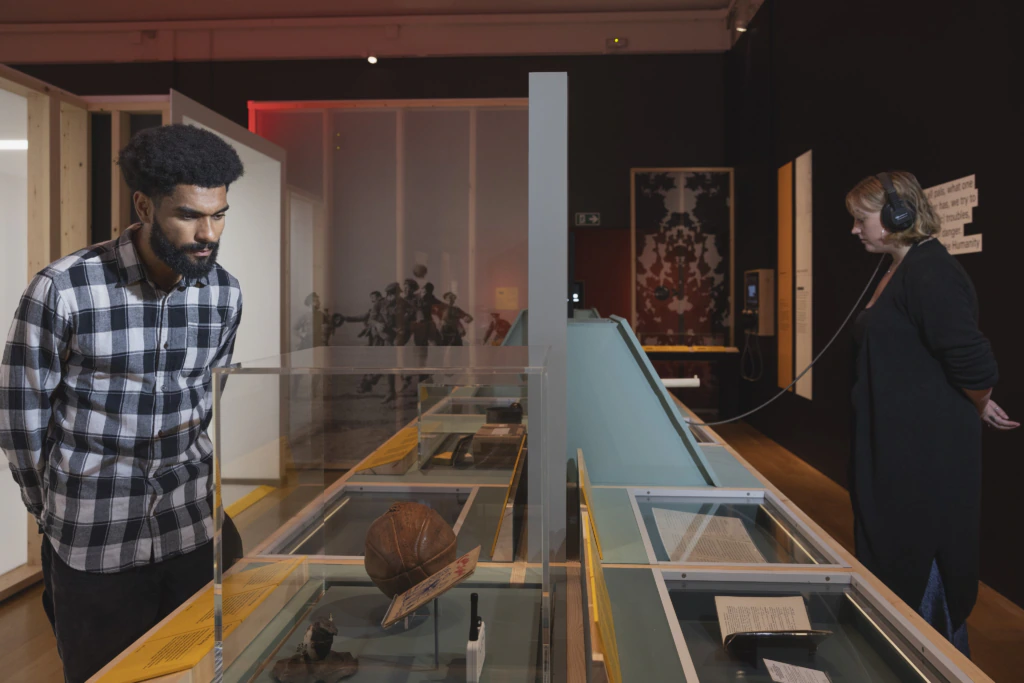
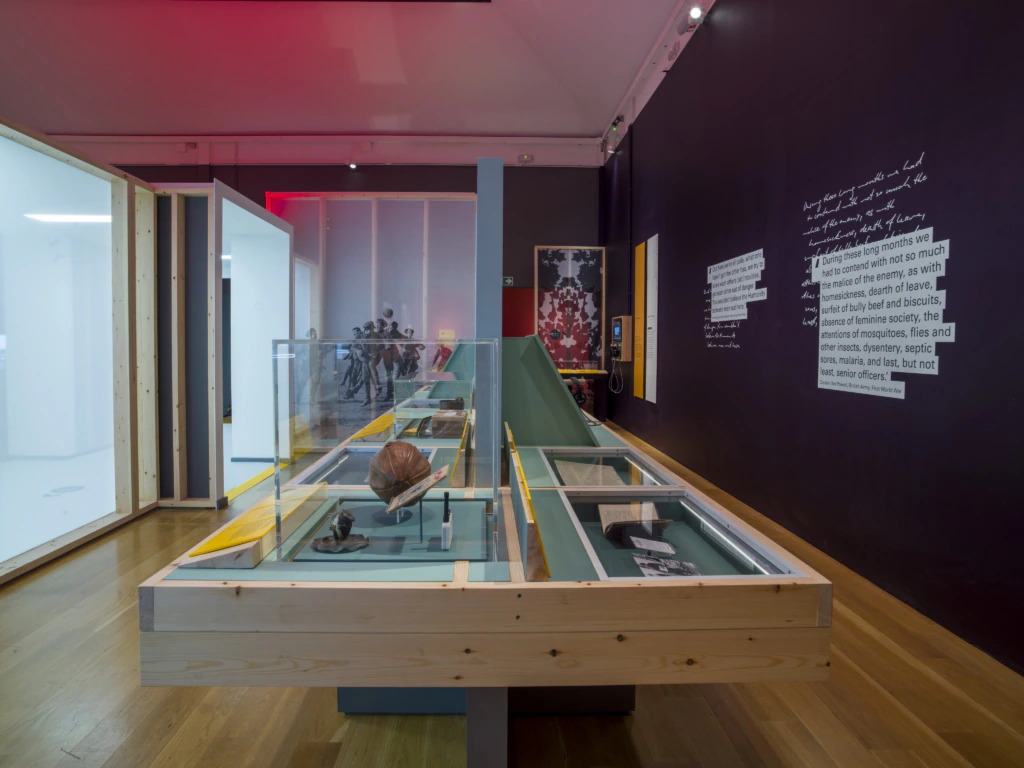
War and the Mind, which is at Imperial War Museum (IWM) London until 27 April, features more than 150 objects as well as oral history and archive material that explore the psychological impact of conflict on civilians, including peace campaigners, as well as those doing the actual fighting.
The interpretation, which covers the period from the first world war to the present day, is supported by research projects funded by the UKRI Arts and Humanities Research Council.
Laura Clouting, the lead curator of War and the Mind, says these research projects provide visitors with a deeper dive into some of the topics, as well as helping to communicate ideas that lack objects to tell the stories.
“The research projects are placed at different moments throughout the exhibition and they cover a range of topics,” Clouting says. “They are self-contained but incredibly impactful distillations of a great deal of research that we have brought out in a very digestible form for our visitors. They offer a fantastic extra arm of interpretation for us.”
IWM conducted hour-long interviews with each of the researchers, which have been edited down to three-minute films for each project.
Advertisement
The curators of the exhibition had the challenge of helping visitors understand not only the sights and sounds of conflict but also the feel, tastes and smells of the battlefield. The first two were easier, particularly with access to IWM’s vast film archive, but portraying other sensations was trickier.
“Some of the subjects do not necessarily immediately lend themselves to physical form, so we had to think laterally about how to bring that physical form to something that is rather intangible,” Clouting says.
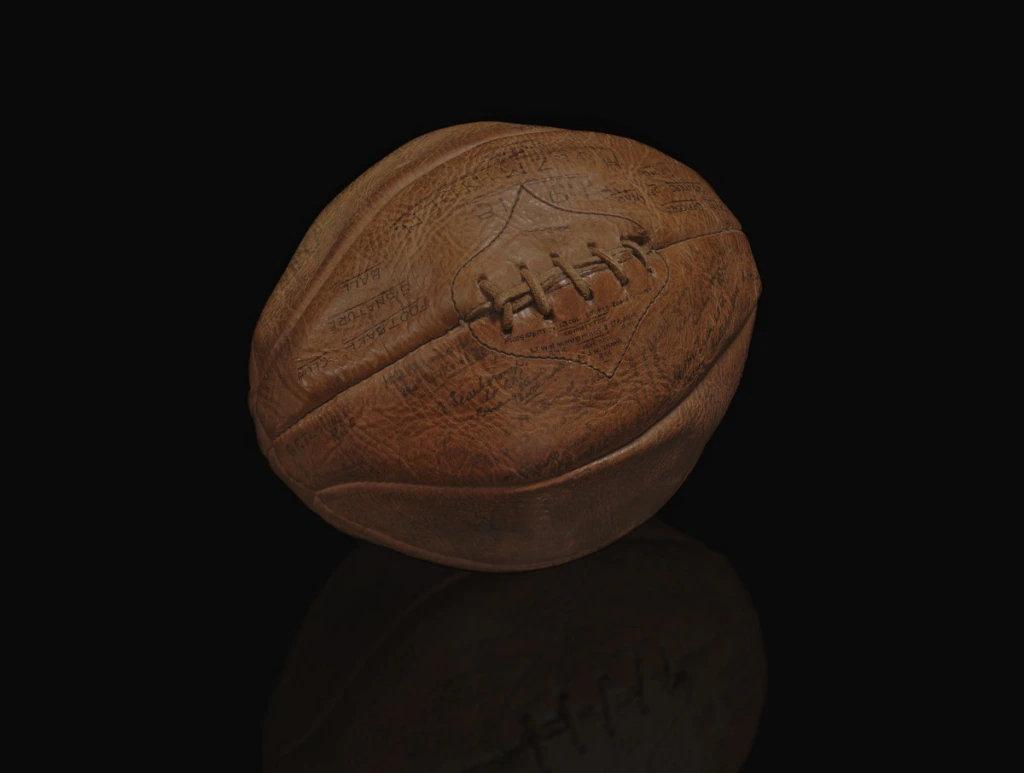
Objects that fall into this category include a knitted rifle breech cover that was designed to prevent mud blocking a weapon. The soldier who used this died and his sister, the author Vera Brittain, wrote about her memory of the object: “The mud of France which covered them was not ordinary mud; it had not the usual clean pure smell of earth, but it was as though it was saturated with dead bodies.”
War stories
IWM curators also found a drawing by cartoonist Ronald Searle that showed the torment of skin irritation caused by lice in the jungle in Thailand during world war two. Searle wrote: “We were kept awake by the swarms of bedbugs that wandered over us, sucking our blood and nauseating us with their smell when we crushed them. Day and night the lice burrowing under our skin kept us scratching.”
Advertisement
Some objects on display help visitors explore the concept of the enemy and what that means for soldiers and civilians.
“We have this array of anti-German British posters that communicate the idea of this kind of barbaric, wicked enemy and the idea that because they are capable of dehumanisation, we can demonise them,” Clouting says. “It all speaks to the social and psychological concepts of us versus them, and how critical that is to the nature of war.”
There is also a handmade knitting bag that was embroidered during the second world war by German female internees held in civilian internment camps on the Isle of Man. The knitting bag is among the objects chosen by IWM curators that tell very personal stories.
Others include a mitten belonging to the baby son of an Avro Lancaster bomber rear gunner, who kept it for comfort while carrying out dangerous operations during the second world war, and a helmet worn by Civil Defence worker Jack Insole while responding to the Bethnal Green tube disaster on 3 March 1943.
But War and the Mind also features material that is about communicating with the public during the war and using propaganda to try to influence the way people think and act.
Advertisement
“There’s this sense that wars are not just about physical destruction, they’re about the control of the mind and keeping people on-message,” Clouting says. “And there are so many different ways that that comes out, either through overt propaganda, of which we have many examples, but also how you deal with the issue of morale on the battlefield, or the worry that air raids would tip people into a state of panic.”
Resonating today
One of the most well-known examples of mass public communication is Protect and Survive, a government booklet issued in Britain in 1980 that “tells you how to keep your home and your family as safe as possible under nuclear attack”.
“The personal stories are a great way of connecting visitors to some of the common themes such as homesickness and separation, but then I think it is also worth noting the importance of officialdom,” Clouting says.
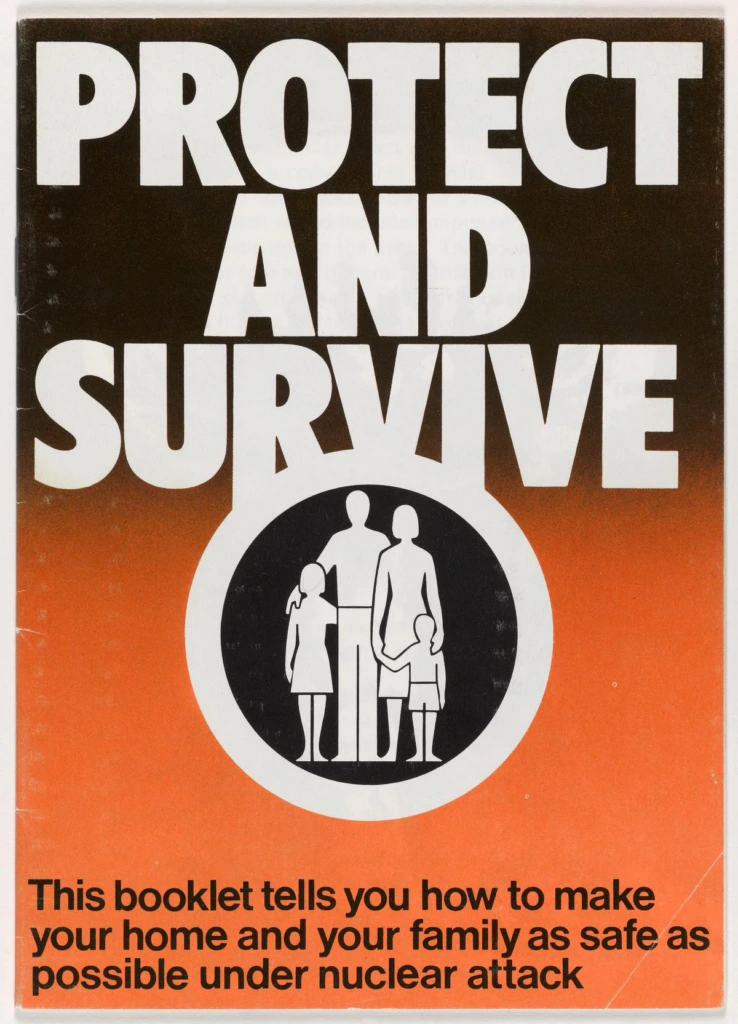
“We’ve got lots of quite unpersonal objects, which speaks to this broader concern about people’s minds that isn’t connected to individual experiences but is treating them as a collective mass. “It’s a different way of thinking about history and people and is quite removed from the personal story approach,” Clouting continues. “I think we have a good balance of personal and non-personal objects in this exhibition.”
Another fascinating item of printed material is an anonymous letter sent to the Imperial War Museum in May 1982, shortly after the invasion of the Falkland Islands. The writer asks: “How can Great Britain pretend that those islands, 7,000 miles from Great Britain, are British?” The letter is displayed next to a T-shirt with the slogan “Keep the Falkland Islands British”.
Research areas: Understanding aspects of war
Training the Troops: British and Commonwealth Armies, 1939-45
Megan Hamilton’s PhD is funded by the Arts and Humanities Research Council (AHRC) Collaborative Doctoral Partnership studentship with King’s College London and Imperial War Museums. It explores how armies around the British empire coordinated their training to fight more effectively during the second world war.
Droned Life: Data, Narrative, and the Aesthetics of Worldmaking
This multi-disciplinary UKRI-funded fellowship was led by Beryl Pong and hosted by the Centre for the Future of Intelligence at the University of Cambridge, where Pong runs the Centre for Drones and Culture. The project considered the politics and ethics of drone use, and how they make us see our world.
To Dream as I Have Never Dreamed Before: Dreams in First World War Literature and Culture
Chloe Nahum undertook an AHRC-funded Collaborative Doctoral Partnership studentship with the University of Oxford and Imperial War Museums. Her thesis examined accounts of dreams in diaries, letters, newspapers, posters, postcards and oral histories from the fighting and home fronts during the first world war.
Strange Meetings: Enemy Encounters 1800-2020
This AHRC-funded fellowship project was a partnership between Cardiff University, the Museum of Military Medicine and the charity Re-Live. Holly Furneaux specialises in English literature and culture at Cardiff, while Matilda Greig is a historian at the National Army Museum. The project explored interaction with the enemy in conflicts across time.
Rediscovering the Bethlem Royal Hospital during the First World War
Rachel Ditchfield is undertaking an AHRC-funded Collaborative Doctoral Partnership studentship between the University of Liverpool and Imperial War Museums. She is examining the experiences of civilians on the home front who experienced mental illness. Ditchfield’s focus is on Britain’s most famous psychiatric hospital, the Bethlem Royal Hospital, which is now home to IWM London.