Sarah Keeling
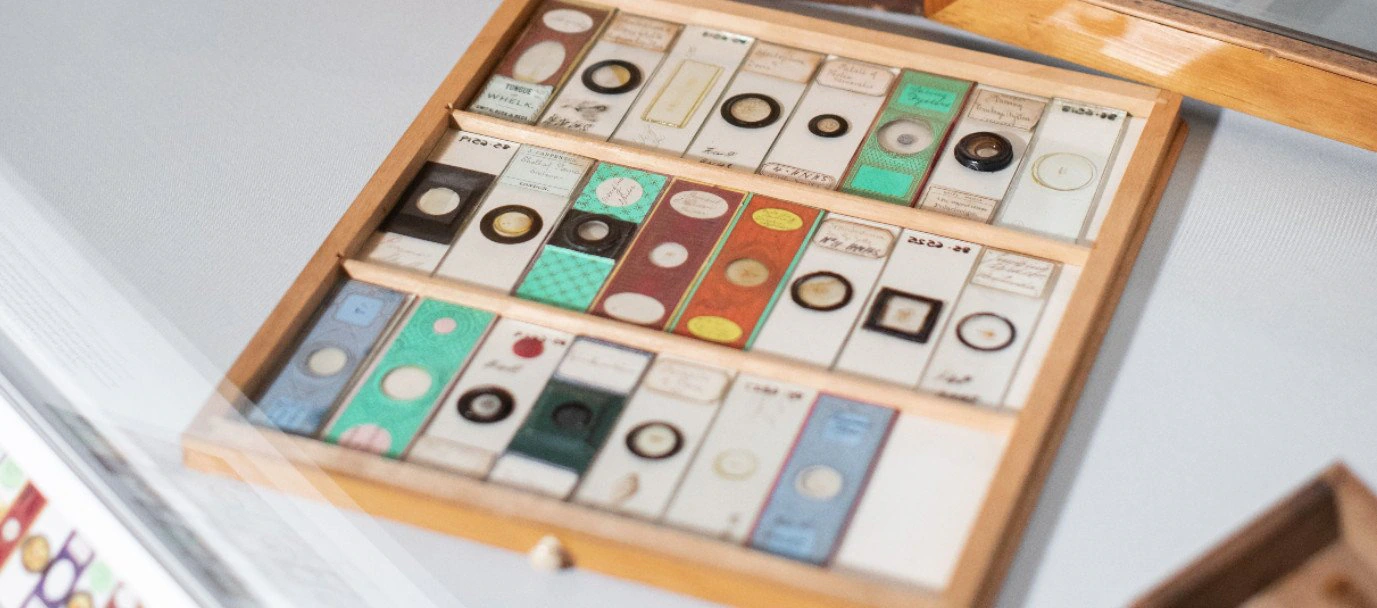
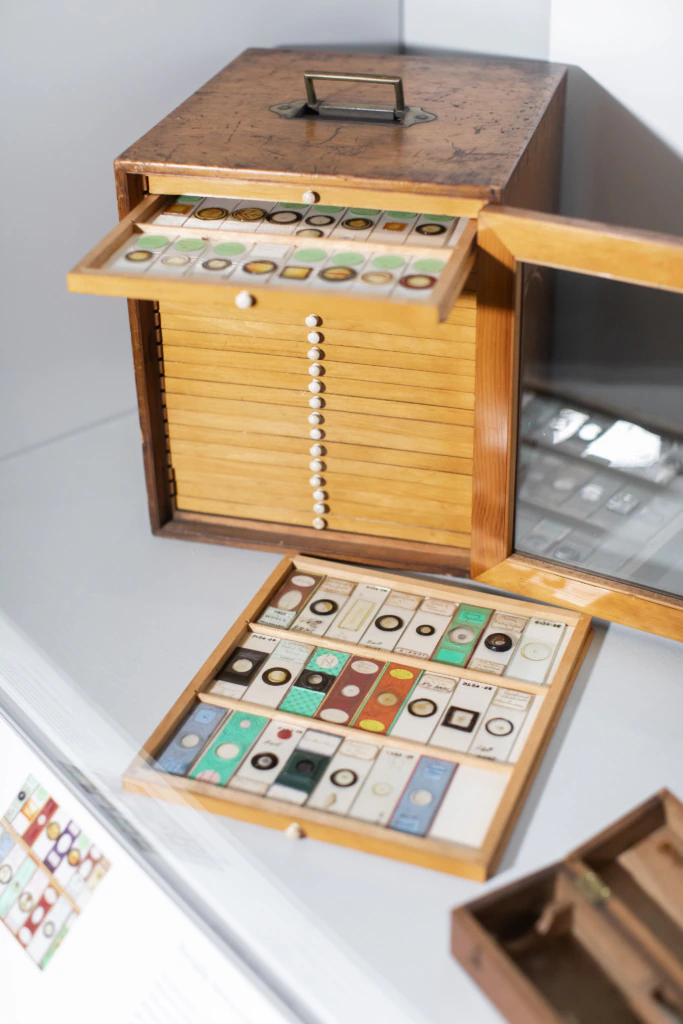
“This intriguing object has been in the collection for around 80 years, but we have no idea who used it or donated it. Despite that, it’s an excellent example of a hobby that well-to-do Victorians developed to gain a greater understanding of the world at a time when people were becoming curious about all things scientific.
This specimen cabinet and its contents would have belonged to someone well-off because it is so beautiful. At that time, people making their own slides – rather than buying pre-prepared ones – often added paper around the edges to secure the delicate glass covers. From around 1840, these covers began to be decorative items in their own right and provided a wonderful connection between science and art as people studied their close-ups of plant leaves or animal hair. As a result, the cabinet looks like an artwork just as much as a collection of slides that enabled people to engage with science in their homes.
One of the themes of this exhibition – Science in St Albans: Novum Organum Scientiarum – is to encourage people to think about how everyone has the capacity to be a scientist without laboratory equipment. These days, of course, you can take close-ups with a smartphone and see extraordinary shots of the natural world on social media.
Another theme celebrates the impact of people who lived and worked in this area on science, from medieval abbots and the naturalist and explorer Alfred Russel Wallace to the pioneering work of the theoretical physicist Stephen Hawking.
It seems appropriate to hold such a show in our new museum, which is housed in the old town hall building that once boasted its own planetarium. One of our most famous locals is the philosopher and statesman Francis Bacon (1561-1626), who was first viscount of St Alban and is known as the father of the scientific method, knowledge based purely on reasoning and close observation of nature.
Advertisement
These slides are the perfect example of people looking at the world and evolving ideas with the evidence they see, rather than adding too much weight to a theory that might not be correct. We explore how Bacon’s ‘new’ method was subsequently used by scientists and scientific firms – such as the engineering organisations Marconi and Vickers-Armstrongs – in this area, and look at its relevance today.
In his 1620 philosophical work, Novum Organum Scientiarum – ‘a new instrument of science’ – Bacon talked about the ‘idols of the mind’, manmade barriers that obstruct correct scientific reasoning. In the current climate, it is interesting to apply this to the assumptions people make purely based on what others around them think and say. Whether it’s fake news, misunderstanding between different groups or the echo chamber of sections of social media, it’s intriguing to note that it’s something humans have always done.”
Science in St Albans: Novum Organum Scientiarum is at St Albans Museum and Gallery until 15 March
Sarah Keeling is the curator of collections, post-medieval to contemporary, at St Albans Museum and Gallery