The first world war may have ended more than 100 years ago, but the remains of soldiers are still being found on the battlefields of France and Belgium. What happens to these discoveries is among the stories told in the Commonwealth War Graves Commission (CWGC) Experience, a visitor centre that opened near the town of Arras, northern France, last June.
The commission was founded as the Imperial War Graves Commission in May 1917 as conflict still raged across Europe. The organisation, which commemorates the 1.7 million Commonwealth servicemen and women who died during the two world wars, changed its name to the Commonwealth War Graves Commission in 1960.
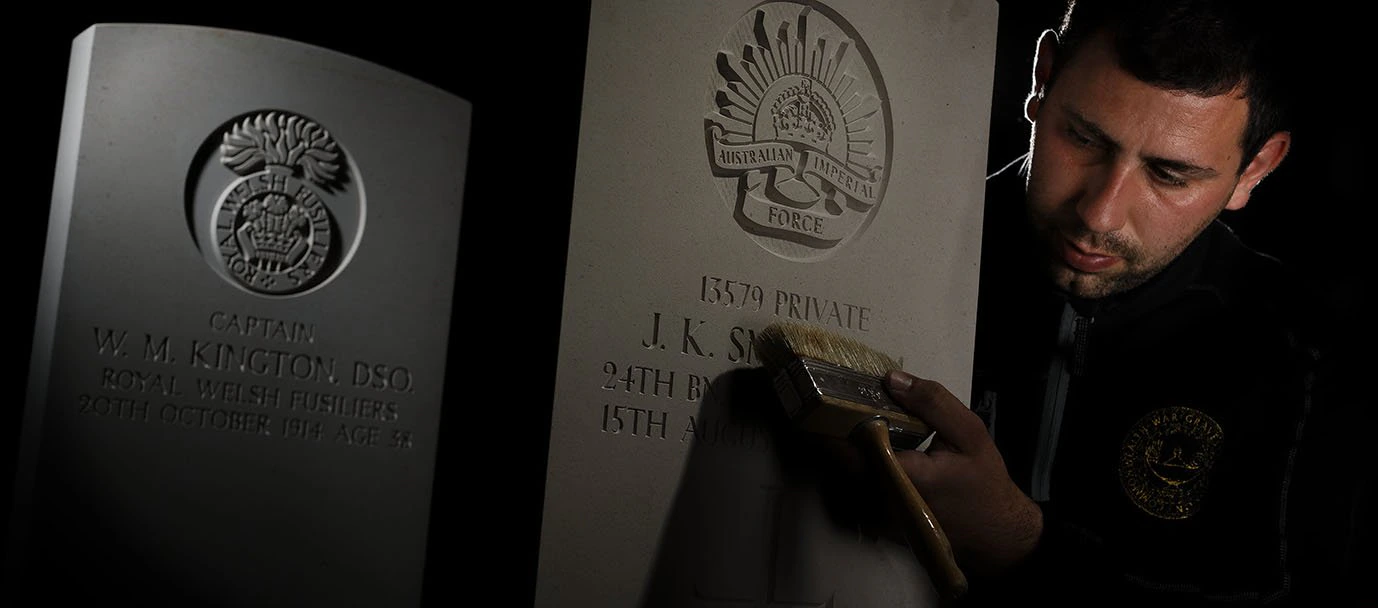
It operates in 23,000 locations in more than 150 countries and territories. It has 1,300 employees, including 850 gardeners and a range of craftspeople who contribute to the upkeep of the graves and memorials. These include stonemasons, blacksmiths, carpenters, sign-makers and mechanics.
The aim of the visitor centre is to tell the story behind its work to commemorate the war dead. A visit begins with a film looking at the history of the CWGC. It was set up through the determination of Fabian Ware, a commander of a mobile unit of the British Red Cross who wanted to make sure that the final resting places of the dead would not be lost. Once the commission was established, three key architects of the day, Edwin Lutyens, Herbert Baker and Reginald Blomfield, were chosen to design the cemeteries and memorials. Ware asked Frederic Kenyon, the director of the British Museum at the time, to interpret the differing approaches of the architects.
As visitors tour the centre using an audioguide, they see craftspeople in their workshops and learn more about the global responsibilities of the commission. Its cemeteries are dotted around the world, including in war zones and remote locations, such as Ascension Island in the south Atlantic Ocean.
One room looks at the recovery and reburial of the war dead, including the tricky process of identifying the bodies. The displays include items such as helmets, boots, bottles, toothbrushes, combs, razors and forks, all of which can help with identification. The remains of as many as 40 first world war soldiers are found on the old western front each year.
Advertisement
The CWGC is hoping to attract 15,000 people a year to the visitor centre. This area of northern France is rich with battlefield sites, including the Canadian National Vimy Memorial, Cabaret-Rouge British Cemetery and, further away, Thiepval Memorial at the Somme. Arras, which has a cemetery and memorial itself, wants to become the capital of remembrance tourism in the region. Victoria Wallace is the director general of the CWGC.
Why was the visitor centre needed?
Victoria Wallace: For decades we have informally welcomed visitors to our workshops. The decision to make the centre fully visitor-friendly and open to all was part of a wider strategy to make the commission’s role more visible, and to celebrate our team’s part in commemorating the war dead. We also felt we needed a public face – we have opened a small information centre in one centre of tourism on the western front – Ypres in Belgium – but this underlined our commitment to engaging with the public about what we do.
What are the key messages you want to communicate?
Our key message is that our work continues. While the battles themselves might have ended 100 years ago, the commission’s work of caring for the war dead with the finest care and craftsmanship carries on unchanged. Our staff are proud of that task and work with traditional materials to deliver the highest possible standards around the world.
We chose not to make this a contemplative experience – that is for the cemeteries. This is about the work of the organisation, its quality, its reach and its complexity – and about the people who do that work.
Advertisement
How is the story told?
We have tried hard to use the voices and words of our staff. Very little was formally scripted – visitors encounter staff at work and the audiovisual elements take people through what they are doing, in the words of the workers, and how this is replicated around the world.
What are the key objects that visitors will see?
Our people at work are the key objects – the point of the centre is to see our staff as they engrave headstones, restore doors and gates, and service machinery. So visitors will come across carpenters, stonemasons and blacksmiths.
The display isn’t really object-led, though there are examples of the stone we use for headstones and of signage to show how global our work is. The exception to this is in our recovery and reburial centre, where we use recovered artefacts to illustrate how bodies found today are identified from the objects they have with them.
What types of audiences are you expecting?
We see this as a useful adjunct to the standard visit to battlefields, for tour groups (usually accompanied by battlefield guides) and for individuals who make the pilgrimage. We hope the latter will find it a useful wayfinder, signposting a number of sites they might choose to visit on this trip or at a later date.
Advertisement
Although it’s bilingual in its presentation, we assumed, correctly, that most visitors would be Anglophone. But it is gratifying to see plenty of French visitors, and we are working on materials for both UK and French school visits. We were careful to ensure that the interpretation would offer enough additional insight for those who already know us, as well as serving as a primer of the CWGC for those who are new
to our work.
What is the most innovative element of the visitor centre?
For the commission, this is a massive step into areas that we have not tried before – offering audiovisual aids, showing our team at work and having a retail offer. So there was lots of innovation for us, though it is not groundbreaking in terms of a museum or visitor experience. We wanted the experience to feel authentic and direct, so we have kept the technology familiar. The key element that we hope visitors will take away is the staff who make visitors genuinely welcome – their pride in showing off their skills is palpable.
cwgc.org/visit-us/visitor-centres/cwgc-experience
- Cost £1m
- Main funder £700,000 Libor grant; Commonwealth War Graves Commission
- Exhibition design One & More
- Graphic design Andy Spencer Design
- Basebuild architect Gasnier-Gossart
- Audioguide Soundgarden
- Admission Free. The centre reopens on 3 February