“Why do normal? Normal is so boring,” says Errol Francis, the artistic director and CEO of Culture&, an independent charity that develops programmes with arts and heritage institutions to promote diversity in the sector workforce.
Francis hasn’t taken a conventional route into the museum sector. “I set up one of the first independent mental health charities for the African Caribbean community – the African Caribbean Mental Health Association,” he says.
“There was huge concern about the over representation of black and minority ethnic people in mental health services, so we started providing community services like nursing, housing support, legal advice. It was very successful in terms of its impact.”
It was the work of the philosopher Frantz Fanon, who wrote about race, that got Francis interested in mental health. “Frantz Fanon wrote about the psychological stereotypes and characterisation of black people as being inferior,” says Francis. “These negative stereotypes have a potency if you look at a doctor-patient relationship, say, and the doctor has to decide whether or not you’ve got a mental disorder. That’s what I find fascinating about it.”
Francis is still passionate about the subject but remembers challenging times in his earlier career. He was researching the over-representation of young black men in the criminal justice system during a short fellowship on forensic psychiatry at the Cambridge Institute of Criminology, and as part of that worked with Broadmoor Hospital, a high-security psychiatric hospital in Berkshire.
“I’d been on a public enquiry there, and I remember one of the guys that I saw was alleged to have committed an armed robbery at a betting shop. But it wasn’t a proper robbery because, first of all, he had a toy gun, which people thought was a real gun, and he left his name and address.
So it wasn’t a proper armed robbery, right? He was clearly not well. Anyway, he ends up at Broadmoor Hospital. He didn’t harm anybody, he didn’t kill anybody, he didn’t shoot anybody, but it was felt that he was potentially so dangerous he was sent to Broadmoor Hospital. So, these were the kind of cases we were dealing with.”
Unpicking the system
As an expert in the mental health sector, Francis explains just how much more complicated it is compared to other areas of medicine, and how much more severe the punishment is if a criminal act is committed.
“The legal procedures for dealing with mentally disordered offenders are much worse than any other situation. So, if you’re actually found guilty the judge can order that you are detained in a mental hospital, without limit of time, and you can only be released by permission of the Home Secretary.”
Francis slowly moved out of the health sector with a role developing strategy for community engagement programmes at the Sainsbury Centre for Mental Health, while lecturing part time on the BA photography course at the University of the Arts London.
In 2008, he started a PhD at the Slade School of Fine Art in London looking at postcolonial artistic responses to museums. During his studies in 2012 he was approached by the Mental Health Foundation to run an arts festival. “I remember when I pitched the idea of an anxiety arts festival to the organisation, the CEO said ‘this is the maddest thing I’ve ever heard, but if you can get the money for it, we’ll back it’. And I did get the money for it.”
Francis says that the foundation itself is a fairly straight-laced charity that does research and service development, which had done things with the arts before, but his idea was leftfield in comparison.
“Anxiety’s everywhere,” says Francis. “We’ve all got different levels of it, and it’s not necessarily an illness, and it can be quite an inspirational thing for artists. And anyway, can you get up in the morning and go to work if you’re not slightly anxious about motivating yourself? So, the whole thing was about trying to normalise it, get people to talk about it, via the mediums of film, music, drama and visual art.”
Francis directed the festival, which was a big hit. He is also the curatorial adviser for On Edge: Living in an Age of Anxiety (until 19 January 2020) at the Science Gallery in London, on now.
From the bottom up
Francis has been advising on that while also running Culture&, which puts its own events as well. “I got an invitation to pitch for a Friday Late at the Wellcome Collection and I just thought: cyborgs. You can ask all sorts – how does human identity change as a result of body enhancements or alterations? How does it change in relation to race, gender, social class? Working with the Wellcome Collection was such a good experience. Tackling an urgent question related to the collection but not central to it is a model we could bring to other museums – using museums spaces to think differently.”
Events are just one of areas that Culture& is involved in – it is the professional development work that is the main focus of the organisation. “Paradoxically, one of the things I miss about working in the health and social care field is the diversity of the staff, whereas the museum and arts sector has managed to continue with a very undiverse workforce even in such a diverse city like London,” Francis says. “It’s really weird.”
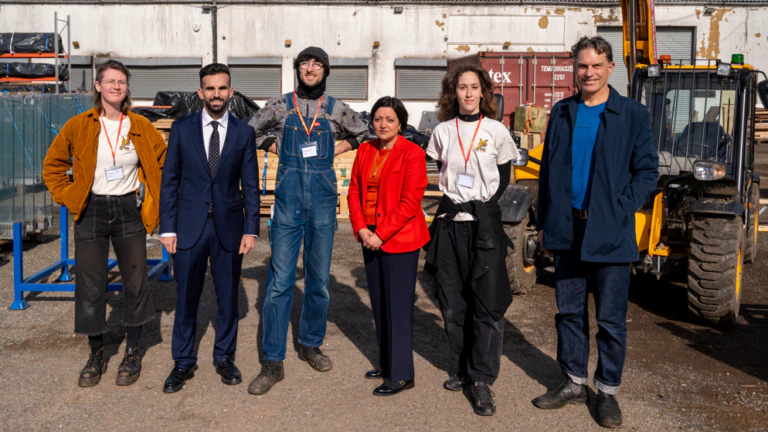
He is working on changing this. Over the past two years, he’s boosted the New Museum School, a programme that delivers year-long traineeships in heritage organisations for BAME people.
“We deliver an accredited level three diploma, we have a course tutor, we had 16 trainees this year, and we have 18 next year,” says Francis. “That’s 34 over the last two years. Each trainee receives monthly tutorials and develops an online portfolio to build up 100 units to get the qualification. I think this should be the gold standard – there’s no reason why work-based training shouldn’t be as prestigious as
a university qualification.”
Francis says that the selection process for the trainees is based on testing people’s life experience. “We have this amazing selection day where we whittle down applicants via a group exercise, so you can actually see them working, how they interact with other people, how they problem solve, how they work as a team.”
On top of all this, Francis also pursues his own photography career. He’s particularly excited about a project at the Pitt Rivers Museum in Oxford, where he spotted an empty horizontal display case while on a visit. “I just had this automatic desire to get in it,” he says. Nine months down the line, Francis got his way.
The photograph shows Francis posed in the display case with the rifle that Augustus Pitt Rivers modernised, the bible that the pilgrims took to America, and a breadfruit. The other half of the diptych shows a white female posing with exactly the same objects. Raising questions around colonialism and the perception of identity, Francis’s new work will be launched later this year.
So, why do normal? Francis certainly does not.
Errol Francis is speaking in the session A Black British Museum: is this the future? at the Museums Association Conference in Brighton on Thursday 3 October
Errol Francis at a glance
Errol Francis started his career working in the mental health sector, particularly with black, Asian and minority ethnic (BAME) groups. After founding the African Caribbean Mental Health Association, he moved on to be the director of Kensington and Chelsea Mind, the mental health charity.
He became the programme director for the Frantz Fanon Health Centre in Birmingham in 1996, then joint programme lead for the Sainsbury Centre for Mental Health in London in 2002.
Four years later, Francis moved to Arts Council England to be the Inspire programme director. Francis was researching for his PhD, in postcolonial artistic responses to museums, when he was asked to direct an arts festival by the Mental Health Foundation.
After finishing his doctorate in 2016, Francis was appointed the artistic director and CEO of Culture&, an independent arts and education charity in London.
Culture& at a glance
Culture& is an independent arts and education charity set up in 1988 in London.
Formerly known as Cultural Co-operation, the chartity works with arts and heritage institutions and artists to develop programmes that promote diversity in the workforce and expand audiences.
Culture&’s flagship programme is the New Museum School, which is in its second year. A collaboration with Create Jobs, the school partners with arts organisations – the Southbank Centre, National Trust, Magnum Photos, Royal Collection Museum of London, William Morris Gallery – to provide one-year accredited traineeships, developing diverse talent in the sector.
On completion, trainees achieve a RQF Level 3 Diploma in Cultural Heritage. Culture& also runs projects in collaboration with arts organisations, such as the Memory Archives, set up with the London Metropolitan Archives and the Friends of the Huntley Archives, which launched on Windrush Day 2019.