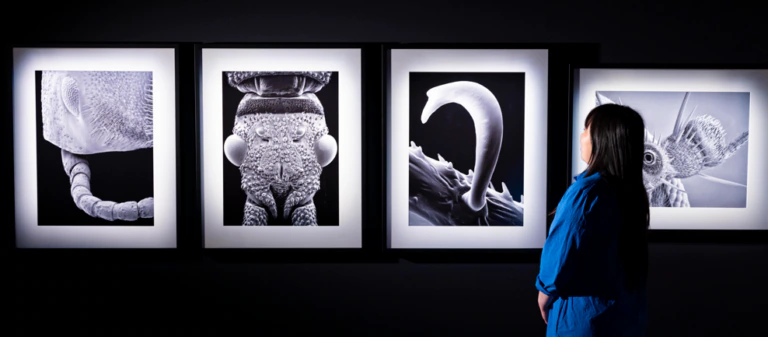
“Nature is declining globally at rates unprecedented in human history – and the rate of species extinctions is accelerating, with grave impacts on people around the world now likely.” This is the alarming warning from a recent United Nations report created by the Intergovernmental Science-Policy Platform on Biodiversity and Ecosystem Services (IPBES).
“The health of ecosystems on which we and all other species depend is deteriorating more rapidly than ever,” says Robert Watson, the chair of IPBES. “We are eroding the very foundations of our economies, livelihoods, food security, health and quality of life worldwide.
“The report also tells us that it is not too late to make a difference, but only if we start now at every level from local to global. Through ‘transformative change’, nature can still be conserved, restored and used sustainably.”
The world’s natural history museums are playing an important role in the battle to understand and address biodiversity loss. But it is a challenging area to be involved in, particularly when communicating the value of this work to the public.
After Darren Mann, the head of life collections at the Oxford University Museum of Natural History, wrote a blog that celebrated the discovery of a rare beetle by a 10-year-old girl in Oxfordshire, he received several negative responses that queried why the bug needed to be caught and added to the museum’s collection of insect specimens.
This process, which might seem counterintuitive in environmental terms, is actually crucial to monitor biodiversity loss, explained Mann in a follow-up article: “Unlike plants and birds, many insects can only be identified with the aid of a microscope, to study tiny features that distinguish closely related species. Some groups even require the dissection of minuscule genitalia to really tell them apart. Entomologists need to know what a species is, where it occurs and as much about it as possible, so we can inform biodiversity conservation.”
Nature calls
Tim Littlewood, the head of life sciences at the Natural History Museum (NHM), London, says that natural history collections are being used to answer key questions about life on earth.
“They help us map a sustainable future for ourselves and the natural systems on which we depend,” he says. “And to answer fundamental scientific questions about ecological, evolutionary and geological processes, and how they interact to shape our changing planet.”
With 80 million specimens, the NHM says it has the world’s most important collection. The museum is digitising its collection, and the processing of this information will be invaluable to understand the extent of biodiversity loss, as these records are often the only source of information on the past distribution of species. To help with a seemingly impossible task, the museum has developed a programme called Synthesys+, which uses artificial intelligence to speed up the rate of collection digitisation.
It is not only the collections themselves, however, but the interchange of specimens between museums that play a key role in analysing and combating biodiversity loss. Paolo Viscardi is the chair of the Natural Sciences Collections Association (Natsca), a subject specialist network and membership organisation that represents natural history collections and the people who work with them. This proved key in a recent Florida investigation into an unusual type of insect.
Parasitoid wasps might not sound like the most pleasant creatures but by laying their eggs inside the bodies of pests, they can be used to help protect crops, in place of chemical pesticides. The association has been able to provide specimens for research through the contributions of member museums.
“This is the kind of thing we do all the time, because each of us in the sector is in this network of colleagues who have known each other for years,” says Viscardi.
The development of the UK’s first national zoological biobank in 2018 was also a landmark moment for museums. The CryoArks Biobank is a hub for researchers across the UK, giving them access to cells and DNA from endangered species and other wildlife, which can be used in their research and for conservation planning.
These examples show that great work is occurring behind the scenes, but biodiversity loss is a difficult concept to illustrate to the public in an effective way. It is all-encompassing affecting everything around us. And, as with climate breakdown, it paints a bleak picture of the future on planet Earth. For Viscardi, the first issue is with the word itself.
“Biodiversity is just a term for nature that can be used in scientific literature with a bit more gravitas,” he says. “It’s jargon, really. It’s a shame because it’s made it harder for the public to engage with the concept, let alone what it means, in terms of loss of species and loss of genetic diversity.”
A 2010 survey that found that Brits most commonly thought biodiversity was a type of washing powder would seem to support this view. However, Viscardi feels that it isn’t hard to put across important messages about biodiversity loss it just requires museums to understand their audience.
He draws on the example of the kakapo, a critically endangered flightless parrot. This features in the Jurassic Skies – When Dinosaurs Took to the Air exhibition (until 30 June) at the National Museum of Ireland in Dublin, which Viscardi curated. The bird went viral when a kakapo tried to copulate with a cameraman during a BBC documentary about animals on the edge of extinction, presented by Stephen Fry.
The exhibition focuses on the animal’s unusual and comedic side, rather than the fact it has nearly gone extinct.
“Examples, such as the story of the kakapo or the panda bear, provide a handy hook to talk about other species that are endangered,” says Viscardi. “It’s harder for the public to engage with lifeforms like plants, unless they are keen gardeners.”
Fostering positivity
This positivity can be fostered more easily when museums make exciting breakthroughs – and this is just what has happened at the Horniman Museum and Gardens in south-east London.
“We have an aquarium and, amazingly, we’re the first place in the world to captively breed coral – and a big part of biodiversity loss isn’t just insects and plants, it’s coral bleaching,” says Horniman director Nick Merriman. “We’re at the forefront of trying to accelerate its breeding to tolerate warmer waters and possibly regrow some of the bleached coral on the reefs.”
Alongside this project, which could have worldwide ramifications, the Horniman follows the mantra “think global, act local”. Merriman says the museum’s family audiences are more likely to show concern for the world that their children will inherit, and seek to make a difference.
“Sometimes these things seem so overwhelming, but you need to focus on what you can do to improve the situation,” he says. “The approach we’re taking at the Horniman is about empowerment. It is museum displays that are not just informing, but acting as catalysts for action, and saying ‘this is what you can do’.
“It can range from programmes on making bug houses that encourage insects in your garden or window box, to selling related material such as wildflower seeds in the shop. It’s also key that we start working actively with schools and try to insert this into the national curriculum.”
For Merriman, this is a continuation of a long-held tradition: “Our founder Frederick Horniman came from a Quaker family, so there was that kind of ethical and social justice ethos behind the origins of the museum, and we’re trying to recapture that. If he were alive today, he’d be concerned about biodiversity loss and climate change, and would be shaping the museum to address those issues.”
Blurring the boundary between museum and audience is another logical way of engaging the public directly with a cause, which can prove beneficial for both parties. This is something that the NHM has had great success with, says Littlewood.
“Answering the big science questions around climate change and the diversity of life requires lots of data, and our researchers can’t gather this alone,” he says.
“Our citizen science projects invite people to actively contribute to the museum’s science research. By recording observations of wildlife, collecting samples or transcribing handwritten records, people can unlock the potential of our collections and gather vital data for our scientists, helping them to better understand the natural world and contribute to addressing some of the big challenges facing biodiversity.”
Bridget McKenzie founded the pop-up Climate Museum because she was dissatisfied by the methods of traditional museums in dealing with key environmental issues.
By setting up in different locations and engaging directly with the public about climate change, biodiversity loss and related issues, the project targets “compassionate, conversational methods for supporting people in a changing time”. McKenzie hopes it will inspire other museums to play a more active role in exploring difficult truths head on.
Natural history museums play a key role in monitoring the effects of biodiversity loss through their collections, and it’s clear that they are starting to do much more than that.
This includes working with institutions on an international level to share exciting specimens, and even developing solutions to environmental issues, such as Project Coral at the Horniman.
However, just as important is their role in inspiring visitors to make changes to their lifestyles that impact positively on the planet, and to campaign for policies that truly reflect the severity of the issues faced by humankind, including the dangers of biodiversity loss.
Miles Rowland is a freelance writer.
Bridget McKenzie is among the speakers at the Museums Association Conference & Exhibition in Brighton on 3-5 October. The theme is Sustainable and Ethical Museums in a Globalised World
Clarification
26.06.2019
The article has been updated to give a more accurate description of Natsca.