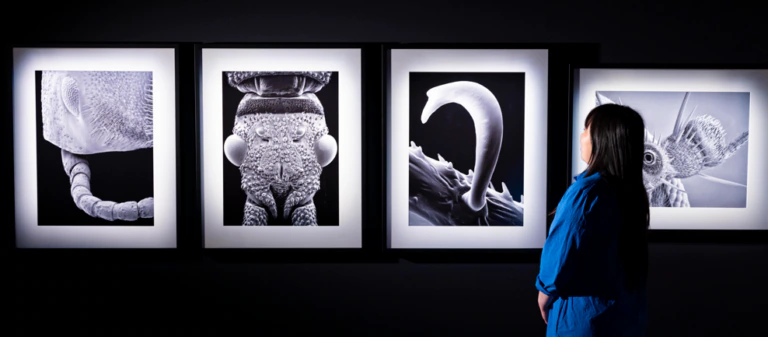
The journey of the Great Exhibition of the North from concept to reality has taken place against a tumultuous backdrop. It seems a long time ago now that the former chancellor George Osborne laid out his ambitions for a major exhibition to showcase the north of England as a hub of innovation, arts and industry – part of his grand plan to establish a northern powerhouse that would act as an economic counterweight to London.
Who could have predicted back in 2014 that Osborne, then tipped as the next British prime minister, would be editing the London Evening Standard newspaper by the time his vision came to be realised. Or that Britain, still fresh from presenting itself as the inclusive, global-facing nation that hosted the 2012 London Olympics, would be negotiating to leave the European Union.
But while the past few years in politics have been unpredictable, the organisers of the Great Exhibition of the North don’t seem to have let it distract them from the task at hand. Led by the Newcastle-Gateshead Initiative, in partnership with cultural organisations including Tyne and Wear Archives and Museums (Twam), the team won the bid in late 2016, leaving around 18 months to put together an event on a scale that would generally take far longer to plan.
“Something like this has never been done before with such a short turnaround, so there are challenges we are having to resolve on our feet,” says the exhibition’s executive director Carol Bell. “It’s manic but exciting.”
The result is an 80-day programme of exhibitions, performances, feats of invention and art. The events, which kicked off on 22 June and run until 9 September, are free to attend and aim to showcase the pioneering spirit of the region.
“We knew we wanted it to be theatrical in design and spread throughout the area rather than in a gallery,” says Iain Watson, the director of Twam, who worked closely with Bell on the bid and programming. “We wanted to take a creative and constructivist approach.”
The concept of a multi-venue “dispersed exhibition”, which has been trialled by Twam to great success in previous projects, means related objects and installations don’t always appear side by side, but are instead displayed across the exhibition’s three hub venues – the Great North Museum, the Sage Gateshead concert hall, and the Baltic Centre for Contemporary Art – and numerous other sites around Newcastle-Gateshead. This will enable the expected three million visitors to curate their own experience by choosing one of three walking trails themed around design, innovation and art. “We weren’t looking to build a pavilion,” says Bell. “We wanted to use the assets we had.”
Fitting location
Anyone who has visited Newcastle-Gateshead would know why it’s an ideal setting for such an event. Aside from an ambitious bid proposal, it was the city’s dramatic vista – the bridges and quayside buildings – that swayed the judges to choose it ahead of strong bids from Bradford and Sheffield, says Gary Verity, who helped develop the idea for the exhibition project and is chairman of its board. The geography of the city plays a starring role: an 80-metre water sculpture along the River Tyne forms a centrepiece of the exhibition, sending jets of water up every hour in synchrony with three original music compositions.
It’s not the first time Newcastle has staged this type of global expo: in 1929, it played host to the North East Coast Exhibition, a four-month event designed to showcase the region’s heavy industry. It’s an irresistible parallel that the project nods to at various points. Baltic’s show, Idea of North, uses the 1929 expo with its mix of “pavilions and spectacle” as a reference point, according to the gallery’s director Sarah Munro. “It was about using our largest space on level four of the gallery to develop moments of intrigue, with projects across different media.”
This link with the 1929 expo is fortuitous: from the start, the event was intended to emulate the great exhibitions of yesteryear (see p29), particularly their utopian focus on the world of tomorrow. It was the futuristic icons displayed at those fairs – such as the Skylon, the cigar-shaped structure that rose above London’s South Bank like an alien spacecraft at the Festival of Britain in 1951 – that resonated most with visitors.
“Things that looked to the future, that’s what people wanted to see,” says Watson.
A key inspiration for the organisers was The Blazing World, a 1668 novella that has attracted cult status as one of the earliest written works of science fiction. Fittingly, the book’s author was the Duchess of Newcastle, Margaret Cavendish, who envisaged a utopian world filled with as-yet-unimagined miracles such as engine-powered boats, blending scientific theory with vivid flights of imagination. In homage to the novel, one of the galleries in the Great North Museum’s This Way North show, entitled Journey Into the Blazing World, features a first edition of the manuscript displayed alongside fantastical objects such as Doctor Who’s sonic screwdriver.
Creating a buzz
Elsewhere, the events reference the past while exploring visions of the future: in 1879 Mosley Street in Newcastle became the first street in the world to be lit by an incandescent light bulb – now it’s been transformed by the technology firm Cisco into what is being called a “smart street” featuring digital technology designed to help improve the environment. The nearby Literary Philosophical Society has a display of light bulbs made of graphene, a super-conductive material that earned scientists in Manchester a Nobel Prize following its discovery in 2004.
Similarly, the most high-profile exhibit, the early steam locomotive Stephenson’s Rocket, on display at the Discovery Museum, is used as a starting point to explore futuristic modes of transport such as the Hyperloop, a high-speed tube envisioned by the US entrepreneur Elon Musk.
Securing Stephenson’s Rocket on loan from the Science Museum was a big coup. The rocket was built in Newcastle for the 1829 Rainhill Trials, a competition to find a new prototype for steam locomotion. It won the trials, setting a world record speed of 35mph, and its design became a model for mainline locomotive engineering.
“Having it here has brought in a range of other things – all because of the excitement over one object,” says Watson. With one eye on the future, Twam enlisted a Newcastle-based digital consultancy, Hedgehog Lab, to create a virtual reality experience that allows visitors to enter the 1800s and climb aboard the engine.
Ensuring a legacy
When the 80-day programme was first announced, there were concerns about how the eventual host city might represent the north of England as a whole. “Northernness” is a vague concept that encompasses numerous cities, landscapes and cultures, all distinctive in their own right. Unlike other city-based events such as the City of Culture festival, the exhibition team had to be conscious not to put too strong an emphasis on Geordie culture alone.
“The people who are represented – scientists, inventors, engineers, artists – are very much northern, not just of the north-east,” says Watson. Twam has sourced ideas from across the region by, for example, working with museum development networks to gather content for the online exhibition, A History of the North in 100 Objects.
Baltic has chosen to analyse what the north represents with its temporary exhibition, whose title was inspired by a Peter Davidson book, The Idea of North (2005). “The book poses questions such as ‘Where does north begin and end?’, conveying that we all carry our own idea of the north,” says Munro. “It has been important to incorporate a strong DIY attitude, at making the community visible at specific moments rather than a singular narrative.”
The exhibition explores architecture and design, as well as individual stories of community, protest and counter culture in the region through displays such as Real Arcadia, an installation on Cumbria’s little-known “cave rave” scene in the 1990s, when a number of illegal raves were held in caves.
Alongside the exhibition programme, the region as a whole has been invited to tap into the buzz through the Inspired By programme, which publicises events across the region such as the Cumbria Literary Festival and the York Festival of Ideas.
So will the Great Exhibition of the North achieve Osborne’s vision of showcasing the north as a hub of innovation? Legacy plans are already in place, including a £15m funding pot to support cultural regeneration; this has been allocated towards projects such as a new museum in Blackpool. The exhibition programme aims to inspire young people to get involved in science, technology, engineering and mathematics (Stem) subjects. There are extensive schools events that will reach around 27,000 schoolchildren, as well as the Family Expo in Newcastle’s St James’ Park stadium, where children can try out activities such as 3D printing. “We want young people to go ‘oh that’s really cool, I could do that’,” says Bell.
The whole project has also succeeded in building connections between the cultural, science, technology and business sectors, says Watson. “There have been some fantastic partnerships between the public and private sectors. A lot of us knew each other but weren’t working as closely together.”
A business expo is running alongside the main exhibition, and parallel endeavours, such as the Creative Fuse North East partnership, which connects universities, cultural organisations and local digital companies, have also benefited. In the longer term, the exhibition’s legacy and the success of the northern powerhouse will be determined by commitment from central government. In spite of the political upheaval, Bell says the government has “stayed incredibly supportive” of the programme.
But there are rumblings of discontent in the north of England. Last month, in an unprecedented show of unity, more than 20 northern newspapers published a joint editorial to warn the prime minister, Theresa May, that she would be “jeopardising the credibility of the northern powerhouse and alienating this region for good” if the transport chaos across northern England – caused in part by her government’s cancellation of rail electrification projects – was not resolved. It is noticeable that there is not much mention of Brexit, although leaving the single market and customs union would surely have consequences for Stem and other industries in the region.
For the moment, the organisers are solely focused on making the event an experience visitors won’t forget. “What we want is for people to come and see an amazing example of a northern city,” says Bell. “We want to make them aware of all the great stuff that’s happening here.”
The first international expo of its kind in Britain, the Great Exhibition was organised by Prince Albert and staged in the huge, purpose-built Crystal Palace pavilion in south London. Its primary aim was to demonstrate the superiority of British manufacturing, design and industry, although it also showcased foreign goods and the trappings of empire, with lavish exhibits on India and other British colonies. An estimated six million people attended, with the event offering a rare opportunity for people of different social classes to mingle. Many of the objects on show went on to form the first collection of the South Kensington Museum (later the Victoria and Albert Museum). Profits from the event also funded the creation of the Science Museum and the Natural History Museum.
North East Coast Exhibition, Newcastle, 1929
Held from May to October, the North East Coast Exhibition was a world fair designed to promote the north-east, showing “the country and the world at large the many and varied products of its yards, factories and workshops”. It has left a legacy across Newcastle, including Exhibition Park, the Discovery Museum – which started out as a temporary pavilion in the exhibition – and the art deco Palace of the Arts. In addition to showcasing heavy industry, the event featured an amusement park, a women’s pavilion and an African village populated by 100 Senegalese tribespeople, reflecting the racist colonial attitudes of the time. It attracted more than four million visitors. In an unfortunate accident of timing, the Wall Street Crash occurred just days after the exhibition closed, ushering in the Great Depression.
The Festival of Britain, London and nationwide, 1951
Who could have predicted back in 2014 that Osborne, then tipped as the next British prime minister, would be editing the London Evening Standard newspaper by the time his vision came to be realised. Or that Britain, still fresh from presenting itself as the inclusive, global-facing nation that hosted the 2012 London Olympics, would be negotiating to leave the European Union.
But while the past few years in politics have been unpredictable, the organisers of the Great Exhibition of the North don’t seem to have let it distract them from the task at hand. Led by the Newcastle-Gateshead Initiative, in partnership with cultural organisations including Tyne and Wear Archives and Museums (Twam), the team won the bid in late 2016, leaving around 18 months to put together an event on a scale that would generally take far longer to plan.
“Something like this has never been done before with such a short turnaround, so there are challenges we are having to resolve on our feet,” says the exhibition’s executive director Carol Bell. “It’s manic but exciting.”
The result is an 80-day programme of exhibitions, performances, feats of invention and art. The events, which kicked off on 22 June and run until 9 September, are free to attend and aim to showcase the pioneering spirit of the region.
“We knew we wanted it to be theatrical in design and spread throughout the area rather than in a gallery,” says Iain Watson, the director of Twam, who worked closely with Bell on the bid and programming. “We wanted to take a creative and constructivist approach.”
The concept of a multi-venue “dispersed exhibition”, which has been trialled by Twam to great success in previous projects, means related objects and installations don’t always appear side by side, but are instead displayed across the exhibition’s three hub venues – the Great North Museum, the Sage Gateshead concert hall, and the Baltic Centre for Contemporary Art – and numerous other sites around Newcastle-Gateshead. This will enable the expected three million visitors to curate their own experience by choosing one of three walking trails themed around design, innovation and art. “We weren’t looking to build a pavilion,” says Bell. “We wanted to use the assets we had.”
Fitting location
Anyone who has visited Newcastle-Gateshead would know why it’s an ideal setting for such an event. Aside from an ambitious bid proposal, it was the city’s dramatic vista – the bridges and quayside buildings – that swayed the judges to choose it ahead of strong bids from Bradford and Sheffield, says Gary Verity, who helped develop the idea for the exhibition project and is chairman of its board. The geography of the city plays a starring role: an 80-metre water sculpture along the River Tyne forms a centrepiece of the exhibition, sending jets of water up every hour in synchrony with three original music compositions.
It’s not the first time Newcastle has staged this type of global expo: in 1929, it played host to the North East Coast Exhibition, a four-month event designed to showcase the region’s heavy industry. It’s an irresistible parallel that the project nods to at various points. Baltic’s show, Idea of North, uses the 1929 expo with its mix of “pavilions and spectacle” as a reference point, according to the gallery’s director Sarah Munro. “It was about using our largest space on level four of the gallery to develop moments of intrigue, with projects across different media.”
This link with the 1929 expo is fortuitous: from the start, the event was intended to emulate the great exhibitions of yesteryear (see p29), particularly their utopian focus on the world of tomorrow. It was the futuristic icons displayed at those fairs – such as the Skylon, the cigar-shaped structure that rose above London’s South Bank like an alien spacecraft at the Festival of Britain in 1951 – that resonated most with visitors.
“Things that looked to the future, that’s what people wanted to see,” says Watson.
A key inspiration for the organisers was The Blazing World, a 1668 novella that has attracted cult status as one of the earliest written works of science fiction. Fittingly, the book’s author was the Duchess of Newcastle, Margaret Cavendish, who envisaged a utopian world filled with as-yet-unimagined miracles such as engine-powered boats, blending scientific theory with vivid flights of imagination. In homage to the novel, one of the galleries in the Great North Museum’s This Way North show, entitled Journey Into the Blazing World, features a first edition of the manuscript displayed alongside fantastical objects such as Doctor Who’s sonic screwdriver.
Creating a buzz
Elsewhere, the events reference the past while exploring visions of the future: in 1879 Mosley Street in Newcastle became the first street in the world to be lit by an incandescent light bulb – now it’s been transformed by the technology firm Cisco into what is being called a “smart street” featuring digital technology designed to help improve the environment. The nearby Literary Philosophical Society has a display of light bulbs made of graphene, a super-conductive material that earned scientists in Manchester a Nobel Prize following its discovery in 2004.
Similarly, the most high-profile exhibit, the early steam locomotive Stephenson’s Rocket, on display at the Discovery Museum, is used as a starting point to explore futuristic modes of transport such as the Hyperloop, a high-speed tube envisioned by the US entrepreneur Elon Musk.
Securing Stephenson’s Rocket on loan from the Science Museum was a big coup. The rocket was built in Newcastle for the 1829 Rainhill Trials, a competition to find a new prototype for steam locomotion. It won the trials, setting a world record speed of 35mph, and its design became a model for mainline locomotive engineering.
“Having it here has brought in a range of other things – all because of the excitement over one object,” says Watson. With one eye on the future, Twam enlisted a Newcastle-based digital consultancy, Hedgehog Lab, to create a virtual reality experience that allows visitors to enter the 1800s and climb aboard the engine.
Ensuring a legacy
When the 80-day programme was first announced, there were concerns about how the eventual host city might represent the north of England as a whole. “Northernness” is a vague concept that encompasses numerous cities, landscapes and cultures, all distinctive in their own right. Unlike other city-based events such as the City of Culture festival, the exhibition team had to be conscious not to put too strong an emphasis on Geordie culture alone.
“The people who are represented – scientists, inventors, engineers, artists – are very much northern, not just of the north-east,” says Watson. Twam has sourced ideas from across the region by, for example, working with museum development networks to gather content for the online exhibition, A History of the North in 100 Objects.
Baltic has chosen to analyse what the north represents with its temporary exhibition, whose title was inspired by a Peter Davidson book, The Idea of North (2005). “The book poses questions such as ‘Where does north begin and end?’, conveying that we all carry our own idea of the north,” says Munro. “It has been important to incorporate a strong DIY attitude, at making the community visible at specific moments rather than a singular narrative.”
The exhibition explores architecture and design, as well as individual stories of community, protest and counter culture in the region through displays such as Real Arcadia, an installation on Cumbria’s little-known “cave rave” scene in the 1990s, when a number of illegal raves were held in caves.
Alongside the exhibition programme, the region as a whole has been invited to tap into the buzz through the Inspired By programme, which publicises events across the region such as the Cumbria Literary Festival and the York Festival of Ideas.
So will the Great Exhibition of the North achieve Osborne’s vision of showcasing the north as a hub of innovation? Legacy plans are already in place, including a £15m funding pot to support cultural regeneration; this has been allocated towards projects such as a new museum in Blackpool. The exhibition programme aims to inspire young people to get involved in science, technology, engineering and mathematics (Stem) subjects. There are extensive schools events that will reach around 27,000 schoolchildren, as well as the Family Expo in Newcastle’s St James’ Park stadium, where children can try out activities such as 3D printing. “We want young people to go ‘oh that’s really cool, I could do that’,” says Bell.
The whole project has also succeeded in building connections between the cultural, science, technology and business sectors, says Watson. “There have been some fantastic partnerships between the public and private sectors. A lot of us knew each other but weren’t working as closely together.”
A business expo is running alongside the main exhibition, and parallel endeavours, such as the Creative Fuse North East partnership, which connects universities, cultural organisations and local digital companies, have also benefited. In the longer term, the exhibition’s legacy and the success of the northern powerhouse will be determined by commitment from central government. In spite of the political upheaval, Bell says the government has “stayed incredibly supportive” of the programme.
But there are rumblings of discontent in the north of England. Last month, in an unprecedented show of unity, more than 20 northern newspapers published a joint editorial to warn the prime minister, Theresa May, that she would be “jeopardising the credibility of the northern powerhouse and alienating this region for good” if the transport chaos across northern England – caused in part by her government’s cancellation of rail electrification projects – was not resolved. It is noticeable that there is not much mention of Brexit, although leaving the single market and customs union would surely have consequences for Stem and other industries in the region.
For the moment, the organisers are solely focused on making the event an experience visitors won’t forget. “What we want is for people to come and see an amazing example of a northern city,” says Bell. “We want to make them aware of all the great stuff that’s happening here.”
Great exhibitions of the past
The Great Exhibition of the Works of Industry of All Nations, London, 1851The first international expo of its kind in Britain, the Great Exhibition was organised by Prince Albert and staged in the huge, purpose-built Crystal Palace pavilion in south London. Its primary aim was to demonstrate the superiority of British manufacturing, design and industry, although it also showcased foreign goods and the trappings of empire, with lavish exhibits on India and other British colonies. An estimated six million people attended, with the event offering a rare opportunity for people of different social classes to mingle. Many of the objects on show went on to form the first collection of the South Kensington Museum (later the Victoria and Albert Museum). Profits from the event also funded the creation of the Science Museum and the Natural History Museum.
North East Coast Exhibition, Newcastle, 1929
Held from May to October, the North East Coast Exhibition was a world fair designed to promote the north-east, showing “the country and the world at large the many and varied products of its yards, factories and workshops”. It has left a legacy across Newcastle, including Exhibition Park, the Discovery Museum – which started out as a temporary pavilion in the exhibition – and the art deco Palace of the Arts. In addition to showcasing heavy industry, the event featured an amusement park, a women’s pavilion and an African village populated by 100 Senegalese tribespeople, reflecting the racist colonial attitudes of the time. It attracted more than four million visitors. In an unfortunate accident of timing, the Wall Street Crash occurred just days after the exhibition closed, ushering in the Great Depression.
The Festival of Britain, London and nationwide, 1951
Despite marking the centenary of the Great Exhibition, the five-month Festival of Britain was different in tone, reflecting a much-changed country. Staged by the postwar Labour government, the event on London’s bombed out South Bank was intended to foster a sense of recovery and offer a vision for a socialist utopia. The festival celebrated modernist architecture and showcased the principles of urban design, as well as introducing visitors to futuristic innovations such as the Telekinema, a 400-seat cinema that showed 3D films and television programmes. Around eight million visitors attended the London site. A month after it closed, a Conservative government came to power and removed almost all traces of the festival, including the iconic Skylon – a 300ft-high steel, wire and aluminium sculpture by the river Thames. Only the Royal Festival Hall remains today.