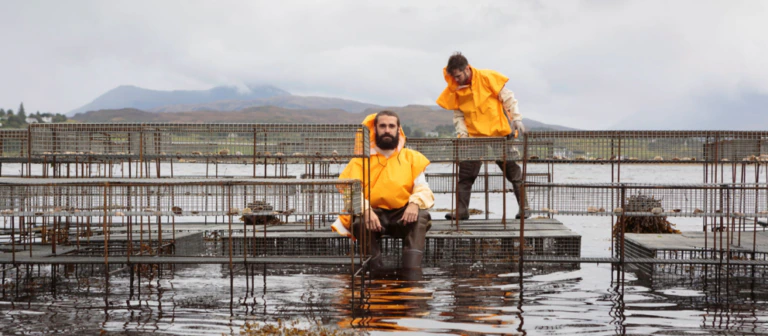
“It’s important for people to view art in spaces that aren’t white cubes,” says Sarah McCrory, the director of Glasgow International (8-25 April), a contemporary art biennial. The event aims to take art to a wide range of audiences by showing work in non- traditional spaces, as well as in Glasgow’s more established museums and galleries.
This year marks McCrory’s second festival as director, but the first she’s seen through from start to finish. She took over when the last event was about to start, so she had to hit the ground running because of the very short lead time. And though it was a race against time to get everything done, 2014’s festival was a great success. McCrory joined Glasgow International having gained significant experience curating art around a city with Frieze Projects East, which took place during the 2012 London Olympics.
“That was really challenging,” she says. “Finding empty space that you can afford in east London is really hard.”
It’s no mean feat to direct a city-wide contemporary art festival incorporating listed buildings, established venues, as well as new works being commissioned, but McCrory says she finds directing and curating Glasgow International comparatively easy compared with Frieze.
“There’s still a real wealth of interesting, listed buildings here, most of which we can afford to use too,” she says. “Of course there are architectural gems that are still really hard to get permission to use, and organising a festival like this is still a difficult process, but once you jump the initial hurdles there are plenty of great spaces to inhabit with great art in Glasgow.”
Artistic roots
As an ex-artist, McCrory has always been sensitive to the display of art. After studying fine art at degree level, she went on to study curating, but she says that even when she was an artist she spent a lot of time organising shows and was often more interested in writing and curating other people’s projects than actually making her own art.
McCrory clearly loves curating and says that she wouldn’t have taken the job as the director of Glasgow International had there not been any curatorial work involved. She oversees a part of the festival called the director’s programme, as well as selecting all the organisations that take part and all the other artists’ projects involved.
“Developing relationships with artists is what I’m really interested in, and unearth- ing works that haven’t been seen for either a long time or at all,” says McCrory, who often travels to meet the artists she works with.
New commissions also make up an integral part of the festival, and McCrory cites the artist Alexandra Bircken, “who’s using the kind of traditional industrial materials you would find in a working Glaswegian shipyard. She’s fitting wheels to her sculp- tures and aligning them to the tram tracks in the Tramway gallery, so there’s a relevance to the building and its history.”
McCrory is keen for the artists involved to pick up on the industrial heritage of the city, but not so much that it clouds the work.
“A successful art festival is always about getting a good range of responses and not hammering a theme down the audience’s throat,” she says.
She finds Glasgow a particularly culturally rich arena to work within because “the art world is less separated than London’s. Musicians are very closely tied to the Glasgow art world, which is also closely tied to film. Because it’s a smaller city there’s a lot of crossover.”
Glasgow-based artists tend to make larger works because of the amount of space in the city and that awareness filters into the work, she says. This in contrast to London, where far more artists make digital art, which they need little space to create, often just a laptop. “There’s a really strong studio culture in this city – ceramic studios, production studios, sculpture, print,” McCrory says.
Cultural landscape
The city itself has been an art capital in the UK since the 19th century, when it was one of the country’s major ports, and the Mackintosh-designed Glasgow School of Art was founded. McCrory says that the art school runs the unusual course on environmental art, which encourages artists to think about site-specific work that engages with its surroundings, and she thinks this is integral to the success of Glasgow International as an event, because it has led to a greater understanding of art interventions across the city.
In fact the practice of the art school doesn’t just inform the perception of the festival but also boosts visitor figures: “We have a huge art school audience, which definitely contributes to our core audience of people involved in the art world, professional visitors and art enthusiasts.”
It showcases the best of local and international art by populating venues, museums and galleries across the city with new artwork. These are supported by a programme of talks and events.
There are six staff members who manage the festival, and about 70 volunteers help operate the day-to-day running of it. About 33,000 people visited in 2014.
Glasgow International‘s four core funders are Glasgow Life, Creative Scotland, The Glasgow City Marketing Bureau and Events Scotland. This is supplemented with funds from individual patrons and donors.
Glasgow International runs from 8-25 April this year.
McCrory has worked as a co-curator of Studio Voltaire, London, and has also curated exhibitions for London galleries Vilma Gold and the ICA.
She spent three years as the curator of Frieze Foundation, a non-profit organisation, where she managed Frieze Projects East, a scheme that encompassed six new public art projects in the Olympic host boroughs of east London, as part of the London 2012 Festival.
She became the director of Glasgow International, a biennial festival of contemporary art, in 2013.
This year marks McCrory’s second festival as director, but the first she’s seen through from start to finish. She took over when the last event was about to start, so she had to hit the ground running because of the very short lead time. And though it was a race against time to get everything done, 2014’s festival was a great success. McCrory joined Glasgow International having gained significant experience curating art around a city with Frieze Projects East, which took place during the 2012 London Olympics.
“That was really challenging,” she says. “Finding empty space that you can afford in east London is really hard.”
It’s no mean feat to direct a city-wide contemporary art festival incorporating listed buildings, established venues, as well as new works being commissioned, but McCrory says she finds directing and curating Glasgow International comparatively easy compared with Frieze.
“There’s still a real wealth of interesting, listed buildings here, most of which we can afford to use too,” she says. “Of course there are architectural gems that are still really hard to get permission to use, and organising a festival like this is still a difficult process, but once you jump the initial hurdles there are plenty of great spaces to inhabit with great art in Glasgow.”
Artistic roots
As an ex-artist, McCrory has always been sensitive to the display of art. After studying fine art at degree level, she went on to study curating, but she says that even when she was an artist she spent a lot of time organising shows and was often more interested in writing and curating other people’s projects than actually making her own art.
McCrory clearly loves curating and says that she wouldn’t have taken the job as the director of Glasgow International had there not been any curatorial work involved. She oversees a part of the festival called the director’s programme, as well as selecting all the organisations that take part and all the other artists’ projects involved.
“Developing relationships with artists is what I’m really interested in, and unearth- ing works that haven’t been seen for either a long time or at all,” says McCrory, who often travels to meet the artists she works with.
New commissions also make up an integral part of the festival, and McCrory cites the artist Alexandra Bircken, “who’s using the kind of traditional industrial materials you would find in a working Glaswegian shipyard. She’s fitting wheels to her sculp- tures and aligning them to the tram tracks in the Tramway gallery, so there’s a relevance to the building and its history.”
McCrory is keen for the artists involved to pick up on the industrial heritage of the city, but not so much that it clouds the work.
“A successful art festival is always about getting a good range of responses and not hammering a theme down the audience’s throat,” she says.
She finds Glasgow a particularly culturally rich arena to work within because “the art world is less separated than London’s. Musicians are very closely tied to the Glasgow art world, which is also closely tied to film. Because it’s a smaller city there’s a lot of crossover.”
Glasgow-based artists tend to make larger works because of the amount of space in the city and that awareness filters into the work, she says. This in contrast to London, where far more artists make digital art, which they need little space to create, often just a laptop. “There’s a really strong studio culture in this city – ceramic studios, production studios, sculpture, print,” McCrory says.
Cultural landscape
The city itself has been an art capital in the UK since the 19th century, when it was one of the country’s major ports, and the Mackintosh-designed Glasgow School of Art was founded. McCrory says that the art school runs the unusual course on environmental art, which encourages artists to think about site-specific work that engages with its surroundings, and she thinks this is integral to the success of Glasgow International as an event, because it has led to a greater understanding of art interventions across the city.
In fact the practice of the art school doesn’t just inform the perception of the festival but also boosts visitor figures: “We have a huge art school audience, which definitely contributes to our core audience of people involved in the art world, professional visitors and art enthusiasts.”
Glasgow International at a glance
Glasgow International biennial festival of contemporary art is now in its 7th edition, having begun in 2005.It showcases the best of local and international art by populating venues, museums and galleries across the city with new artwork. These are supported by a programme of talks and events.
There are six staff members who manage the festival, and about 70 volunteers help operate the day-to-day running of it. About 33,000 people visited in 2014.
Glasgow International‘s four core funders are Glasgow Life, Creative Scotland, The Glasgow City Marketing Bureau and Events Scotland. This is supplemented with funds from individual patrons and donors.
Glasgow International runs from 8-25 April this year.
Sarah McCrory at a glance
Having studied fine art at the Royal College of Art at degree level, Sarah McCrory returned to the college to do a course in curating.McCrory has worked as a co-curator of Studio Voltaire, London, and has also curated exhibitions for London galleries Vilma Gold and the ICA.
She spent three years as the curator of Frieze Foundation, a non-profit organisation, where she managed Frieze Projects East, a scheme that encompassed six new public art projects in the Olympic host boroughs of east London, as part of the London 2012 Festival.
She became the director of Glasgow International, a biennial festival of contemporary art, in 2013.