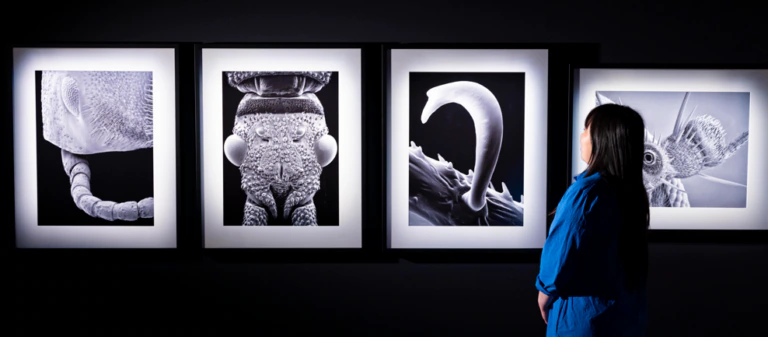
The Musée d’ethnographie de Genève (Geneva Museum of Ethnography), which was founded in 1901, has reopened following a £42.5m redevelopment.
The project saw the renovation of the institution’s historic building and the construction of a new wing. Plans for the new building were contentious when they were first proposed, which led the city to hold a referendum to approve its construction in 2010.
The new wing has been designed to be unobtrusive, with most of it lying underground, topped by a landscaped garden that will host cultural activities and a playground for children.
The redevelopment has quadrupled the amount of exhibition space in the museum, allowing it to put more than 1,200 objects from its 80,000-strong collection of world culture on display. It has also created a new library and media centre, auditorium, cafe and shop.
The museum was redeveloped to increase its visitor capacity and attract a much wider range of people, particularly children. The museum says that all of its displays are informed by a robust research programme.
In 2010, the institution established its Anthropological Research Centre, which conducts scientific research on collections and extensive anthropological fieldwork across the world. The centre has six departments – Africa, the Americas, Asia, Europe, Oceania and ethnomusicology – and the six curators of those departments have each created a permanent gallery within the reopened museum.
More than 1,500 diverse cultures are represented in the collection. Part of the institution’s ethos is to democratise the objects on display, says the museum’s director, Boris Wastiau, meaning that modest, everyday items are given the same level of interpretation and prominence as major works of art.
The museum also features extensive displays of European culture, an aspect that Wastiau says ethnographic museums have often overlooked in the past.
The museum has commissioned several artworks to sit alongside its permanent collection, including a dramatic, 18-metre-long video installation by French artist Ange Leccia. Staff work closely with source communities and collect contemporary art from living world cultures.
The museum’s current temporary exhibition, Mochica Kings: Divinity and Power in Ancient Peru (until 3 May), features treasures from Peru’s 8th-century royal Mochica culture that were unearthed in a tomb in 2008.
The interpretation uses firsthand archaeological data to contextualise the objects, an approach that Wastiau says the museum hopes to continue in its future programming.
How have visitors responded to the redevelopment?
Boris Wastiau: So far they’ve responded very positively. We have had 13,000 visitors in the first weekend and 25,000 visitors within the first three weeks, which is already more than half the number we had during the six months before we closed for redevelopment.
They have been mostly very happy and we have many visitors who are already returning and becoming loyal to the museum. Because the public has different needs it is always difficult to please everyone with the design, graphics, lighting and so on, but it seems we have struck a good balance.
What kind of audiences are you hoping to attract?
My aim was to make the exhibition galleries much more accessible than before to everyone – children, people with buggies, those in wheelchairs. People can get around more easily now and children can run around the galleries because the objects are in glass cases. I hope we will have more families coming here.
What were the main challenges of the project?
The biggest, of course, was that we wanted to be on time and on budget, which we were. Then, having to make the selection of art and objects in the permanent collection and articulate them in a meaningful walk-through exhibition.
We had quite an ambitious idea that we would put a lot of objects on permanent display – nearly 1,200 – but this gave us less chance to be original in the presentation of those galleries. However, half of the space in the museum is for temporary exhibitions and that is where we can be more daring and ambitious.
What is the most innovative aspect of the redevelopment?
For us, what is innovative for an ethnographic museum is to have a public programming department that makes sure we have a full programme of live art, dance, concerts and storytelling.
We have had a new team working on this for the past 18 months. We have a new library, new spaces, larger galleries and an auditorium that the public was not aware of, so the team needed to find a way to draw people in.
We plan programming all around the museum and inside the exhibition galleries themselves; it makes a big difference to have someone in the galleries talking to people about the objects. Some programmes are so popular that we have a problem – but so far we have been very happy with our problems because they are mostly to do with having too many visitors.
Ethnographic collections in museums sometimes have a difficult colonial history. What is your approach to interpreting such objects?
One-fifth of the permanent display is devoted to telling the history of the collections and explores aspects like orientalism and the taste for the exotic [in the 19th century] that were important to the development of the museum.
Some of the collection is based on antiquities that are not necessarily representative of their country’s contemporary culture, other objects represent living cultures. It is important to historicise the object; every display mentions the provenance of the item and the place in which it was made.
One innovative aspect was to feature contemporary art in our permanent collection; for example, we include contemporary African painting alongside the older African carvings. It’s a way to give an identity back to those unknown artists.
The project saw the renovation of the institution’s historic building and the construction of a new wing. Plans for the new building were contentious when they were first proposed, which led the city to hold a referendum to approve its construction in 2010.
The new wing has been designed to be unobtrusive, with most of it lying underground, topped by a landscaped garden that will host cultural activities and a playground for children.
The redevelopment has quadrupled the amount of exhibition space in the museum, allowing it to put more than 1,200 objects from its 80,000-strong collection of world culture on display. It has also created a new library and media centre, auditorium, cafe and shop.
The museum was redeveloped to increase its visitor capacity and attract a much wider range of people, particularly children. The museum says that all of its displays are informed by a robust research programme.
In 2010, the institution established its Anthropological Research Centre, which conducts scientific research on collections and extensive anthropological fieldwork across the world. The centre has six departments – Africa, the Americas, Asia, Europe, Oceania and ethnomusicology – and the six curators of those departments have each created a permanent gallery within the reopened museum.
More than 1,500 diverse cultures are represented in the collection. Part of the institution’s ethos is to democratise the objects on display, says the museum’s director, Boris Wastiau, meaning that modest, everyday items are given the same level of interpretation and prominence as major works of art.
The museum also features extensive displays of European culture, an aspect that Wastiau says ethnographic museums have often overlooked in the past.
The museum has commissioned several artworks to sit alongside its permanent collection, including a dramatic, 18-metre-long video installation by French artist Ange Leccia. Staff work closely with source communities and collect contemporary art from living world cultures.
The museum’s current temporary exhibition, Mochica Kings: Divinity and Power in Ancient Peru (until 3 May), features treasures from Peru’s 8th-century royal Mochica culture that were unearthed in a tomb in 2008.
The interpretation uses firsthand archaeological data to contextualise the objects, an approach that Wastiau says the museum hopes to continue in its future programming.
How have visitors responded to the redevelopment?
Boris Wastiau: So far they’ve responded very positively. We have had 13,000 visitors in the first weekend and 25,000 visitors within the first three weeks, which is already more than half the number we had during the six months before we closed for redevelopment.
They have been mostly very happy and we have many visitors who are already returning and becoming loyal to the museum. Because the public has different needs it is always difficult to please everyone with the design, graphics, lighting and so on, but it seems we have struck a good balance.
What kind of audiences are you hoping to attract?
My aim was to make the exhibition galleries much more accessible than before to everyone – children, people with buggies, those in wheelchairs. People can get around more easily now and children can run around the galleries because the objects are in glass cases. I hope we will have more families coming here.
What were the main challenges of the project?
The biggest, of course, was that we wanted to be on time and on budget, which we were. Then, having to make the selection of art and objects in the permanent collection and articulate them in a meaningful walk-through exhibition.
We had quite an ambitious idea that we would put a lot of objects on permanent display – nearly 1,200 – but this gave us less chance to be original in the presentation of those galleries. However, half of the space in the museum is for temporary exhibitions and that is where we can be more daring and ambitious.
What is the most innovative aspect of the redevelopment?
For us, what is innovative for an ethnographic museum is to have a public programming department that makes sure we have a full programme of live art, dance, concerts and storytelling.
We have had a new team working on this for the past 18 months. We have a new library, new spaces, larger galleries and an auditorium that the public was not aware of, so the team needed to find a way to draw people in.
We plan programming all around the museum and inside the exhibition galleries themselves; it makes a big difference to have someone in the galleries talking to people about the objects. Some programmes are so popular that we have a problem – but so far we have been very happy with our problems because they are mostly to do with having too many visitors.
Ethnographic collections in museums sometimes have a difficult colonial history. What is your approach to interpreting such objects?
One-fifth of the permanent display is devoted to telling the history of the collections and explores aspects like orientalism and the taste for the exotic [in the 19th century] that were important to the development of the museum.
Some of the collection is based on antiquities that are not necessarily representative of their country’s contemporary culture, other objects represent living cultures. It is important to historicise the object; every display mentions the provenance of the item and the place in which it was made.
One innovative aspect was to feature contemporary art in our permanent collection; for example, we include contemporary African painting alongside the older African carvings. It’s a way to give an identity back to those unknown artists.
Project data
- Cost £42.5m
- Architect Graber Pulver Architekten
- Lighting and scenography for Mochica Kings MCBD Architectes
- Mochica Kings runs until 3 May