Reaching a consensus among the people of Northern Ireland on how - or even whether - to establish a museum of the Troubles was never going to be easy.
It's seven years since Sinn Fein risked the ire of unionist parties by calling for the H-blocks at Belfast's Maze Prison, where IRA commander Bobby Sands died after 66 days on hunger strike in 1981,to be turned into a memorial to the conflict.
Now, with plans for an accompanying £300m sports stadium kicked into touch earlier this year, the Northern Ireland Executive's proposal to transform part of the site into a "conflict transformation centre" seems as distant a prospect as ever.
But anyone who feared progress towards opening a Troubles museum was doomed to the same glacial pace as that which once dogged the peace talks is in for a surprise. After years of fine-tuning, the coming months will see the launch of not one, but two, permanent galleries dedicated to the conflict.
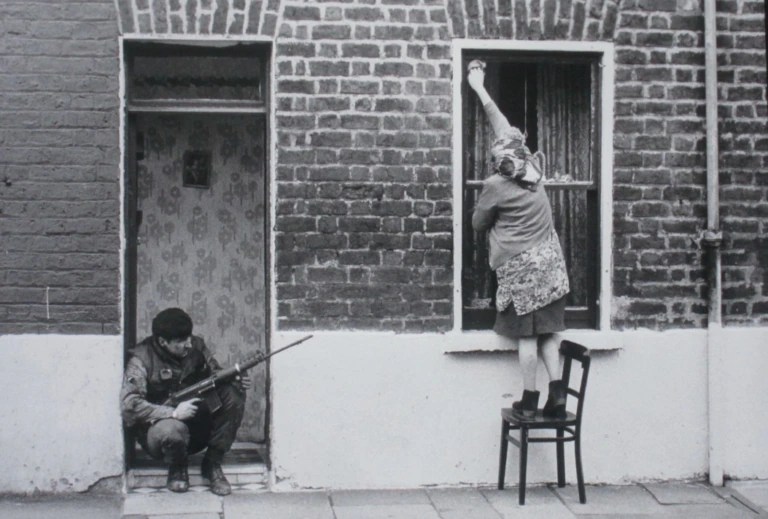
First up is an online archive of artworks produced during - and "inspired by" - the three decades when sectarian violence was at its height. Funded by the Arts Council of Northern Ireland (ACNI), the £36,000 project will use paintings, photographs and literature to chronicle the period from the civil rights marches of the late 1960s to the 1998 Good Friday Agreement.
Meanwhile, October sees the long-awaited reopening of Belfast's Ulster Museum after a three-year, £17.2m make-over - complete with a dedicated Troubles gallery.
The collection ranges from the shirt worn by founding Social Democratic and Labour Party (SDLP) leader Gerry Fitt when he was felled by a Royal Ulster Constabulary (RUC) baton at a 1968 rally, to a plaque commemorating a match played by Manchester United on the first anniversary of the 1998 Omagh bomb in aid of victims' families.
Impartial representation
So how did curators bring these projects to fruition? And amid reminders of the violence, such as the recent Real IRA shootings, how will they navigate the minefield of sensitivities left by the province's turbulent history?
For Trevor Parkhill, keeper of history at the Ulster Museum, concerns about reopening old wounds had to be balanced against the opportunity to incorporate a lasting space dedicated to the Troubles into the redevelopment: "The more I thought about it, the more I realised, we have to do it."
His confidence is down to the far from hysterical resp-onse to the museum's previous foray into confronting the Troubles - its 2003 exhibition Conflict: The Irish at War, which charted the evolution of warfare on the island from the Mesolithic to the present day: "Almost as much impact was created by what visitors posted on the noticeboard as the exhibition," Parkhill says.
"It was very gentlemanly, though, with no real defacing: the only bit was someone who replied to a comment accusing the exhibition of being biased towards the Republicans or the Loyalists by gently writing 'thicko' beside it."
Mindful of the need to guarantee impartiality in the new displays, the museum formed a Troubles advisory group, comprising nationalists and unionists. When the gallery is unveiled in October, it will house a resource area for private reflection, featuring searchable image and documentary databases. An ongoing programme will record the testimonies of Troubles victims through oral histories and/or storytelling workshops.
Andrea Rea, who, as ACNI's dedicated Troubles archivist, has spent three years compiling the digital archive, also says engaging with people across the political spectrum is crucial to winning public confidence.
"Early on we had a consultation event to which we invited arts practitioners, including community arts groups," Rea says. "This was practitioner-led, not particularly tied to sides in the conflict, though all shades of opinion were represented. We asked for feedback and ideas for the project's realisation. An online archive was one of a number of possibilities."
The digital option emerged as the most popular - not least because of mounting wariness about the idea of building a cultural attraction at the empty Maze (though opening a physical archive in Belfast's rapidly rejuvenating Titanic Quarter is still a possibility).
The next question was whether to focus exclusively on images, or to embrace the arts more generally. Rea plumped for the latter, setting herself an upper limit of 50 artists at the launch, each represented by up to five self-chosen works.
Among the paintings that will feature are several from the ACNI's own collection, including Victor Sloan's Market Street, Derry - a sepia-tinted watercolour of children crossing the road in front of a military vehicle.
Joining them will be John Kindness's cartoonish images of drive-by shootings, and the dark triptych Ulster Crucifixion, depicting a young boy hanging from a lamppost above a platoon of soldiers marching past burnt-out houses.
Ken Howard, the artist who painted it while chronicling the Troubles for the Imperial War Museum in the 1970s, declared it his finest achievement when, in 2003, it was bought by the Art Fund and installed in the Ulster Museum.
As for writers, Rea is finalising the rights to include a number of works owned by institutions further afield, including Atlanta's Emory University, where an endowment has enabled the Robert W Woodruff Library to accumulate a collection of work by Seamus Heaney, Ciaran Carson and Pulitzer Prize-winning poet Paul Muldoon.
This is where a digital archive comes into its own: items that could otherwise only be exhibited temporarily while on loan from their owners can reside permanently on the new website in virtual format.
"There will also be lots of links to other gallery sites," Rea adds. "We want to be an umbrella for information on Troubles art - a first-stop portal."
Responsibility for the future
By way of material unique to the website, ACNI has commissioned 12 accompanying essays, all personal reflections on the Troubles. Authors include Carson himself and veteran BBC correspondent Feargal Keane, who will chair the council's annual conference this month, when the archive will be formally launched.
Though confident they have been inclusive while developing their respective projects, both Rea and Parkhill still anticipate some controversy.
"There will be a bit of sniping," says Parkhill. "I'd be disappointed if it didn't engender debate. I see it as part of a continuing process that will hopefully help prevent something as horrible happening again. Museums can be neutral spaces where people can go without feeling someone else is looking over their shoulder - though 20 years ago, I'm not sure they'd have seen themselves that way."
As for the difficulty of "imposing" objectivity on an archive culled from a period of civil war, Rea argues that, in spite of the circumstances in which they were produced, few works display sectarian bias: "The arts appears to have been one arena where divisions weren't so apparent. Most of the art doesn't make political points. It's often difficult to identify a particular artist as Protestant or Catholic."
One of the few Belfast institutions with experience of the challenges facing the Ulster Museum and the ACNI is the Linen Hall Library in Belfast. In 2003 it launched Troubled Images, an award-winning exhibition of sectarian posters drawn from an archive spanning a quarter of a million items of printed matter relating to the conflict - ranging from stickers and Christmas cards to manifestos.
It toured the US, eventually returning for a well-received homecoming in Portadown, still the scene of periodic tensions between Catholics and Orangemen.
Acting librarian John Killen concedes that the library had the advantage of building its collection over decades, gradually negotiating links with communities across the divide. Many now make proactive donations.
Displaying work publicly, he argues, was a logical next step. He says the library's experience offers valuable lessons for other institutions about the importance of collaborating with communities on a continual basis.
"The exhibition was handled sensitively," Killen says. "Throughout the process, the librarian would be in contact with the groups, sounding them out as to what they thought were their most iconic or important images."
But how will the main political parties in Stormont react to the new projects? Barry McElduff, Sinn Fein chairman of the Northern Ireland Assembly's culture, arts, and leisure committee, which was consulted about both projects, is cautiously upbeat:
"I think there's a value in retaining and exhibiting material from the conflict. Young people, I find, are very curious to hear the experiences of their parents. Some parents might choose to protect their children from the stories, but I think it's important the stories are told."
But he adds that curatorial balance is vital - a view shared by fellow committee member, Democratic Unionist (DUP) Jim Shannon: "The history of the Troubles is deeply contested. It's important it's presented in a sensitive and even-handed manner. The DUP would be opposed to any reporting of past events that would seek to provide a moral justification for terrorism or criminality.
"Having said that, it's important we do not forget what happened during the violence in Northern Ireland in order that our society is not dragged back to those times."
James Morrison is a freelance journalist.
It's seven years since Sinn Fein risked the ire of unionist parties by calling for the H-blocks at Belfast's Maze Prison, where IRA commander Bobby Sands died after 66 days on hunger strike in 1981,to be turned into a memorial to the conflict.
Now, with plans for an accompanying £300m sports stadium kicked into touch earlier this year, the Northern Ireland Executive's proposal to transform part of the site into a "conflict transformation centre" seems as distant a prospect as ever.
But anyone who feared progress towards opening a Troubles museum was doomed to the same glacial pace as that which once dogged the peace talks is in for a surprise. After years of fine-tuning, the coming months will see the launch of not one, but two, permanent galleries dedicated to the conflict.
First up is an online archive of artworks produced during - and "inspired by" - the three decades when sectarian violence was at its height. Funded by the Arts Council of Northern Ireland (ACNI), the £36,000 project will use paintings, photographs and literature to chronicle the period from the civil rights marches of the late 1960s to the 1998 Good Friday Agreement.
Meanwhile, October sees the long-awaited reopening of Belfast's Ulster Museum after a three-year, £17.2m make-over - complete with a dedicated Troubles gallery.
The collection ranges from the shirt worn by founding Social Democratic and Labour Party (SDLP) leader Gerry Fitt when he was felled by a Royal Ulster Constabulary (RUC) baton at a 1968 rally, to a plaque commemorating a match played by Manchester United on the first anniversary of the 1998 Omagh bomb in aid of victims' families.
Impartial representation
So how did curators bring these projects to fruition? And amid reminders of the violence, such as the recent Real IRA shootings, how will they navigate the minefield of sensitivities left by the province's turbulent history?
For Trevor Parkhill, keeper of history at the Ulster Museum, concerns about reopening old wounds had to be balanced against the opportunity to incorporate a lasting space dedicated to the Troubles into the redevelopment: "The more I thought about it, the more I realised, we have to do it."
His confidence is down to the far from hysterical resp-onse to the museum's previous foray into confronting the Troubles - its 2003 exhibition Conflict: The Irish at War, which charted the evolution of warfare on the island from the Mesolithic to the present day: "Almost as much impact was created by what visitors posted on the noticeboard as the exhibition," Parkhill says.
"It was very gentlemanly, though, with no real defacing: the only bit was someone who replied to a comment accusing the exhibition of being biased towards the Republicans or the Loyalists by gently writing 'thicko' beside it."
Mindful of the need to guarantee impartiality in the new displays, the museum formed a Troubles advisory group, comprising nationalists and unionists. When the gallery is unveiled in October, it will house a resource area for private reflection, featuring searchable image and documentary databases. An ongoing programme will record the testimonies of Troubles victims through oral histories and/or storytelling workshops.
Andrea Rea, who, as ACNI's dedicated Troubles archivist, has spent three years compiling the digital archive, also says engaging with people across the political spectrum is crucial to winning public confidence.
"Early on we had a consultation event to which we invited arts practitioners, including community arts groups," Rea says. "This was practitioner-led, not particularly tied to sides in the conflict, though all shades of opinion were represented. We asked for feedback and ideas for the project's realisation. An online archive was one of a number of possibilities."
The digital option emerged as the most popular - not least because of mounting wariness about the idea of building a cultural attraction at the empty Maze (though opening a physical archive in Belfast's rapidly rejuvenating Titanic Quarter is still a possibility).
The next question was whether to focus exclusively on images, or to embrace the arts more generally. Rea plumped for the latter, setting herself an upper limit of 50 artists at the launch, each represented by up to five self-chosen works.
Among the paintings that will feature are several from the ACNI's own collection, including Victor Sloan's Market Street, Derry - a sepia-tinted watercolour of children crossing the road in front of a military vehicle.
Joining them will be John Kindness's cartoonish images of drive-by shootings, and the dark triptych Ulster Crucifixion, depicting a young boy hanging from a lamppost above a platoon of soldiers marching past burnt-out houses.
Ken Howard, the artist who painted it while chronicling the Troubles for the Imperial War Museum in the 1970s, declared it his finest achievement when, in 2003, it was bought by the Art Fund and installed in the Ulster Museum.
As for writers, Rea is finalising the rights to include a number of works owned by institutions further afield, including Atlanta's Emory University, where an endowment has enabled the Robert W Woodruff Library to accumulate a collection of work by Seamus Heaney, Ciaran Carson and Pulitzer Prize-winning poet Paul Muldoon.
This is where a digital archive comes into its own: items that could otherwise only be exhibited temporarily while on loan from their owners can reside permanently on the new website in virtual format.
"There will also be lots of links to other gallery sites," Rea adds. "We want to be an umbrella for information on Troubles art - a first-stop portal."
Responsibility for the future
By way of material unique to the website, ACNI has commissioned 12 accompanying essays, all personal reflections on the Troubles. Authors include Carson himself and veteran BBC correspondent Feargal Keane, who will chair the council's annual conference this month, when the archive will be formally launched.
Though confident they have been inclusive while developing their respective projects, both Rea and Parkhill still anticipate some controversy.
"There will be a bit of sniping," says Parkhill. "I'd be disappointed if it didn't engender debate. I see it as part of a continuing process that will hopefully help prevent something as horrible happening again. Museums can be neutral spaces where people can go without feeling someone else is looking over their shoulder - though 20 years ago, I'm not sure they'd have seen themselves that way."
As for the difficulty of "imposing" objectivity on an archive culled from a period of civil war, Rea argues that, in spite of the circumstances in which they were produced, few works display sectarian bias: "The arts appears to have been one arena where divisions weren't so apparent. Most of the art doesn't make political points. It's often difficult to identify a particular artist as Protestant or Catholic."
One of the few Belfast institutions with experience of the challenges facing the Ulster Museum and the ACNI is the Linen Hall Library in Belfast. In 2003 it launched Troubled Images, an award-winning exhibition of sectarian posters drawn from an archive spanning a quarter of a million items of printed matter relating to the conflict - ranging from stickers and Christmas cards to manifestos.
It toured the US, eventually returning for a well-received homecoming in Portadown, still the scene of periodic tensions between Catholics and Orangemen.
Acting librarian John Killen concedes that the library had the advantage of building its collection over decades, gradually negotiating links with communities across the divide. Many now make proactive donations.
Displaying work publicly, he argues, was a logical next step. He says the library's experience offers valuable lessons for other institutions about the importance of collaborating with communities on a continual basis.
"The exhibition was handled sensitively," Killen says. "Throughout the process, the librarian would be in contact with the groups, sounding them out as to what they thought were their most iconic or important images."
But how will the main political parties in Stormont react to the new projects? Barry McElduff, Sinn Fein chairman of the Northern Ireland Assembly's culture, arts, and leisure committee, which was consulted about both projects, is cautiously upbeat:
"I think there's a value in retaining and exhibiting material from the conflict. Young people, I find, are very curious to hear the experiences of their parents. Some parents might choose to protect their children from the stories, but I think it's important the stories are told."
But he adds that curatorial balance is vital - a view shared by fellow committee member, Democratic Unionist (DUP) Jim Shannon: "The history of the Troubles is deeply contested. It's important it's presented in a sensitive and even-handed manner. The DUP would be opposed to any reporting of past events that would seek to provide a moral justification for terrorism or criminality.
"Having said that, it's important we do not forget what happened during the violence in Northern Ireland in order that our society is not dragged back to those times."
James Morrison is a freelance journalist.
Troubles collections
Arts Council of Northern Ireland
The arts council has a number of works in its collection that relate to the Troubles. Artists who tackle the subject include Rita Duffy, Joe McWilliams, Jack Pakenham and Victor Sloan.
National Army Museum, London
Artist Ralph Lillford visited Northern Ireland a number of times between 1971 and 1976. The resulting works were most recently shown by the National Army Museum in 2006 in an exhibition called Painting the Troubles.
Tower Museum, Derry
The Story of Derry at the Tower Museum was recently revamped and includes displays on the build-up to the civil rights movement and the impact of the Troubles on the people in the city.
Ulster Museum
National Museums Northern Ireland's redevelopment of the Ulster Museum, which will be complete in October, has included the creation of galleries devoted to the Troubles. Examples of items in its collection include Mairead Corrigan's 1976 Nobel Peace Medal and Rev Joseph Parker's What Price Peace? material.
Wolverhampton Art Gallery
The gallery has collected works that address the political context of Northern Ireland's since the 1980s. Last November it opened The Northern Ireland Collection: Fresh Perspectives, a year-long exhibition that considers the role of the visual arts in presenting the country's contested past and future.
Arts Council of Northern Ireland
The arts council has a number of works in its collection that relate to the Troubles. Artists who tackle the subject include Rita Duffy, Joe McWilliams, Jack Pakenham and Victor Sloan.
National Army Museum, London
Artist Ralph Lillford visited Northern Ireland a number of times between 1971 and 1976. The resulting works were most recently shown by the National Army Museum in 2006 in an exhibition called Painting the Troubles.
Tower Museum, Derry
The Story of Derry at the Tower Museum was recently revamped and includes displays on the build-up to the civil rights movement and the impact of the Troubles on the people in the city.
Ulster Museum
National Museums Northern Ireland's redevelopment of the Ulster Museum, which will be complete in October, has included the creation of galleries devoted to the Troubles. Examples of items in its collection include Mairead Corrigan's 1976 Nobel Peace Medal and Rev Joseph Parker's What Price Peace? material.
Wolverhampton Art Gallery
The gallery has collected works that address the political context of Northern Ireland's since the 1980s. Last November it opened The Northern Ireland Collection: Fresh Perspectives, a year-long exhibition that considers the role of the visual arts in presenting the country's contested past and future.
Links
An Arts Council of Northern Ireland's one-day conference, Art and Conflict, is being held at the Grand Opera House, Belfast, on 17 June. An exhibition focusing on the Northern Ireland Troubles Archive opens at the Ormeau Baths Gallery in Belfast on 18 June and the Troubles archive goes online the following week.
www.artscouncil-ni.org
An Arts Council of Northern Ireland's one-day conference, Art and Conflict, is being held at the Grand Opera House, Belfast, on 17 June. An exhibition focusing on the Northern Ireland Troubles Archive opens at the Ormeau Baths Gallery in Belfast on 18 June and the Troubles archive goes online the following week.
www.artscouncil-ni.org