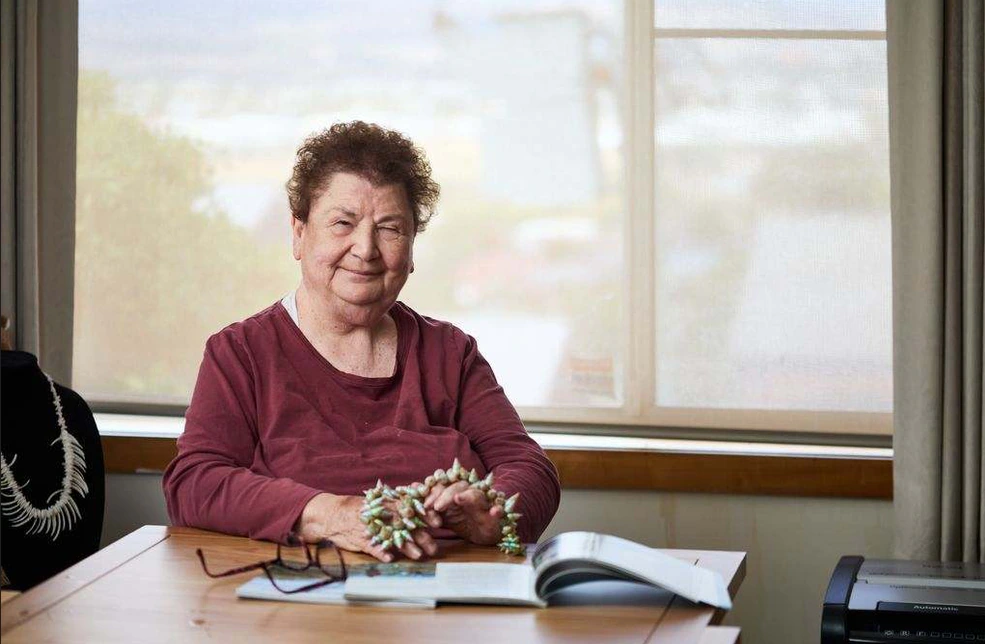
Before she was Aunty Lola Greeno, she was a girl who lived on Cape Barren Island, 100 metres from the beach.
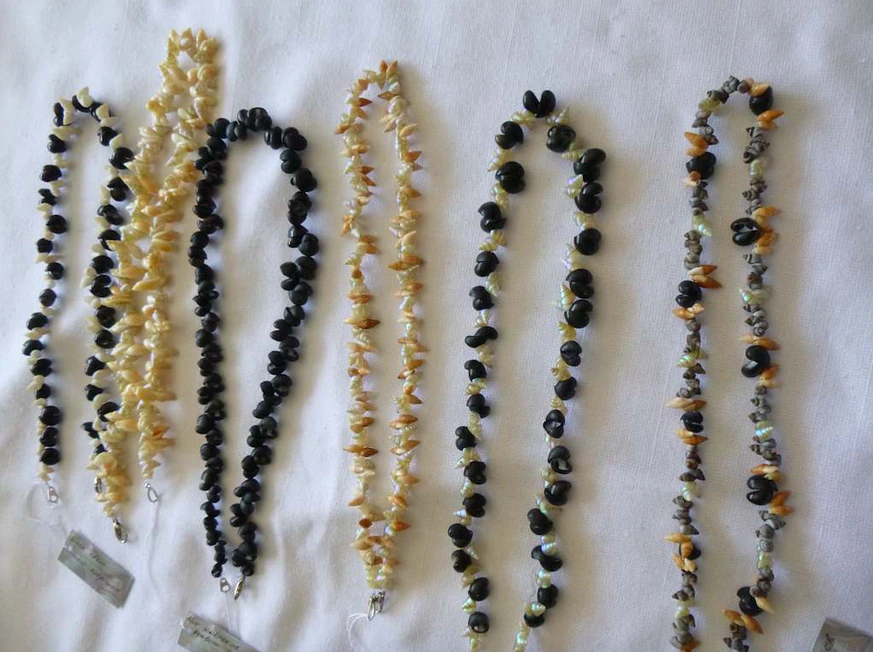
After church on a Sunday, while her mum and other Palawa Elders chatted, she would wander along the sand, picking up shells – cockles, warreners, toothies and dried maireeners – and putting them in her pockets. Then, she was more interested in eating the fish that the shells held. But later, she had more questions.
Through family conversations, Greeno learned how her mother had also collected shells as a girl. "She talked about one of the elderly aunties having shells in her apron," says Greeno. "She used to shake them up, so the shells landed on top, and the sand landed underneath."
Greeno learned to pierce the shells with a tailor's awl and thread them on to cotton, also finding out that before European contact, her ancestors pierced them with a sharpened wallaby bone tooth and threaded them on to kangaroo sinew.
She heard about Wybalenna, an internment site where Tasmanian Aboriginal people were exiled by the British colonial government in the 19th century. And she also learned that during this time, shell stringing was not just a way for Palawa women to maintain connections to their cultural traditions but a trade, providing a source of income to supplement meagre state-distributed rations.
Colonial intervention
Greeno came to understand that colonial intervention influenced how these necklaces were made, and why, but that intervention never interrupted the practice itself. Passed down by her mother, her grandmother and all the generations before them, the unbroken tradition of Tasmanian Aboriginal shell stringing is continued by Greeno.
Advertisement
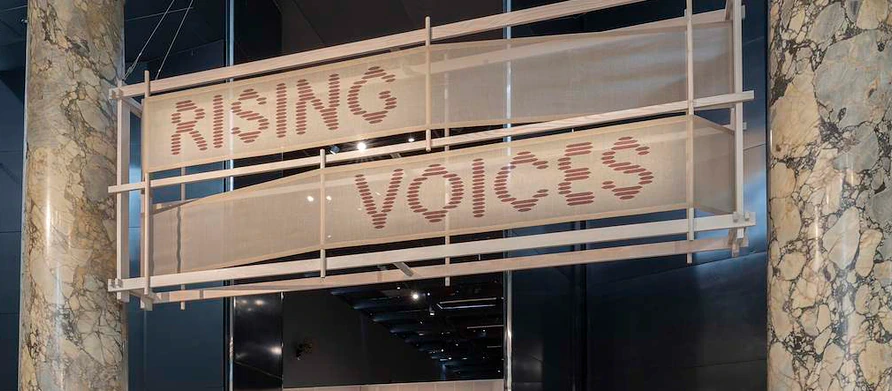
Examples of her work are on display at the Victoria and Albert Museum (V&A) in London, as part of Rising Voices: Contemporary Art from Asia, Australia and the Pacific. The exhibition, which runs until 10 January 2027, is a collaboration between the V&A and Brisbane's Queensland Art Gallery and Gallery of Modern Art.
For Greeno, it's a source of pride that pieces of her cultural heritage are on display in a museum halfway across the world. Moreover, for a contemporary Palawa artist to demonstrate that the traditions of her people continue to exist, despite the efforts of the colonial mission to which the V&A contributed, it's a powerful act of defiance.
“When they asked me, I wanted to swear. But instead of swearing, I gave my response in my necklaces”
This exhibition is not the first in which Greeno's work reflects on cultural tension. In 2011, she was invited to contribute to a group exhibition celebrating Tasmanian Aboriginal artists. It was titled Robinson's Cup, in reference to George Augustus Robinson, who oversaw the enforced exile of Tasmanian Aboriginal people to Wybalenna, and whose mismanagement resulted in the death of many of those exiled.
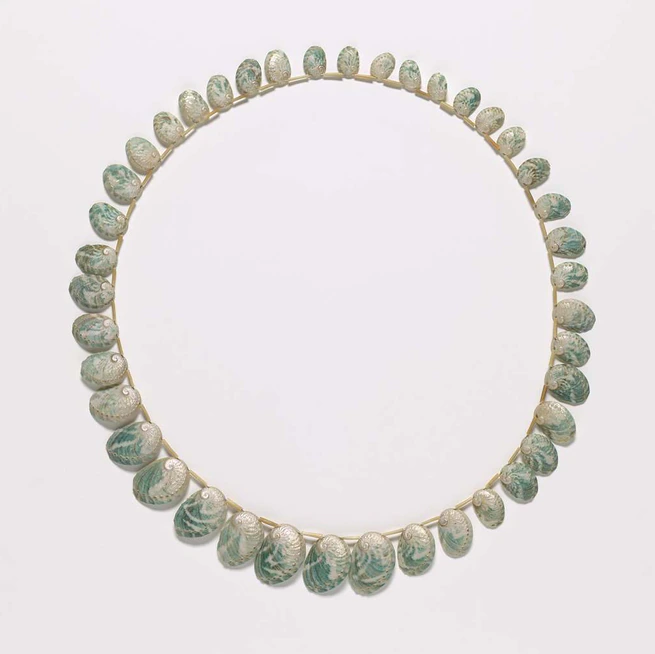
"When they asked me, I wanted to swear," says Greeno. "But instead of swearing, I gave my response in my necklaces." Pieces made of abalone, possum belt and shells that provide food for her community, and a practice that provides connection to Ancestors and Country.
While Palawa women have continuously made shell necklaces, many Indigenous Australian cultural practices were lost through European colonial intervention. The Anindilyakwa women of Groote Eylandt, an island that lies off the coast of the Northern Territory, used to make dadikwakwa-kwa, or shell dolls, that taught kinship systems, held secrets safe and looked after girls as they grew. In the 1950s, the growth of the colonial mission and the establishment of manganese mining disrupted daily life, and the dadikwakwa-kwa lost their prominence in it.
Advertisement
In 2022, however, the Anindilyakwa community was approached by Manchester Museum, which believed it held a collection of more than 80 dadikwakwa-kwa donated by anthropologist Peter Worsley following a research trip. With the support of the Australian Institute of Aboriginal and Torres Strait Islander Studies (Aiatsis), a government statutory authority, Manchester Museum permanently returned the dadikwakwa-kwa to their traditional community.
Revival of cultural practice
This not only resulted in the revival of this cultural practice among the Anindilyakwa people but created a long-term relationship between them and Manchester Museum. Now, new generations of Anindilyakwa women will have memories of making, playing with and learning from dadikwakwa-kwa.
Similarly, two rikawa, or water carriers, returned to Tasmania for the taypani milaythina-tu: Return to Country exhibition, which was hosted by the Tasmanian Museum and Art Gallery (TMAG) from October 2022 to May 2023. The carriers, which are made from bull kelp formed into the shape of a cup by tea tree skewers, are the only two known precolonial models of their kind. The bull kelp contains iodine, which confers health-related benefits such as preventing thyroid issues.
Prior to the exhibition, a handful of Elders continued the tradition of making bull kelp carriers on the Furneaux Group – the same islands Greeno calls home. Following the items' return, the community was able to revive making kelp water carriers, says Zoe Rimmer, former senior curator of First Peoples Art and Culture at TMAG.
Advertisement
But unlike the dadikwakwa-kwa, the rikawa returned to Tasmania as part of a two-year loan agreement, and were not permanently restituted to the Palawa community.
A return does not have to be permanent to support cultural revival within the community, as Rimmer explained to the National Indigenous Times: "To bring the rikawa and other ancestral cultural material home to lutruwita [the Palawa name for Tasmania] is an incredible opportunity for reconnection, healing and cultural revitalisation."
One of the rikawa is in the British Museum's collection and, along with the other eight million objects held there, cannot be permanently returned due to the British Museum Act 1963, which largely restricts deaccessioning objects from its holdings. A similar act, passed in 1983, applies the same law to all other national museums in England, including the V&A, Royal Botanic Gardens and Natural History Museum.
These laws are sometimes cited by museum directors and politicians as a way of disengaging with uncomfortable conversations on repatriation, as if changing them seems beyond the realms of their control.
Aiatsis demonstrated a more fluid approach in its report on the Return of Cultural Heritage Programme, 2020-2024. "Many countries had or have legal frameworks that do not allow for the return of cultural heritage or in some cases deaccessioning of any object from a collection," the report said. "However, such frameworks are not set in stone."
Indeed, the French parliament recently passed a law permitting deaccession of cultural property that was unlawfully appropriated by "theft, pillage or gift obtained by coercion or violence" between 1815 and 1972. In April, meanwhile, the German government announced the establishment of a body to support the returns process for cultural property taken from former colonies.
Imagine a world in which the UK's national museums could deaccession items and return cultural heritage to its traditional communities.
How many Aboriginal Australian children would grow up learning the practices of their people, sharing in traditions that have connected them to each other, to Ancestors and Country for generations? And how many of them might become contemporary artists?
How many exhibitions like Rising Voices might there be? How many traditional practices shared, how much more cultural exchange, how much understanding and respect might there be between communities?
And what of the First Nations people of North America, South America, Africa and Asia similarly affected by colonial activities disrupting their traditional practices, or interrupting it altogether?
These are crucial questions for museums to consider. Addressing them could bring real benefits to Indigenous communities and the whole sector.
Harriet Gilbert Savage studied colonial legacies in Latin American art and literature, before expanding her focus to an Australian context