
“Everybody seems to be stretched – surely this cost cutting can’t continue,” wrote one respondent to the Museums Association’s (MA) latest Members Survey, which covers the year 2025.
For many members, it seems as though funding reductions – and the resulting loss of services – have become a permanent feature of life in the sector.
The survey revealed that almost six in 10 MA members expect cuts in services at their organisation over the coming year due to funding pressures – a figure that hasn’t changed much since 2024.
Out of more than 700 respondents, 58% said their museum was planning cuts in services as a result of funding pressures – broadly similar to the 61% that reported this the previous year, but significantly higher than the 52% in 2023.
Of those respondents who said their museum was facing cuts, 13% said this would result in closures and 41% said it would lead to job losses. Public-facing work will be particularly hit, with more than a third of respondents facing funding cuts saying it will lead to less public programming and 32% saying learning and engagement would be reduced.
A quarter of those facing cuts said their opening hours would be shortened, while 31% warned there would be a fall-off in collections care. Almost three in 10 (28%) said there would be a reduction in operational services.
Advertisement
However, there were also some green shoots in this year’s survey: the proportion of museums warning about these impacts was significantly lower than 2024 in all areas, suggesting that some organisations may have made it through the worst of the post-pandemic funding crisis.
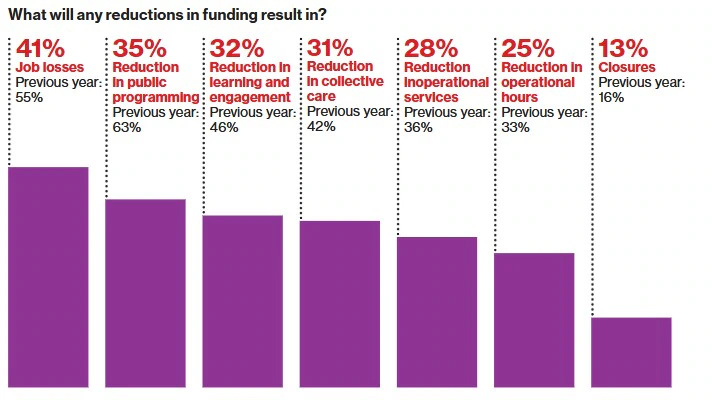
The biggest drops in impact were in public programming (from 63% warning of reductions in 2024 to 35% in 2025), learning and engagement (46% to 32%) and job losses (55% to 41%). This could indicate that the general scale of funding cuts is flattening, although in some cases, it may suggest that services have already been reduced as much as can be.
The depth of the structural challenges facing the sector, however, is exposed in comments from members. Although the past year has seen welcome political attention paid to local and regional museums in all four UK nations, long-term, strategic investment is clearly needed to ensure support goes to where it is most needed.
One member wrote: “Cuts in local authorities [are] being targeted at the smaller museums, which are often the ones with the biggest impact in their local area, so it has a disproportionate effect on communities.
“The larger museums usually have more people to speak up for them, but we need to stand by and care for the smaller civic museums more.”
Advertisement
“Funding seems to go to museums in larger towns that already get a lot of funding,” said another member. “I think they seem like a safer bet for funders – but it becomes a vicious circle.”
One member wrote that “civic museums have been given an impossible task – service their communities with no budgets, and fill the gap with commercial activity. We are all chasing an ever-reducing pot of money”.
Crumbs of comfort
In terms of public funding, there have been pockets of good news for museums over the past year: the Scottish government recently launched its £4m Museum Futures programme, a key plank of which aims to help regional and local museums build resilience and establish new models.
The Welsh government, meanwhile, recently provided £1.9m for 15 projects to help build capacity in local museums, archives and library services.
In England, the one-off £20m Museum Renewal Fund provided an emergency boost to organisations on the brink. In addition, culture secretary Lisa Nandy announced a further £160m for local and regional museums through the existing Museums Estates Development Fund, and a new Museum Transformation programme. which aims to support organisations to move towards more-sustainable business models.
Advertisement
However, one MA member based in England criticised such packages as “dribs and drabs of completely unsustainable funding which achieve nothing, instead of dealing with the actual issue of local authority finances and Arts Council England decision-making.
“You win some and think it’s marvellous, and then lose others. It is no way to run a sustainable museum sector.”
Another member highlighted the “damage to the sector because of a lack of credible, ambitious and socially just strategies for museum sectors in each of the four nations, [which] gives individual museums little support and protection. ”
Sector bodies are working to highlight these failures in government policy. In March, the English Civic Museums Network urged the central government to provide for new funding of £120m a year to support local and regional institutions.
And the MA’s 2026 election manifesto called or strategic public investment in national and local museums, and multi-year funding in all nations to allow museums to plan ahead.
Pressure on staff
These challenges are putting ever-increasing pressure on museum staff. This past year has seen major restructures at a range of organisations, including 550 roles cut the biggest employer in the museum and heritage sector, at the National Trust.
“I see a lot of personal stress and trauma from the culture that develops because of the cuts in funding and jobs, and also people having to take temporary project roles with little job security,” said one respondent.
“I can’t find any full-time jobs to apply for – it is only part-time or zero-hours opportunities,” added another.
For some respondents, the relentless focus on income generation has come at the expense of other areas of museum work. “Collections and in-house exhibitions are not a priority at my workplace, as they are not seen to generate enough income” wrote one respondent. “Priority is given to events.”
The cumulative impact of staff cuts is also evident. “The policy of not replacing posts when people leave, in order to save money, means some posts, especially those collections related, being empty for months, if not years,” said one member. “This puts a huge burden on existing staff to absorb the extra work, without being asked, and with no choice in the matter and certainly not being offered extra hours or pay.
“Gaps then arise that may not be immediately obvious, and it is only when something has not been done that we realise it is no one’s job to do that task any more. Collections work is particularly prone to this; management and outside bodies do not see this as important relative to more public-facing roles, or direct money-generating roles.
Jeopardising inclusivity
Another member highlighted that “funding cuts and reduction in grant-funded roles significantly jeopardise the level of disabled inclusion in the sector”.
“Many of us are having it suggested that we should try volunteering within the organisations we are currently employed by, using professional expertise we currently get paid for,” they added.
One respondent reported that due to the current landscape, the public “can’t visit, can’t study the collections, can’t share the joy or the stories”.
Although there are reasons for optimism, the latest survey ultimately paints a picture of a sector in constant fight-or-flight mode – but one that has the potential to achieve so much more with just a little extra investment.
“Having a thriving museum sector is a part of who we are as a nation,” said one member. “We let it wither at our peril.”