
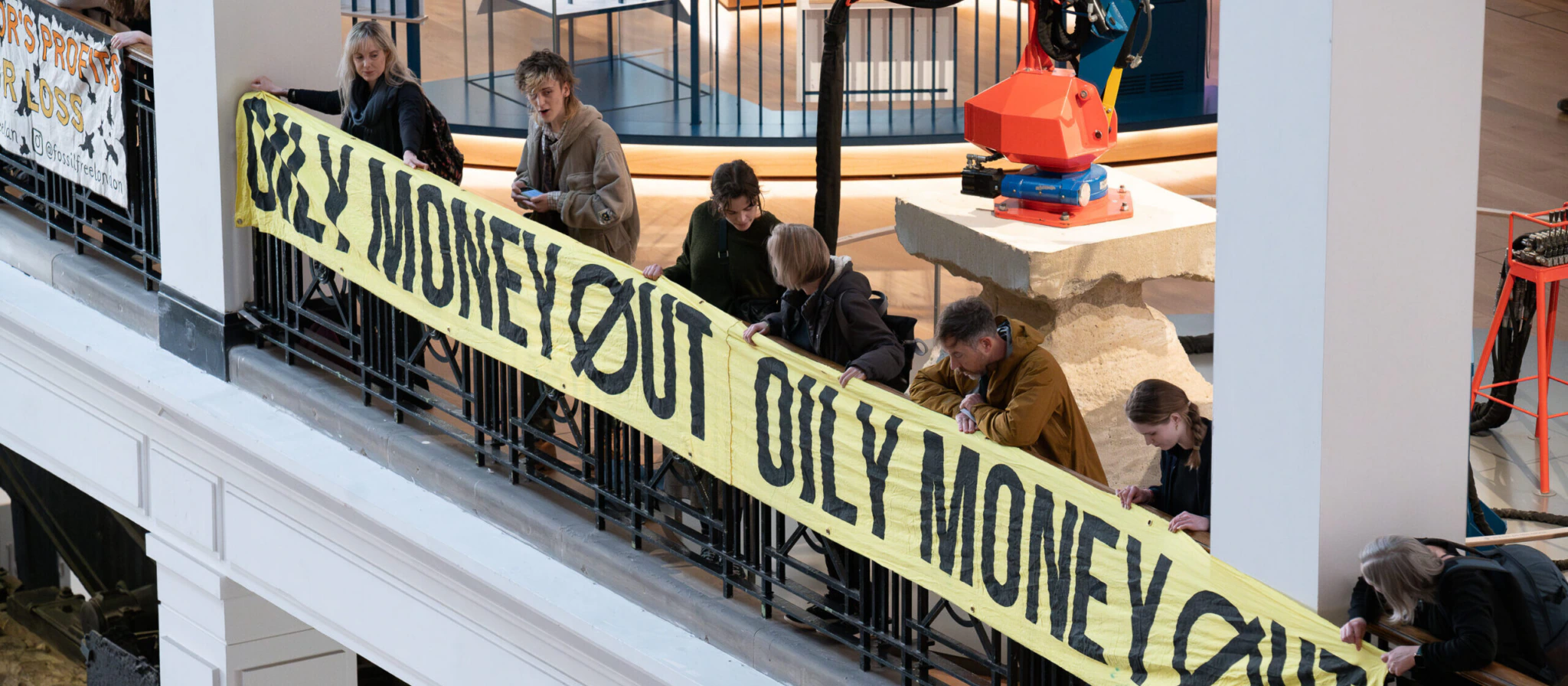
This month, the Museums Association published its latest update of the Code of Ethics, which was revised after extensive sector consultation and is due to be voted on ahead of the association’s AGM in October.
The draft code takes a much firmer line on ethical sponsorship than its previous iteration, advising museums to “transition away from sponsorship from organisations involved with environmental harm (including fossil fuels), human rights abuses, and other sponsorship that does not align with the values of the museum”.
Museums Association members will be able to vote electronically to ratify the new code from the week commencing 15 September until the MA’s AGM, which will take place at Conference 2025 on 7 October.
The code's publication comes as the issue of private investment continues to divide opinion in the sector. Earlier this year, an open letter in the Financial Times newspaper called for an end to the “relentless negativity” around sponsorship in the culture sector.
Signed by, among others, four national museums – the Science Museum Group (SMG), British Museum (BM), National Gallery and Victoria and Albert Museum – it referenced the controversy in May 2024 when investment firm Baillie Gifford was “pushed out of its partnerships with literary festivals following a sustained campaign by activist groups”.
The letter said this incident had been a watershed moment for discussion about private money in the arts and echoed culture secretary Lisa Nandy’s warning that such protests risked “killing off” culture in the UK.
Advertisement
Debate around private money in the arts has evolved in recent years. After a decade in which anti-fossil fuel groups such as Art not Oil and Culture Unstained persuaded many large cultural institutions to divest from such sponsors, some leaders and governance boards appear to have become more wary of being seen to turn down funding or cave in to the demands of campaign groups.
This was in evidence in 2023 when the BM announced a £50m deal with oil giant BP to fund its ambitious masterplan, having formerly hinted that it was seeking to end its relationship with the fossil fuel industry.
In June, Tate director Maria Balshaw, who had previously talked about “public dismay” over the BP deal, told The Times she “wouldn’t rule out the idea that at some time in the future BP might be in a place where it feels that there is a mutual possibility, because those companies are also changing and nobody is on the naughty step for ever”.

She acknowledged that “the fundamental for any organisation regulated by the Charity Commission is that you have to look to take the money first and give a good reason why you don’t”.
The importance of private investment in culture was underlined by a report published in July by Arts Council England, which surveyed more than 7,200 not-for-profit cultural organisations and found that contributed income – including corporate sponsorship, trusts and foundations, and individual donors – accounted for about 17% of their total income in 2023-24.
Advertisement
It is also a fast-growing income source, going up by 36% to £948m between 2021 and 2024, at a time when total income rose by 23%.
Some museum leaders say that the public benefit of sponsorship money outweighs concerns about the source, and that cash-strapped cultural institutions can’t afford to turn their noses up at lucrative income streams.
The SMG strenuously defends its corporate relationships, which include deals with BP and Indian firm Adani Green Energy (part of a group with significant interests in coal and arms production).
An SMG spokesman tells Museums Journal that since 2014, more than 60% of the footprint of London’s Science Museum has been renewed thanks to £100m of private investment.
He says: “This investment enabled the creation of 11 free galleries and two permanent interactive spaces, Wonderlab and Power Up, which invite visitors to explore diverse topics including medicine, communication technologies, mathematics, the worlds of technicians and engineers, as well as the energy transition needed to mitigate climate change.
“As a charity and part-publicly funded institution, we rely on donations from the public, sponsorship from companies and philanthropic gifts to help achieve our mission of engaging the public with science and inspiring the next generation.”
Advertisement
But Chris Garrard, speaking on behalf of Culture Unstained, says the argument that the sector is not in a position to turn down certain sponsors does not hold. “Many museums have moved away from tobacco, arms and fossil fuel funding, and continue to work with the ethical questions around corporate sponsorship through robust policies and due diligence processes,” he says.
“What’s deeply frustrating is that it is a small number of larger, better-funded institutions that are the laggards on this issue, and whose leadership do disservice to the wider sector.”

Garrard points out that the Scottish government’s funding body for the arts, Creative Scotland, increased funding for the Edinburgh Book Festival after Baillie Gifford pulled out, while activist group Fossil Free Books, which campaigned against the investment firm, helped to secure £100,000 from Bloomsbury to support literary festivals.
“We should therefore seek to have a much more rounded and informed conversation about the alternatives to unethical sponsors, taking into account the uneven distribution of funding and how to improve the scale of state support to ease the pressure on those genuinely struggling to make ends meet,” he says.
Garrard believes the position of groups such as Culture Unstained was mischaracterised by the Financial Times letter, and much of the culture sector is already on board with taking a “values-based approach” to sponsorship.
“There is a general consensus that certain sectors – arms, oil and tobacco – cross an ethical red line,” he says.
“But some culture leaders, including the director of the British Museum, have wrongly characterised this as a slippery slope towards rejecting all philanthropy, which just isn’t the case.”
Garrard calls for “much more openness and transparency” from museums on the issue, saying both the public and those working in the sector have concerns about unethical sponsorship.
“Too often, the public is kept in the dark about the benefits being sold to sponsors, preventing them from understanding whether these might be genuine acts of philanthropy or are merely cynical sponsorship deals designed to clean up tarnished brands,” he says.
“We know that many working in national museums and across the sector are also concerned about these issues and that there needs to be dialogue about how we both shift away from unethical sponsors and strengthen the rights of workers within museums at the same time.”
“Too often, the public is kept in the dark about the benefits being sold to sponsors”
Some professionals, however, believe the issue is more nuanced than simply drawing an ethical red line against certain industries.
Museums Association member Alexandra Lawson writes on the Museums Journal website: “Core to this debate is who gets to decide what the ‘red lines’ are and who should adhere to them? Should it be museums, the government or activists who set the red lines and, whoever it is, why them?”
She asks whether “pornography, gambling, vaping, sugar, alcohol, pharma, factory-farmed meat and fish, consumer electronics, water companies and non-sustainable furniture” are acceptable sources of sponsorship.
Public health crisis
In July, meanwhile, the House of Lords debated whether there should be a ban on fossil fuel advertising and sponsorship, on the grounds that the air pollution and climate damage caused by the sector are a “public health crisis”.
Labour MP Jacob Collier argued: “Fossil fuel advertising is not just a matter of a few billboards here and there; it is increasingly a co-ordinated strategy to build trust, shape culture and delay structural change.”
He said sponsors target popular sectors such as museums “because we do not remember the product, we remember the feeling, and if the logo has an association with the feeling, the brand has woven itself into the cultural fabric of our society”.
Collier said there was a “clear precedent” for a ban on fossil fuel sponsorship in the 2002 ban on tobacco advertising, introduced “not because cigarettes had changed or become healthier, but because the science had clarified that the social harm was overwhelming”.
The sponsorship debate looks set to run and run. Faced with trying to balance the wishes of funders, board members, staff, the sector and the public, museum leaders may privately wish some of the trickier decisions could be taken out of their hands.



The suggestion by Jacob Collier that there is any meaningful parallel between tobacco sponsorships is entirely ridiculous and fanciful.
The former is a product which literally nobody in the world actually needs. The latter are products without which (however much we need to transition away from them) our entire way of life (including the Parliament he works in and all our museums) would literally grind to a halt tomorrow .
If this is the level of parliamentary thinking on this issue it’s no wonder we are in a mess.
“between tobacco and fossil fuel sponsorships” 🙂