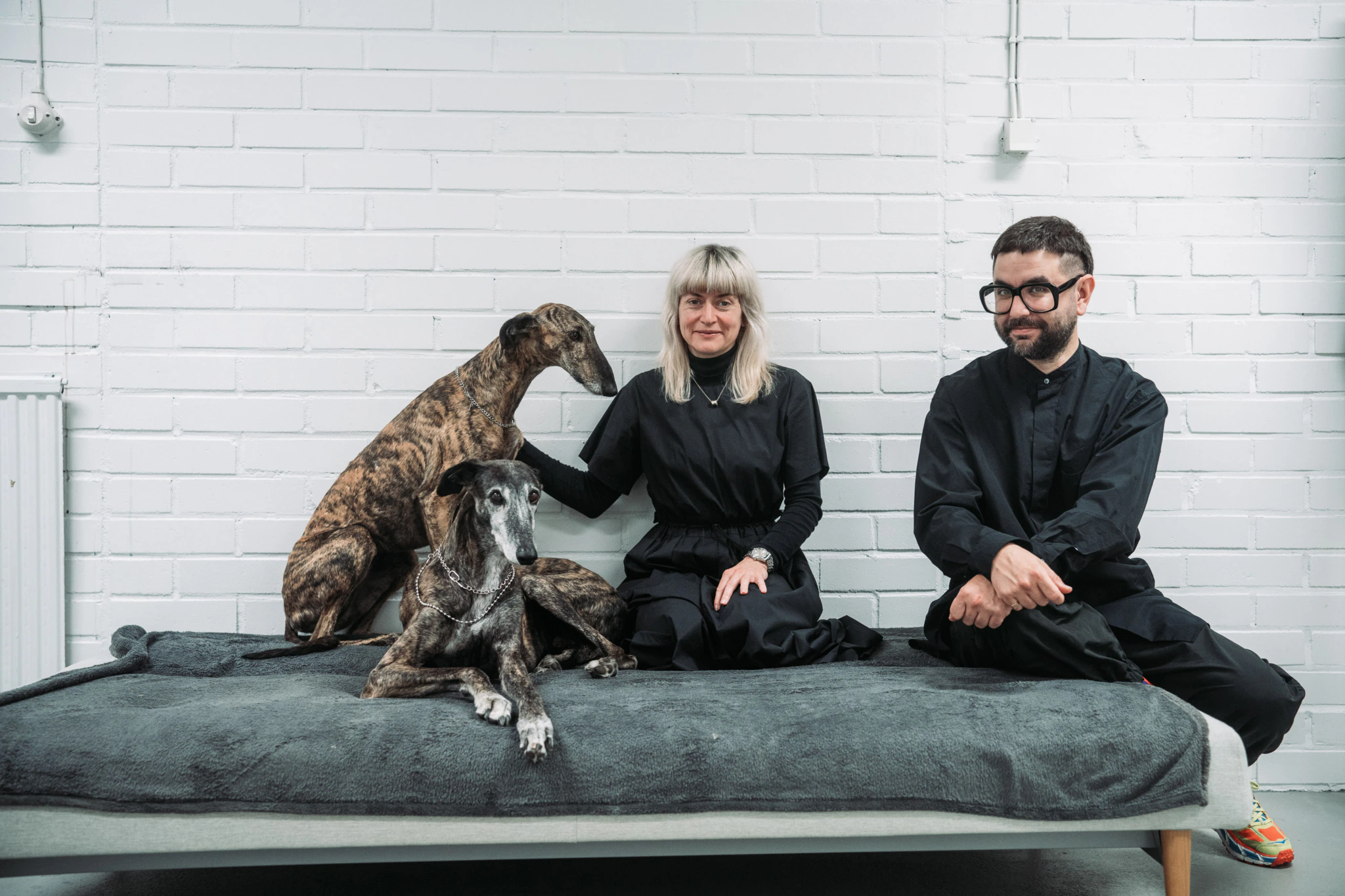
Artist duo FRAUD (Audrey Samson and Francisco Gallardo) recently developed an exhibition at Kingston University’s Stanley Picker Gallery that explored water infrastructure, pollution and extraction through sculpture, performance and public consultation.
A Simultaneous Agreement (23 April-18 July) brought together well over 100 residents, artists and community members in support of a campaign to secure bathing water designation for part of the Hogsmill river. The project culminated in a public performance on 12 June that formed part of the evidentiary process supporting the wider environmental campaign.
How did the idea for the exhibition come about?
Audrey Samson and Francisco Gallardo: We’ve been doing research into critical raw materials for several years, one of which is phosphate rock mainly used for fertiliser (a main culprit of the soil and water body poisoning in the UK). Having spent some time investigating the conditions of production/dispossession and extraction of phosphate rock in one of its main sources, occupied Western Sahara, we wanted to trace how crises are linked globally – how the crisis “there” is intimately linked to the crisis “here”.
Since the invasion of Ukraine, an increasing amount of fertiliser is made with phosphate from the Western Sahara. While farmers understand how geopolitical upheavals causing critical mineral scarcity affect crop prices, how can we begin to understand how our wellbeing here is related to the wellbeing of others elsewhere.
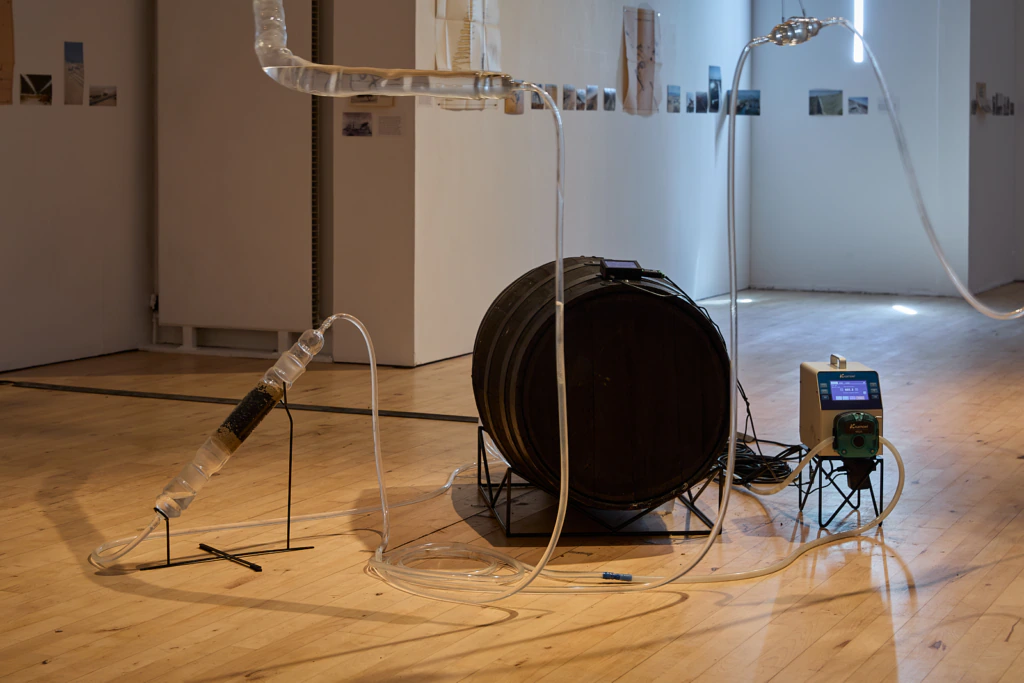
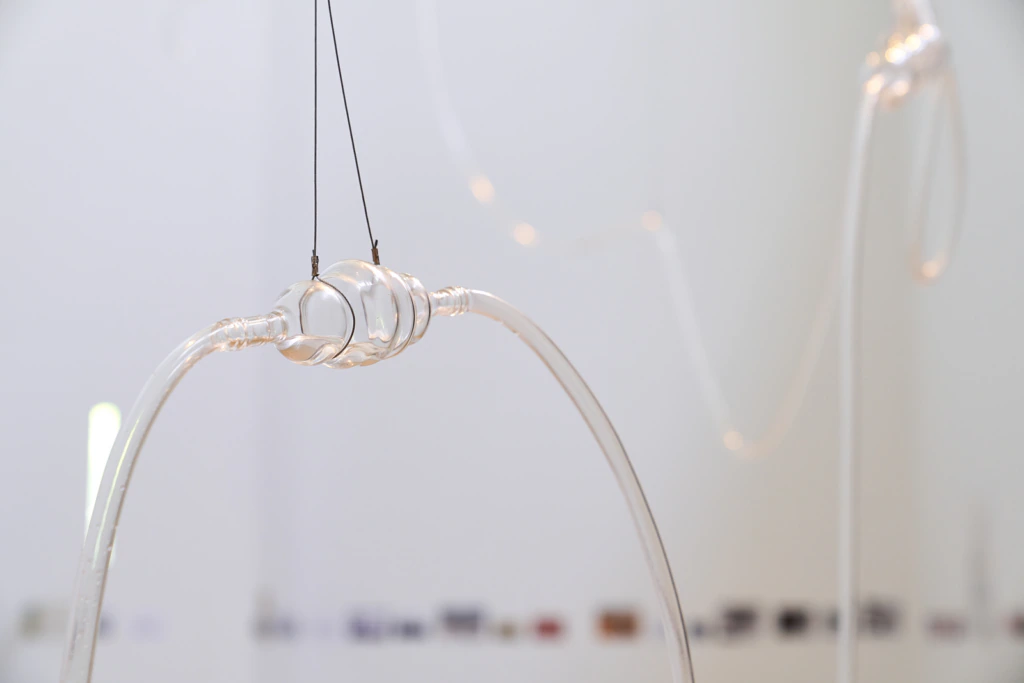
In the exhibition, the glass fountain Saharan Rock, on Panamanian Soil, in South African Waters, which filtered local Hogsmill river water while charting the recirculation of phosphate rock via its market commodity price and global shipping route, was concerned with this web of relations. As such, the tubular glass structure followed the journey of the NM Cherry Blossom – a bulk-carrier ship that carried contested phosphate rock from its port of extraction in Western Sahara to East Asia, via South Africa where it was impounded during the legal dispute over its sovereignty.
Advertisement
Our starting point was the Hogsmill river. It borders the gallery, and is one of the 4,929 bodies of water in England that are all currently deemed unfit for both human and more-than-human life. Like most English rivers, the Hogsmill contains dangerous levels of phosphate and other chemical substances stemming from agricultural run-off and sewage overflow.
One of the things that struck us is that volunteers from the Kingston Biodiversity Network, who monitor the river, often became ill if they had unintentional contact with the river water. The right to conduct volunteer work without getting sick seems a fair, if not obvious, working condition.
And so one of our initial questions was, how can we begin to engage with this complexity? That is, the complexity of corporate, financial and governmental interests that have led to wide-scale water degradation. More importantly, how can we offer an avenue to engage with this issue.
We were inspired by the work of groups around England who are putting forward bathing requests to the Department for Environment, Food & Rural Affairs (Defra). If a water body is deemed a public bathing spot, the ministerial department becomes accountable for the water quality and for publicly conveying the results to would-be swimmers. What is also special about the bathing request, is that it allows any UK resident to put forth such a request that can eventually influence policy. This felt like an excellent way to open up possibilities for real agency over the Hogsmill river quality.
The exhibition’s public programme and performance were therefore designed as a community campaign advocating for the Hogsmill river’s designation as a public bathing site for both human and more than human life.
Advertisement
Can you tell us how FRAUD approached the development of the exhibition?
Audrey Samson and Francisco Gallardo: For the development of the glass fountain, we conducted research into activated charcoal as filtration method and adsorption structures in conversation with engineers and environmental scientists such as Rosa Busquets, David Haskell, Sandra Cavanagh, Silvia Padula from Kingston University; Joaquin Silvestre from the University of Alicante; Azat Seitkhan from Satbayev University; and Sergey Mikhalovsky from the University of Brighton.
In addition to the particulars of the filtration system, a 5-metre tall hanging glass fountain including a charcoal column has some level of complexity i.e. low flow rate, high-head fluid transport, not to mention that it contained toxic Hogsmill water. The health and safety concerns were considerable. It was crucial to have Kingston University’s support through the Stanley Picker Gallery to be able to conduct the necessary research with the various specialists.
In the very beginning of the fellowship, we spent time getting to know the place by going to various meetings and participating in local activities around river health. We learned about the important work already being done by local organisations such as the Kingston Hive, the Hogsmill River Catchment Partnership, the Kingston Biodiversity Network, and the Kingston Environmental Forum. We participated in volunteer species monitoring sessions.
This helped us to understand who was involved with the Hogsmill and what was in place. Once we had a map of “stakeholders”, or you could say friends of the Hogsmill, we began monthly community gatherings. The design of the public programme was defined in these gatherings. It was also a place where we could discuss the evidence that would be submitted to the Defra application.
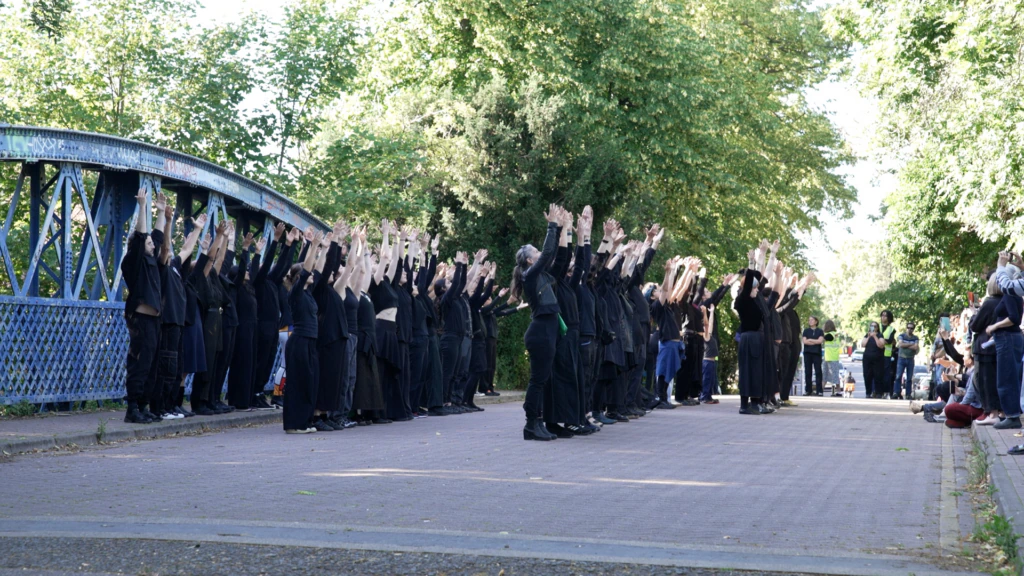
From the beginning, we wanted photographic evidence of bathers to be a choreographed moment. Defra specifications require bathers be shown bathing, even though the water is not of bathing quality. Ethically, and for health and safety reasons, we could not invite people into the water.
Advertisement
As a way to make creative use of this quagmire, that is to show support for the bathing request without the supporters having to go into the water, we worked with choreographer Neus Gil Cortés. Eventually, it developed into a community-cast performance along the riverbank, which really reflected the tension between the desire to go into the water and the impossibility of it.
How have the community been involved in the project?
Audrey Samson and Francisco Gallardo: In the months leading up to the exhibition we organised monthly gatherings to get feedback on our intentions and ideas and, more importantly, to hear about local initiatives around the health of the river and how this project could be used to further platform them. The gatherings continued during the exhibition, and really shaped the public programme, which was community-led.
During these meetings various people would volunteer to lead a workshop or a walk that was relevant to the work of their own organisations or practices.
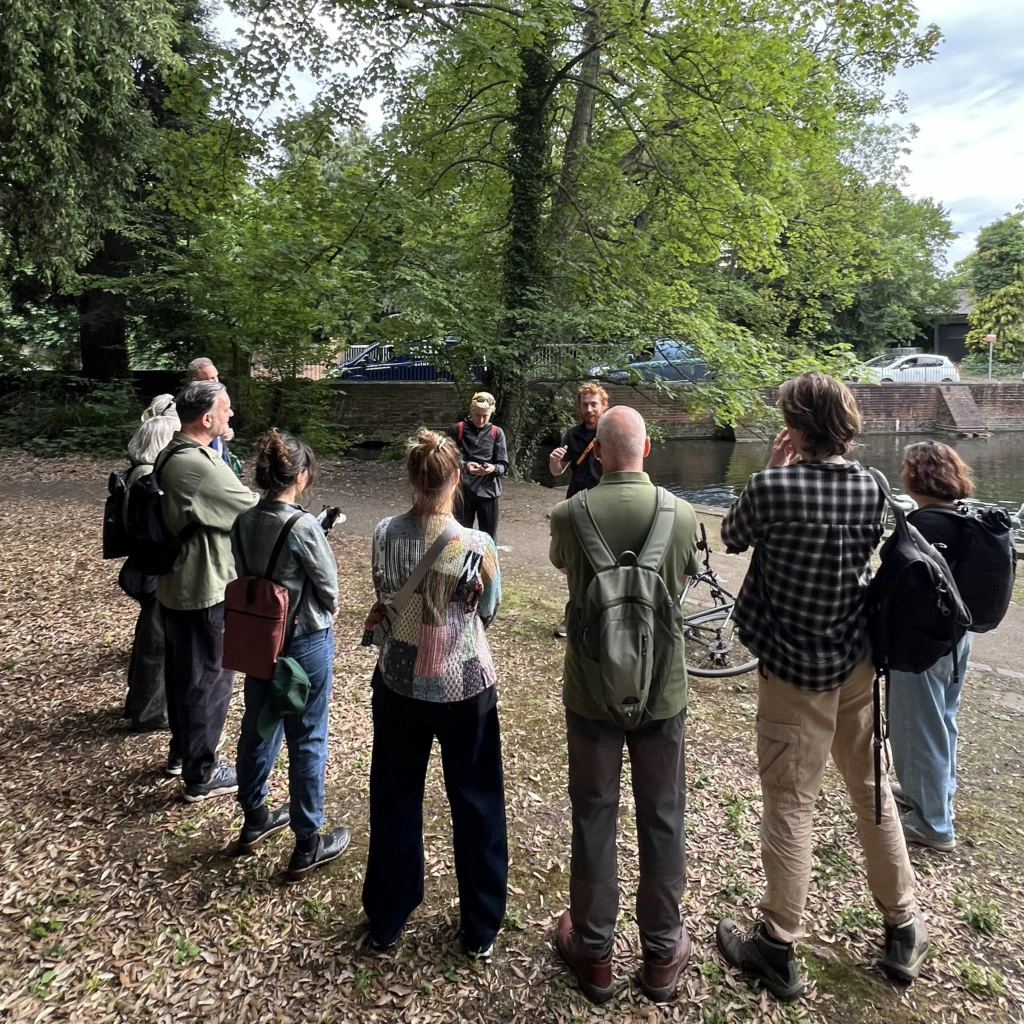
Citizen Zoo, for example, took us for a walk from the source of the Hogsmill, downstream through rewilding projects. There was a poetry workshop centred on the Hogsmill, we worked with the council to screen the People’s Emergency Briefing, there was weaving, how to write a letter to your MP and a walk to the local sewage treatment plant – all of this was community led.
There was also the performance that was the central part of the public programme, in which around 140 community members moved for the river.
How have visitors responded to the exhibition?
Audrey Samson and Francisco Gallardo: We have had an overwhelming response, especially from those who took part in the performance. All of us moving together was powerful. It is hard to truly describe as it was an embodied collective experience, but one of our guiding questions in this project has been from Herrero and Gago in their text Ecofeminismos (translated title Ecofeminism, the sustainability of life): “How do we move from a logic of resistance, of putting our bodies on the line, to one of reappropriation and collective joy, capable of sustaining all those infrastructures differently?” The performance felt like one such a moment of collective joy.
Another encouraging response we received was: “how can we help?” and “what’s next?”, which is amazing, because this is a project that is about the river, and should continue long after our fellowship at Stanley Picker. To witness other people taking ownership of it feels particularly important to us.
What impact do you think the exhibition will have?
Audrey Samson and Francisco Gallardo: From the premise that all species have the right to healthy water in which to live, nest and bathe, we hope that the river will become hospitable for the creatures that inhabit it, and the humans that live around it. That it is no longer feared to the touch, but rather enjoyed, and that the community’s heart is healthy again.
We understand bathing water legislation as a form of environmental and artistic advocacy (very much in line with the work of Paulo Tavares, an architect, researcher and writer based in South America, and Portuguese sociologist Boaventura de Sousa Santos) through which polluted rivers coastlines, and affected communities acquire a certain legal visibility and generate evidence that seeks to challenge environmental harms produced by privatised water infrastructures and agricultural practices.
Here, legal mechanisms could be understood to operate as a site of counter-hegemonic struggle, enabling citizens, local activists and environmental groups to mobilise claims against dominant corporate and regulatory interests that have normalised ecological degradation.
In this sense, campaigns for bathing water designation, such as that of the successful Ilkley Clean River Group, have transformed the legal sphere into a political arena where such injustices are contested and public claims to clean water, ecological health, and democratic accountability are articulated.
Ultimately, this addresses the crisis in governance that underscores water and agricultural management.
What has the project taught you about the role of galleries as civic spaces?
Audrey Samson and Francisco Gallardo: As most galleries and art spaces have some level of public funding, the civic responsibility is implicit. Not all galleries take it as seriously, but many do.
The difficulty is for spaces that were once for the “cultured elite” (and arguably still are) to appeal to and gain the trust of new audiences. This requires serious commitment and investment, and the willingness to “kill your darlings”, to genuinely reinvent the gallery as civic space.
Art has of course always had an intimate and fraught relationship with power, either by representing it, or to be used as propaganda (be it to reinforce power or to incite revolution). In this time of crises, where democracy itself is being called into question while power is concentrated in the hands of few, civic engagement could not be more important.
In this project we have learned so much from everyone in the Hogsmill area who has been involved, and I think we were ourselves surprised at the level to which the passion for the river mobilised people. More than one person said to us that the Hogsmill is the heart of the community. We are honoured to have been part of ongoing efforts to support this heart, and to be able to work with a gallery like Stanley Picker, which genuinely considers its role in the local community.
What do you hope will be the legacy of the project?
Audrey Samson and Francisco Gallardo: We hope, of course, that the Hogsmill river will become hospitable to its inhabitants and visitors, that it is a place to safely live, nest and bathe for more-than-human species.
Towards this, the aim is that the exhibition, and the Defra application that stemmed from it, is the beginning of longer-term conversation around the health of Hogsmill, which joins a national concern.
These applications are all one aspect of a long-term process; they are usually not immediately accepted and therefore a multi-year application prospect is envisageable, and if/when the application is accepted, it is not permanent, efforts must be continued.
The success of the application itself is almost incidental – what is really important is the pressure that it exerts on the government and water companies, and the sustaining of these efforts.
Hopefully, the legacy of this project is a galvanised long term civic engagement for the Hogsmill that supports/reinforces the national conversation on the issue of the water crisis.